
The carry trade meaning is simple enough to state in one line. You borrow a currency that pays little, hold a currency that pays more, and collect the difference for as long as the position stays open.
What that line hides is the risk you take on while collecting. This guide covers the mechanics, the classic currency pairing, and the uncomfortable arithmetic that decides whether the idea suits you at all.
Carry Trade Meaning in Plain Terms
Two currencies sit inside every forex position. You hold one and you owe the other.
Each currency has an interest rate attached to it. So one side of the trade pays you and the other side charges you.
A carry trade sets that arrangement up deliberately. You choose the direction so the paying side wins, then hold the position to collect night after night.
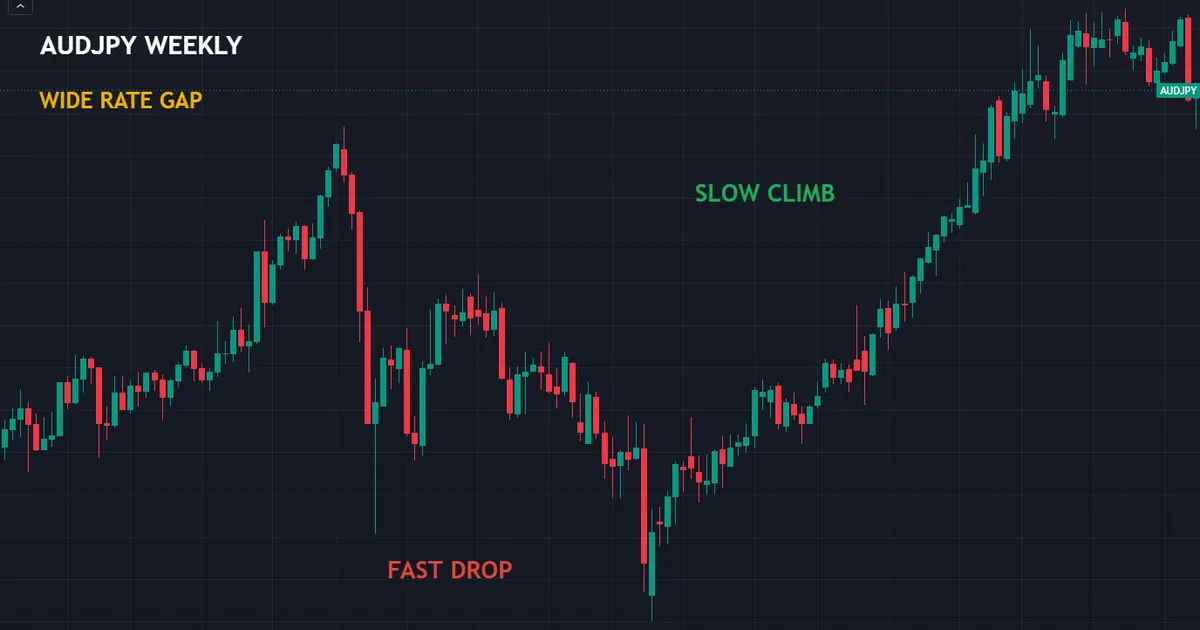
The chart above tracks AUDJPY on weekly bars. Australia and Japan ran very different policy rates for years, which turned this pair into the textbook example of the idea.
The Funding Currency
One leg supplies the money. Traders call it the funding currency, and it carries the lower interest rate of the two.
Selling it amounts to borrowing it. You pay the small rate attached to that currency for as long as you hold.
Low rates make a currency cheap to borrow. That single feature, rather than any view on the country, decides which currency plays the role.
The Target Currency
The other leg holds the money. Traders call it the target or investment currency, and it carries the higher rate.
Buying it amounts to depositing in it. You receive the larger rate attached to that currency each night.
Net the two amounts and the credit remains. Our explainer on the interest rate differential in forex works through the sum in detail.
What You Actually Collect
Brokers apply the net amount through the daily rollover. It shows on the statement as swap, financing or rollover, depending on the platform.
Timing matters as much as the figure. Most brokers run the cut-off at five in the afternoon New York time, so a trade closed before it collects nothing.
One weekday carries a triple charge as well. Settlement rules push the weekend into that roll, and Wednesday usually takes it on currency pairs.
The credit arrives in small nightly instalments. Nothing dramatic happens on any single evening, which is exactly the appeal.
Steady accrual feels reassuring, and that feeling causes trouble later. Our swap calculator converts a published rate into a figure per lot per night so the scale stops being abstract.
How a Carry Position Earns and Loses
Five steps describe the whole life of the trade. Follow them and both halves of the outcome become visible.
- Borrow in a low-rate funding currency. Selling that currency inside the pair does the borrowing for you.
- Hold a higher-rate target currency. Buying the other side of the pair does the depositing.
- Collect the gap through nightly swap. The broker credits the net financing at each daily rollover.
- Carry the full exchange-rate risk throughout. Every tick of the pair hits the position at full size.
- Close out and settle the price change. The final result nets the accrued credit against the move in the rate.
Step four does the damage in most losing versions. Traders describe the strategy by step three and then discover that step four decides the outcome.

Write both halves down before entering. A plan built on the credit alone ignores the larger of the two forces.
The Classic Funding and Target Pairing
Certain currencies fill these roles again and again. The reasons run deeper than habit.
Why the Yen Became the Funding Currency
Japan held interest rates near zero for roughly two decades. Borrowing yen therefore cost almost nothing.
Deep, liquid markets made that borrowing easy at size. Institutions could take on very large positions without moving the price much.
That era has since changed, which matters for anyone reading older material. Japanese policy has moved off its floor, so the gap that defined the classic trade is no longer what it was.
The Swiss Franc Played the Same Role
Switzerland also ran very low rates for long stretches. The franc offered a second cheap funding source alongside the yen.
Both currencies share another trait. Investors buy them during a scare, which makes them awkward to be short of when markets turn.
That combination sits at the heart of the strategy’s danger. A cheap borrow that rallies in a crisis punishes the borrower exactly when everything else goes wrong.
What Makes a Target Currency
Higher rates usually accompany higher inflation or higher perceived risk. Investors demand more return to hold those currencies, and the differential reflects that demand.
The Australian and New Zealand dollars filled the role for years. Emerging market currencies such as the Mexican peso, the Brazilian real and the South African rand offer far wider gaps and far wider swings.
Pairings rotate as cycles turn. Comparing many currencies at once helps here, and the currency strength indicators archive collects tools that rank them side by side.
A Wider Gap Brings a Wilder Chart
High-yield pairs make the trade-off visible. The extra return arrives with extra movement attached.
What the Chart Shows
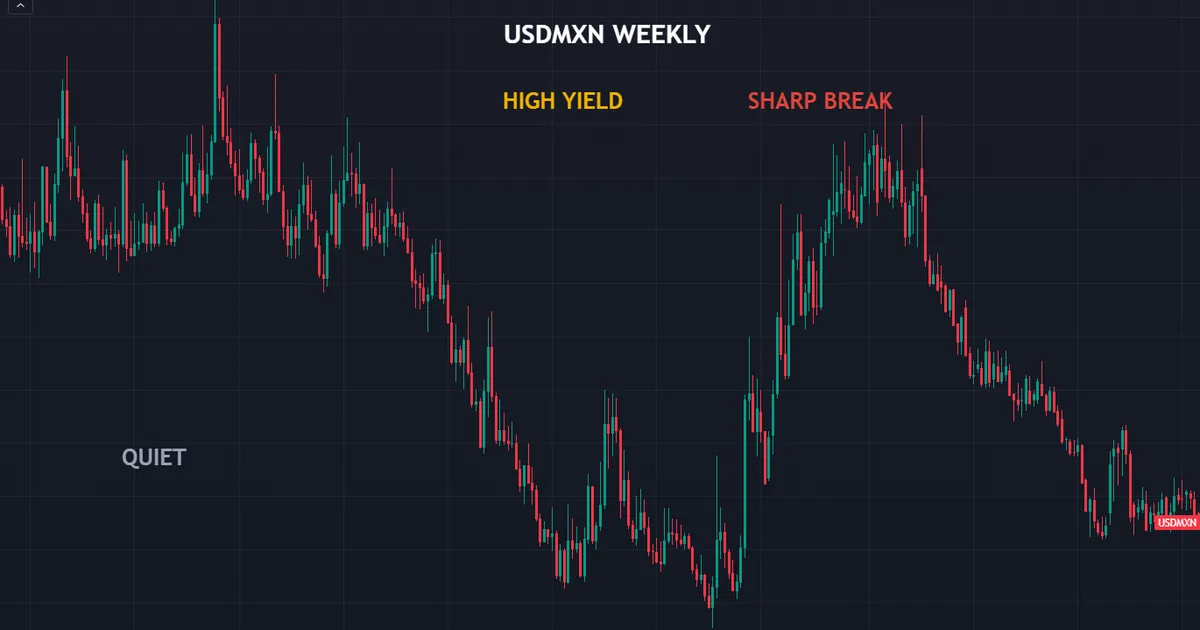
The chart above tracks USDMXN on weekly bars. Mexico has run considerably higher policy rates than the United States for long periods, which puts a wide gap inside this pair.
Long quiet stretches dominate the picture. Sharp interruptions cut across them, and those interruptions cover ground quickly.
Note the direction convention before drawing conclusions. Selling this pair holds the higher-rate currency, so the collecting side sits on the short rather than the long.
Why Wider Is Not Better
A gap of eight per cent sounds far better than one of three. Volatility usually scales with it, and so do spreads and financing markups.
Political and policy surprises hit these currencies harder too. Capital controls, intervention and sudden rate changes all belong to the same territory.
So the extra return compensates for the extra risk rather than beating it. Treating a wide gap as an upgrade misreads what the market is pricing.
A Worked Example in Plain Numbers
Numbers land better than words here. Work one case through and the scale gets clear.
Set Up the Position
Take one lot of a pair. That means a hundred thousand units of the base currency.
Say the rate gap runs at three per cent a year. You hold the side that collects it.
Your broker takes a slice of that gap. So call the real figure two per cent once the markup lands.
Spread It Across the Year
Two per cent of a hundred thousand comes to two thousand units a year. Divide by the days in the year.
That leaves roughly five and a half units a night. Small, steady, and easy to miss on a statement.
Hold for two months and you collect near three hundred and thirty units. Still a modest sum.
Now Look at the Price Risk
The same pair might move half a per cent in a day. On a hundred thousand units, that is five hundred.
So one plain day beats your whole two-month credit. No unusual event needed at all.
A bad week can wipe out a year of it. That ratio, not the swap, should drive how you size the trade.
Who Actually Runs These Positions
The idea reaches far beyond retail screens. Knowing who else holds it helps you read the risk.
Large Funds and Banks
Big funds run the trade at scale and with cheap funding. They can borrow closer to the true market rate than a retail account ever will.
Size gives them an edge on cost. It also makes their exit slow, so they hedge and trim well before a scare peaks.
Their flows shape the pairs you trade. When they cut back, the move shows up on your chart first.
Households and Firms
The idea shows up outside markets too. A firm may borrow in a cheap currency to fund work at home.
Households in some countries have done the same with home loans. The debt costs less each month, and the exchange rate carries the risk.
Both cases share one trait. The gain arrives slowly and the loss can arrive all at once.
Retail Traders
Retail accounts pay the widest markup on financing. So the credit that reaches them is the smallest of the three groups.
Leverage is the usual answer, and it is the wrong one. Bigger size raises the price risk far more than it raises the credit.
A smaller position held with patience makes more sense. It also survives the weeks when the chart moves the wrong way.
The Carry Is Small Next to the Risk
Here sits the honest framing that most descriptions skip. Run the numbers and the proportions speak for themselves.
Do the Arithmetic Once
Take a differential of roughly three per cent a year. Spread across three hundred and sixty-five nights, it comes to about a hundredth of a per cent per day.
Now measure a typical daily range on the same pair. Half a per cent counts as ordinary, and volatile sessions run several times larger.
One average day therefore outweighs fifty nights of accrual. A few days moving against you erases months of collected credit.
Leverage Multiplies Both Sides
Traders reach for leverage precisely because the credit looks small. Ten times the size gives ten times the accrual.
It also gives ten times the price exposure. The component that already dominated now dominates ten times as heavily.
That relationship explains most blown carry accounts. Our note on leverage in forex covers the mechanics of the multiplier itself.
Theory Says the Gap Should Cancel Out
Uncovered interest parity argues that a higher-yielding currency should weaken by roughly the differential. Any credit you collect would then disappear in the exchange rate.
Decades of testing show that relationship failing more often than holding. Economists call the anomaly the forward premium puzzle, and no single explanation commands agreement.
Read that carefully, because it cuts both ways. The strategy has produced returns in calm periods, and it has also produced sharp losses in stressed ones.
Download the complete indicator database
Put these concepts on your charts. One email unlocks the full library of 1,380+ indicators with compiled MT4 and MT5 files, plus my TradingView scripts. No paywall, no spam, unsubscribe any time.
Get free access to my indicator database
One email unlocks 1,380+ free MT4, MT5 and TradingView indicators — the complete library. No single-tool download; you get the whole database.
How to Test the Idea Before Raising Size
Nobody should learn this with real size on. A slow test costs little and teaches plenty.
Start With One Pair and One Lot
Pick a single pair with a clear gap. Open the smallest size your broker allows.
Then leave it alone for a month. The point is the record, not the result.
Note the swap credited each night. You will see the real figure rather than a table entry.
Track Both Halves Side by Side
Keep two columns in a note. One holds the swap, the other holds the change in price.
Add them up at the end of the month. Most traders find the second column dwarfs the first.
That single sheet settles the argument. It also stops you from sizing up on the strength of a small credit.
Watch What a Bad Week Does
Wait for a rough patch and note the drawdown. Every pair gets one within a few months.
Measure how many nights of credit that week erased. The answer is usually months, not days.
Then decide whether the trade still appeals. Plenty of traders drop the idea at this stage, and that counts as a good outcome.
Common Carry Trade Mistakes
Six habits account for most of the damage. Each has a fix that costs nothing but discipline.

Treating the Credit as the Trade
The swap is a side effect, not a thesis. Ask whether you would hold the pair without any financing at all, and skip the position if the answer comes back no.
Sizing From the Accrual Instead of the Risk
A trader chasing a fixed nightly credit ends up with an enormous position. Size from the distance to your invalidation level instead, using our position size calculator to keep the risk constant.
Skipping the Stop Because the Hold Is Long
Long holding periods do not remove the need for an exit. Set a level that ends the trade, then respect it whatever the accrued credit says.
Assuming the Swap Stays Put
Brokers revise financing whenever funding conditions shift, usually without notice. Check the swap table monthly, since a credit can quietly become a charge.
Stacking Correlated Positions
Three high-yield pairs against the same funding currency form one trade, not three. Count correlated exposure as a single position when you calculate total risk.
Ignoring the Crowd
Popular carry positions attract the same traders using the same leverage. Watch for that crowding, because our guide to the carry trade unwind covers what happens when everyone leaves together.
Carry Trade Quick Reference
Keep this table beside your platform. Each row states a check rather than an outcome.
| Element | What to check | Why it matters |
|---|---|---|
| Funding currency | Which leg carries the lower rate | Decides which side you effectively borrow |
| Target currency | Which leg carries the higher rate | Supplies the interest you collect |
| Direction | Whether collecting means long or short | Quote conventions reverse the answer on some pairs |
| Broker swap | Published figure per lot per night | The number that actually reaches the account |
| Daily accrual | Annual gap divided across the year | Shows how small each night really is |
| Daily range | Typical movement on the same pair | Puts the price risk in proportion |
| Correlation | Overlap with other open positions | Reveals hidden concentration in one theme |
| Exit level | The price that ends the trade | Caps the loss the accrual cannot cover |
Notice that no row offers a strike rate. The approach has worked in some periods and failed badly in others, so no honest table can supply one.
What Goes Wrong in Practice
Live carry positions fail in recognisable ways. Four modes cover almost all of them.

The Price Move Swallowed the Accrual
Months of nightly credit vanish in a handful of sessions. Financing arrives in a trickle while exchange rates move in steps.
The panel above splits the result into its two components. A thin financing strip sits beside a much larger block of price movement, which is the whole lesson.
The Position Grew Too Large to Hold
Accruals feel small, so traders raise size to make them meaningful. Then a normal week of movement produces a margin problem.
Size from the risk instead. Our guide to position sizing covers the calculation that keeps this from happening.
The Rate Gap Narrowed Underneath the Trade
Central banks move at different speeds. A funding currency’s central bank can start raising while the target country starts cutting.
The credit then shrinks toward nothing. Worse, the same repricing usually pushes the exchange rate against the position at the same time.
The Broker Changed the Financing
Swap rates vary between brokers and change without notice. A pair that paid a credit last quarter can charge you this quarter with no policy change anywhere.
Check the table before every long hold. Understanding how interest rates affect forex helps you anticipate which way those revisions will run.
The Pair Went Nowhere for a Year
Not every failure involves a loss on price. Some positions simply drift sideways for months on end.
The credit still lands each night, and the account barely grows. Traders then lose patience and close out for almost nothing.
Boredom ends more carry positions than crashes do. Plan the holding period up front so a quiet stretch does not push you out.
Related Ideas Worth Studying Next
The failure mode deserves its own study. Crowded carry positions unwind faster than they build, and that gap in speed shapes how careful traders size them.
Financing also matters to traders who never intend a carry position. Any trade held for weeks accrues the same nightly amount, so the mechanics apply well beyond the strategy itself.
One habit outranks the rest here. Record the actual swap credited to your account for a full month, because your own statement beats every general claim about what the strategy pays.
FAQ
What is the carry trade meaning in simple terms?
It means borrowing a low-interest currency, holding a higher-interest one, and collecting the difference each night through swap. The position keeps full exposure to the exchange rate throughout, so the price move usually decides the result rather than the interest collected.
Which currencies suit a carry trade?
The yen and the Swiss franc funded the classic version for years. Traders held the Australian dollar, the New Zealand dollar or the Mexican peso against them. Those roles rotate as policy shifts, so check today’s rates rather than trusting an older article.
How much does a carry trade pay?
Roughly the rate gap, minus the broker’s markup, spread across the year. A three per cent differential works out near a hundredth of a per cent per night, which one ordinary session of movement can easily outweigh.
Which day carries the triple swap charge?
Wednesday, on most currency pairs, because settlement rules place the weekend inside that roll. Other instruments use a different weekday, so check the contract specification rather than assuming the currency convention applies everywhere.
Is a carry trade a long-term strategy?
The accrual only becomes meaningful over months, so the approach suits patient traders with modest leverage. That long horizon also exposes the position to policy changes, risk-off episodes and revised swap tables along the way.
Why do carry trades fail so suddenly?
Because the same positions attract many traders using leverage. When conditions turn, they exit together, and the funding currency they all sold rallies quickly as they buy it back.
Can I run a carry trade on a small account?
You can, though the numbers rarely justify the attention. A modest deposit collects a very small nightly amount unless you use leverage, and leverage magnifies the price exposure that already dominates the outcome. Treat the financing as a minor tilt inside a properly sized plan, set an exit level in advance, and keep a record of what the trade actually earned. Results are not guaranteed; past performance is not indicative of future results.
External references
- For background on this concept, see Carry Trade at BabyPips Forexpedia.
- For broader market context, see Real Interest Rate on Wikipedia.

About the author
Written by Dominic Walsh, a Forex trader and MT4/MT5 indicator, Expert Advisor and script developer. Every tool on forexmt4systems.com is tested on live charts before release and ships with ready-to-use compiled MT4 (.ex4) and MT5 (.ex5) files. Learn more about the trader and developer behind this site.
How we build, test and correct every tool: Editorial & Testing Policy. Trading carries risk; see the disclaimer.