
New traders usually pick a market before they understand what they are picking. So this comparison of day trading forex vs stocks lays out the structural differences and leaves the choice with you.
No winner gets declared here. Each market suits a different schedule, a different account size and a different tolerance for overnight surprises.
Day Trading Forex vs Stocks: The Short Version
Both markets let you open and close inside a day. Everything else about them differs, sometimes in ways that matter more than any strategy choice.
Forex runs around the clock through the working week and offers a short list of instruments. Listed equities run on an exchange timetable and offer thousands of names.
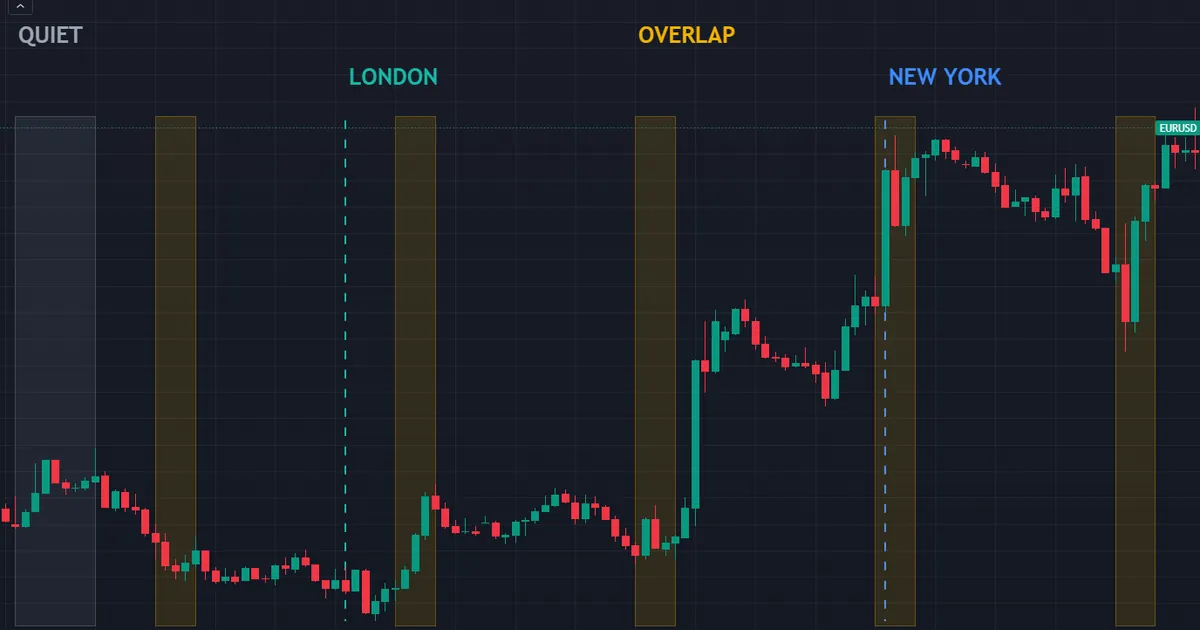
Above sits EURUSD on hourly bars. Activity rises and falls through the day, with the busiest stretches arriving when the large financial centres overlap.
What Genuinely Differs
Six things separate the two markets in practice: hours, instrument choice, cost structure, leverage rules, gap behaviour and market structure. Each one changes how a working day looks.
Everything else transfers. Risk per trade, position sizing, journaling and patience behave identically in both places.
What Does Not Differ
Neither market hands anyone an easier ride. Costs, discipline and the arithmetic of losing runs apply the same way to both.
So treat any claim that one market is simpler with caution. Usually the person making it has only traded one of them.
The Six Differences That Matter
Work through this list before choosing. Each item has a practical consequence rather than a theoretical one.
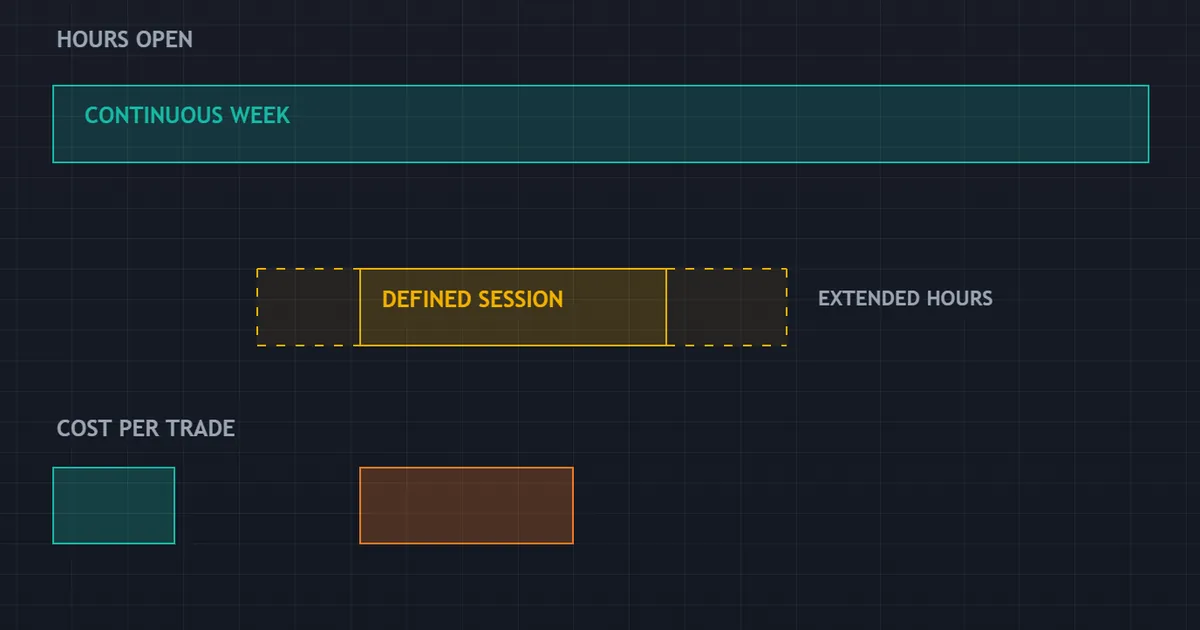
- Hours. Spot forex trades continuously from Sunday evening to Friday evening, while a listed stock has a defined session with quieter extended hours around it.
- Instrument count. Roughly two dozen liquid currency pairs against several thousand listed shares in the United States alone.
- Cost structure. Forex costs usually arrive as a spread, sometimes with commission attached; equity costs vary widely by broker and jurisdiction.
- Leverage. Retail forex leverage is capped by regulator, and equity day trading leverage is capped by margin rules instead.
- Gap behaviour. Shares gap between sessions as a matter of routine, while spot forex mostly gaps only across the weekend.
- Market structure. Shares trade on regulated exchanges with a consolidated volume record; spot forex trades over the counter through your broker.
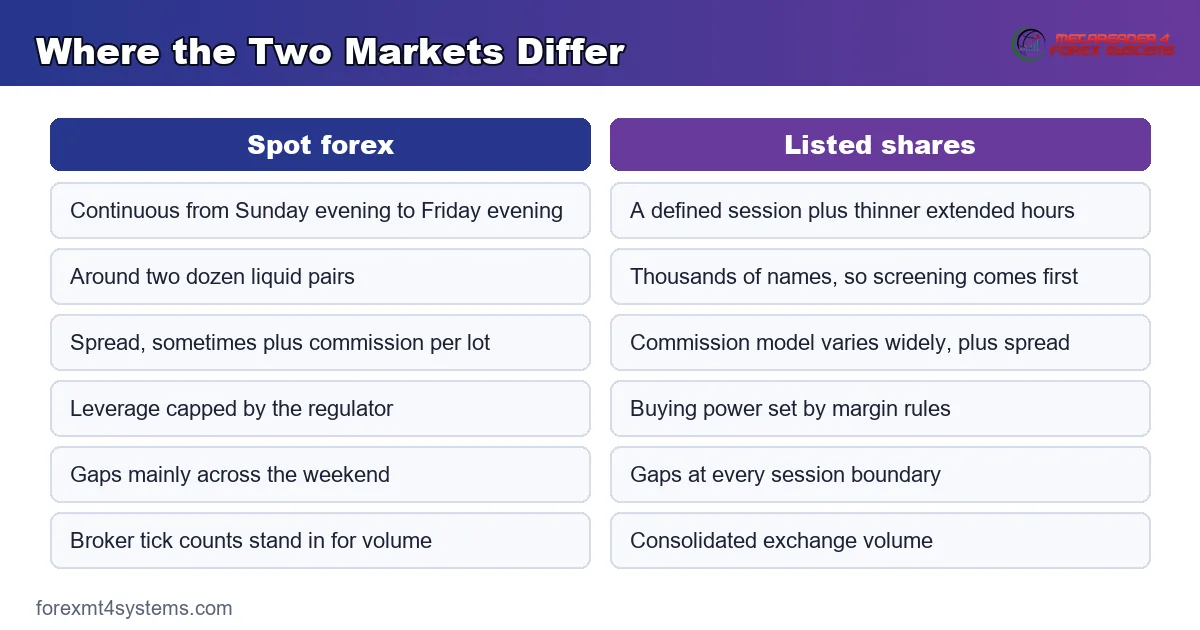
None of those six makes one market better. They simply describe two different working environments.
Hours and the Shape of Your Day
Schedule is the difference most people feel first. It decides whether trading fits around a job or replaces one.
The Forex Week
Spot forex opens on Sunday evening and closes on Friday evening, running continuously in between. Exact times depend on your broker’s server clock.
Continuous does not mean uniform, though. Liquidity concentrates around the London and New York hours, and the quiet stretches carry wider spreads and thinner moves.
Our forex market hours tool shows which centres are open right now, and our guide to forex trading sessions covers how each one behaves.
The Stock Session
United States shares trade a regular session from half past nine in the morning until four in the afternoon, New York time. Volume clusters heavily at the open and again into the close.
That shape suits some people enormously. A concentrated session means you are either at the screen or you are not, which removes a lot of decisions.
Extended Hours
Pre-market and after-hours trading exists, and it is a different animal. Participation drops, spreads widen, and a single order can move a price further than it would at midday.
Earnings releases often land in those windows. Anyone trading them takes on execution risk that the regular session largely hides.
Which Schedule Suits You
Someone in Europe with a day job can trade the New York session for equities only late in the evening. The same person can trade the London open in forex before work.
Geography therefore decides more than preference. Pick the market whose active hours you can actually attend.
Choice of Instruments
Breadth cuts both ways, and traders rarely think this one through.
Forex Concentrates Attention
Seven or eight majors cover most of the liquidity. You can learn their typical ranges, session behaviour and reaction to news within a few months.
Depth of familiarity is the payoff. Traders who watch one pair for a year develop a feel that no screener replicates.
Equities Reward Selection
Thousands of names means something is always moving. Scanners exist precisely because nobody can watch that universe manually.
That breadth adds a skill you do not need in forex: choosing what to trade today. It is genuine work, and it happens before any chart reading starts.
Correlation Cuts the Choice Down
Currency pairs share legs, so they move together more than beginners expect. Buying two dollar-negative pairs is one position wearing two names.
Shares cluster by sector for the same reason. Either way, the effective number of independent bets is smaller than the instrument count suggests.
Costs on Each Side
Cost is where day trading decisions get settled, because frequency multiplies every charge.
How Forex Charges You
Most retail forex accounts charge through the spread, and raw-spread accounts add a commission per lot instead. Positions held past the daily rollover also pay or receive swap.
Our explainer on the spread in forex covers how that charge behaves, and our breakdown of forex trading costs adds the rest.
How Equities Charge You
Fee models vary far more. Some brokers charge nothing per trade on United States shares, others charge per share or per order, and small fees apply when you sell.
Spread still costs you either way. A wide gap between bid and ask on a thinly traded share can cost more than the fee you avoided.
Watch the Cost Against the Move
Compare your usual target to your usual cost. A ten-pip target with a one-pip spread gives away a tenth of the move before you start.
That ratio matters far more than the market you chose. Any plan that only works with zero costs was never a plan.
The Point Both Sides Share
Frequency decides the burden, not the market. Twenty trades a day pays the cost twenty times, whatever the instrument.
Our guide to scalping in forex covers what happens when trade count rises faster than the size of the moves.
Download the complete indicator database
Put these concepts on your charts. One email unlocks the full library of 1,380+ indicators with compiled MT4 and MT5 files, plus my TradingView scripts. No paywall, no spam, unsubscribe any time.
Get free access to my indicator database
One email unlocks 1,380+ free MT4, MT5 and TradingView indicators — the complete library. No single-tool download; you get the whole database.
Leverage and the Rules Around It
Both markets offer leverage, and the two systems work very differently.
Retail Forex Leverage Caps
Regulators set the ceiling. European and United Kingdom rules cap retail leverage on major pairs at thirty to one, and United States rules cap it at fifty to one.
Offshore brokers advertise far higher figures. Higher available leverage changes nothing about sensible position size, which our leverage in forex guide explains at length.
The Pattern Day Trader Rule
United States equity traders meet a rule with no forex equivalent. A margin account that makes four or more day trades within five business days, where those trades exceed six per cent of total activity, gets flagged as a pattern day trader.
Once flagged, the account must hold at least twenty-five thousand dollars in equity to keep day trading. Fall below and the platform restricts you until the balance recovers.
That single rule pushes many small accounts towards forex or futures. It is a regulatory fact rather than a judgement about which market is better.
Margin Mechanics Differ Too
Flagged equity accounts get up to four times buying power intraday and two times overnight. Forex margin works from a required percentage of notional value instead, with no separate day rule.
Either way the sensible answer is the same. Size from your invalidation distance using our position size calculator, and let the margin rules sit unused in the background.
Gap Risk: The Biggest Structural Difference
If one item on this list should decide your choice, it is this one.
Why Shares Gap
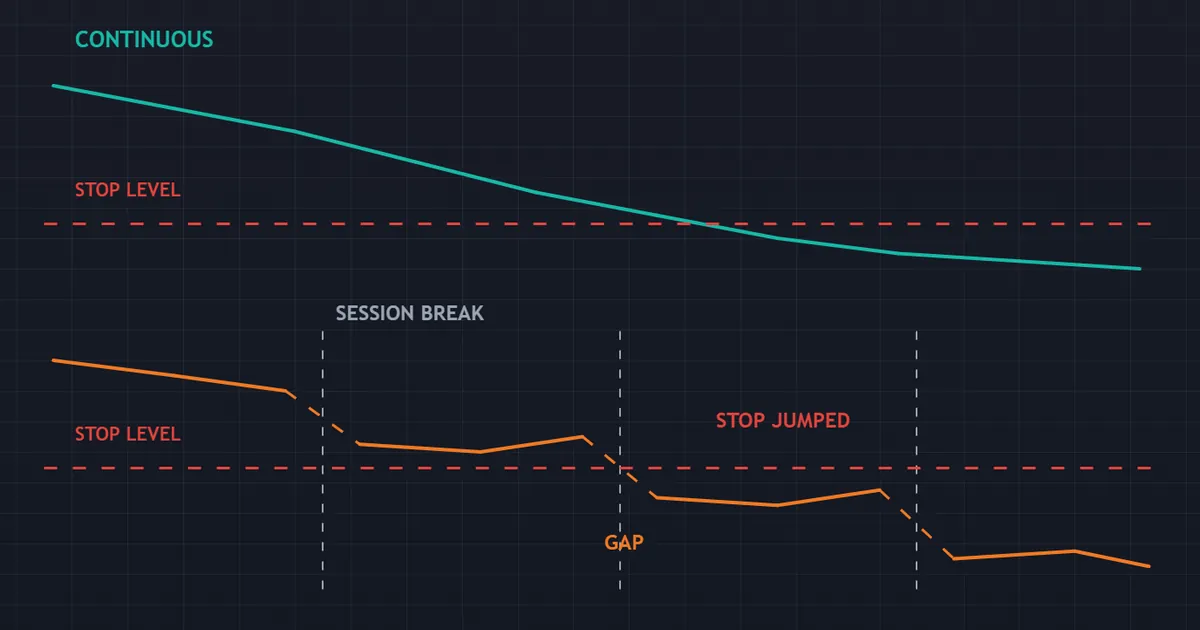
A share stops trading at four in the afternoon and reopens the next morning. News, earnings and analyst actions all land in between, so the opening print can sit well away from the previous close.
Day traders who flatten before the bell avoid that exposure entirely. Anyone holding through the night accepts a risk that no stop order can bound reliably.
Why Spot Forex Mostly Does Not
Currencies trade somewhere in the world through the working week. So the continuous market usually reopens each day at roughly the previous price.
The weekend is the exception, and it is a real one. Our guide to the weekend gap in forex covers what happens when news breaks after Friday’s close.
What This Means for a Stop Order
A stop becomes a market order when touched, so it fills at whatever price exists. Across a gap, that price can sit far beyond your intended level.
Traders sometimes read this as broker malpractice. It is simply what happens when no trading occurs between two prices.
How Traders Handle It
Equity day traders flatten before the close. That single rule removes the whole exposure, and it is why the style has a name.
Swing traders on shares accept the risk and size for it. They cut position size so a bad opening print costs a normal loss rather than a bad week.
Forex traders face a smaller version of the same problem each Friday. Reducing size into the weekend, or closing out, handles most of it.
Gap Protection Is Not Free
Some brokers offer a stop that fills at your price whatever happens. The fee for that cover is real, and it applies whether a gap arrives or not.
Read the terms before relying on one. Cover varies by instrument, and the charge can outweigh the risk on a small position.
A Day in Each Market
Lists tell you less than a walk through the day. Here is how each one tends to run.
A Forex Day
You wake and the market is already trading. Asia has been open for hours, and the London open is close.
Most of the day’s range shows up between the London open and the New York close. Outside that block, price often drifts and the spread widens.
So the work is to pick a window and show up for it. There is no bell, and nobody rings one for you.
At the end of your session you flatten or you do not. The market keeps trading either way, and swap applies to what you leave open.
A Stock Day
Work starts before the bell. You scan for names in play, check the news, and build a short list.
The first half hour moves fastest. Volume is heavy, moves are wide, and most of the day’s chances arrive early.
Midday tends to go quiet. Many day traders stop there, then look again into the last hour when volume returns.
Then the bell rings and the day ends. Anything you still hold is exposed to whatever lands overnight.
The Feel of Each
Forex asks you to build your own structure. Shares hand you one, and the trade-off is that you must be free when the bell rings.
Neither shape is better. Pick the one your week can actually support.
Market Structure and Data
The plumbing differs, and it affects what you can actually see.
Exchange Versus Over the Counter
Shares trade on regulated venues with central clearing and a consolidated record of transactions. Spot forex trades over the counter, so your broker’s feed is one view among many.
Prices across major forex brokers stay very close. Small differences in the last decimal do exist, which matters if you trade very short distances.
Volume Data
Equity volume is real and centralised. Forex volume on a retail platform counts ticks from that broker only, which is a proxy rather than a measurement.
So volume-based methods transfer poorly between the two. Our indicator library flags which tools rely on genuine volume and which use tick counts.
Short Selling
Selling a currency pair is identical to buying it in the other direction, with no borrowing involved. Selling a share short requires locating stock, paying a borrow fee, and living with restrictions during sharp declines.
That asymmetry surprises equity newcomers. In forex the two directions are mechanically the same trade.
Which One Suits You
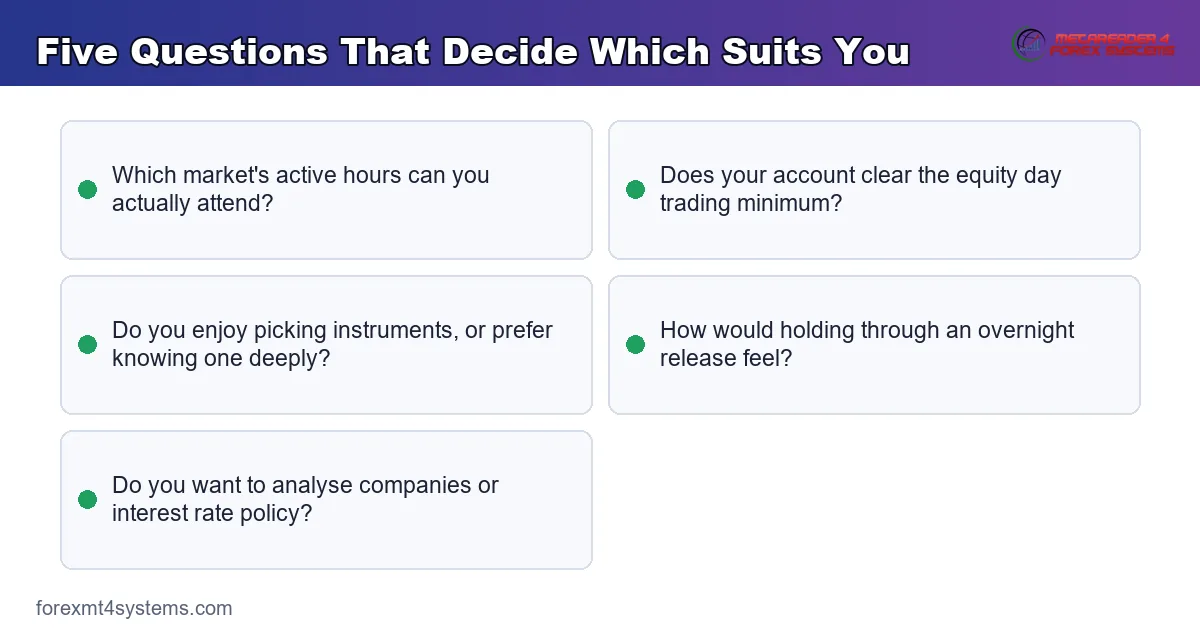
Five questions settle this faster than any comparison table. Answer them honestly.
When Can You Actually Trade?
Match the market’s active hours to your calendar. A market you can only watch at its quietest is the wrong market, whatever its other merits.
How Large Is the Account?
The pattern day trader threshold shapes the answer for smaller United States accounts. Forex has no equivalent minimum, though sensible sizing still limits what a small balance can do.
Do You Enjoy Selecting Instruments?
Some traders love the daily scan across thousands of names. Others find it draining and prefer knowing one pair deeply.
How Do You Feel About Overnight Risk?
If holding through an earnings release would keep you awake, day trading shares means flattening every afternoon without exception.
What Do You Want to Analyse?
Company fundamentals and sector rotation only exist on the equity side. Interest rate policy and cross-border flows only exist on the currency side, and our note on whether forex suits day trading covers that angle.
Quick Reference: Side by Side
Keep this table for the decision itself. It compresses everything above into one screen.
| Factor | Spot forex | Listed shares |
|---|---|---|
| Hours | Sunday evening to Friday evening, continuous | Defined session plus thinner extended hours |
| Instruments | Around two dozen liquid pairs | Thousands of names, screener required |
| Main cost | Spread, sometimes plus commission | Commission model varies, plus spread |
| Leverage | Capped by regulator, thirty or fifty to one | Margin rules, four to one intraday when flagged |
| Gap risk | Mostly weekend only | Every session boundary |
| Volume data | Broker tick counts, a proxy | Consolidated and genuine |
Trying Both Before You Choose
Reading about a market tells you little about living in it. A short trial settles the question faster than any article.
Give Each One a Month
Watch one market for four weeks without trading it. Note when it moves, when it stalls, and whether those hours fit your week.
Then do the same for the other. Eight weeks of watching costs nothing and saves years of drifting.
Score the Fit, Not the Profit
Judge three things at the end: hours, boredom and stress. A market you can attend, stay awake through and sleep after is the right one.
Profit tells you nothing over eight weeks. Fit tells you plenty.
Then Commit for a Year
Switching markets resets your learning. Every market has its own rhythm, and that feel takes months to build.
So pick one and stay. You can always add the second market later, once your records are worth reading.
Paperwork Differs by Country
Tax treatment of trading profits varies widely, and so does the reporting you owe. Check the rules where you live before you scale up.
Nobody on a forum can answer that for you. It is worth an hour with a local accountant.
Common Mistakes When Switching
Traders moving between the two markets repeat the same four errors. Each one has an obvious fix.
Carrying Position Sizes Across
Contract sizes and typical daily ranges differ enormously. Recalculate size from the stop distance in the new market rather than reusing a familiar lot.
Assuming Volume Means the Same Thing
An equity trader arriving in forex often keeps a volume-based tool running. The numbers still appear, and they no longer mean what they used to.
Holding Shares Overnight Out of Habit
A forex day trader is used to a continuous market. Applying that comfort to shares means sleeping through earnings releases, which is a different exposure entirely.
Trading the Wrong Hours
Both markets punish traders who show up at quiet times. Our guide to day trading in forex covers how to pick a window and stay with it.
Expecting the Same Daily Range
A major pair moves in a fairly steady band from day to day. A single share can be flat for a week, then move a tenth of its value on one headline.
So a stop distance that felt normal in one market can look reckless in the other. Work the distance from what this instrument actually does.
Ignoring the Calendar You Now Care About
Forex traders watch rate decisions and jobs data. Share traders watch earnings dates for the names they hold.
Both calendars matter, and they are different lists. Check the right one before you size a position.
FAQ
Is forex easier to day trade than stocks?
Neither is easier in any meaningful sense. Forex removes the instrument selection problem and most overnight gap risk, while shares offer a defined session and genuine volume data. The difficulty sits in execution and risk control, which behave identically in both.
Does the pattern day trader rule apply to forex?
No. The rule comes from equity margin regulation in the United States and covers securities accounts, so spot forex accounts fall outside it. Retail forex has its own restriction instead, in the form of regulator-set leverage caps.
Which market has lower costs?
It depends entirely on your broker and your trade size. A raw-spread forex account and a competitive equity broker can land in a similar place, and the bigger variable is how often you trade rather than which market you chose.
Do the same chart methods work in both markets?
Most of them transfer, with one clear exception. Anything built on real volume needs care in forex, because a retail platform counts ticks from one broker rather than the whole market. Trend, levels and bar reading work the same way in both places.
Can I trade both at the same time?
You can, and most people should not at first. Each market takes months to learn properly, and splitting attention across two sets of hours, costs and conventions slows both down. Learn one, get your records straight, then consider adding the other.
Do stocks really gap that often?
Yes, and it is normal rather than exceptional. Any share can open away from its previous close after news, and earnings dates make the effect routine four times a year. Flattening before the close removes the exposure completely.
Which market suits a small account better?
Forex usually does, mainly because of the equity day trading minimum and because position sizes scale down more finely. That is a practical point about access rather than a claim about returns. Size every trade from its invalidation distance, judge your process over a long run rather than any single trade, and keep expectations modest. Results are not guaranteed; past performance is not indicative of future results.
External references
- For background on this concept, see Pattern Day Trader on Wikipedia.
- For broader market context, see Pattern Day Trader at Investopedia.

About the author
Written by Dominic Walsh, a Forex trader and MT4/MT5 indicator, Expert Advisor and script developer. Every tool on forexmt4systems.com is tested on live charts before release and ships with ready-to-use compiled MT4 (.ex4) and MT5 (.ex5) files. Learn more about the trader and developer behind this site.
How we build, test and correct every tool: Editorial & Testing Policy. Trading carries risk; see the disclaimer.