
Is forex good for day trading? On the raw numbers, yes. The market is deep, the big pairs are cheap to trade, the hours suit most time zones, and no minimum-equity rule blocks you the way it blocks stock traders in the United States.
That answer is about the market, not about you. Leverage, steady costs and the loss figures brokers must publish all pull the other way. So the honest reply has two halves, and you need both.
Is Forex Good for Day Trading? The Short Answer
Judge the market on its own terms and it fits the style well. Currencies trade all week without a break. The biggest pairs quote at a fraction of a pip, and daily turnover runs into trillions of dollars.
Now look at what most retail traders get. Easy leverage, an open market at all hours, and a steady cost on every trade. Those three drag real results well below what the market alone would suggest.

Above sits EURUSD on hourly bars, with the session phases of one day shaded. Most of the movement lands in a few hours. That is the first useful thing the market tells you.
The Answer in One Paragraph
Forex hands day traders great raw material and very easy ways to waste it. The market is rarely the problem. Your account settings and your chosen hours usually are.
So the better question shifts. Do not ask if the market fits the style. Ask if your cash, your hours and your nerve fit this market.
Who the Answer Changes For
Take someone with three clear hours in the London session, a written plan and low leverage. They get a fair deal here. Someone who dips in at odd hours with high leverage does not.
Both trade the same thing. Their results split apart because of choices made before the first order, not because of what the market did.
What the Market Genuinely Offers
Five structural features do the work. Each one has a practical consequence for an intraday trader.
- Continuous access. Trading runs from Sunday evening to Friday evening in New York, so your session exists wherever you live.
- Concentrated depth. A handful of pairs absorb most of the volume, which keeps quotes tight and fills predictable.
- Low headline cost. Major pairs commonly quote under a pip during active hours, before commission.
- Two-way symmetry. Selling a currency pair carries no borrowing complications, because every trade is long one currency and short another.
- No minimum-equity rule. The pattern day trader threshold applies to United States securities accounts, not to spot currency trading.
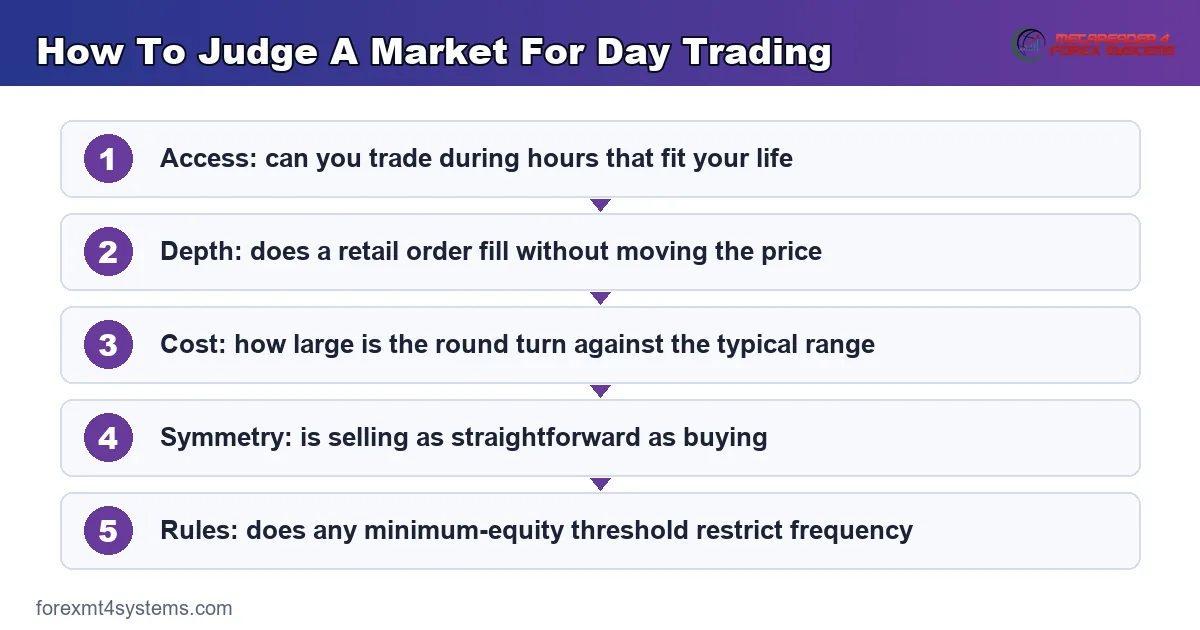
Read that list carefully. Every item lowers a barrier, and lower barriers cut in both directions.
Why Low Barriers Are a Mixed Gift
Each feature above helps a prepared trader and hurts an unprepared one. Easy access means you can trade at three in the morning after a bad day. Low cost means the drag hides until you add up a year of it.
So treat the list as a set of tools rather than as a promise. Tools reward the person who reads the manual first.
What the Market Does Not Give You
Three things are missing here that stock traders take for granted. There is no central exchange, so your quote comes from your broker rather than from one shared book.
Real volume data is also absent. Currency volume figures come from your broker’s own flow, so they show a slice rather than the whole market.
Finally, there is no daily close in the way equities have one. Price runs on through the night, which is why a day trader has to pick a stopping point rather than being handed one.
The Case For, Point by Point
Ads repeat these points and skip the why. Each one deserves a line about what it really changes.
Depth on the Big Pairs
Depth means your order finds the other side near the quoted price. On EURUSD in the London to New York overlap, a retail order fills without shifting the market at all.
Depth also cuts slippage. In normal hours a stop fills close to its level, so your risk plan holds up better than it would in a thin market.
Cost Against Movement
The headline spread matters less than the spread set against range. A pair that costs one pip and moves eighty in your hours gives you far more room than one that costs three and moves forty.
Check both numbers before you pick a pair. Our forex spread comparison tool shows typical spreads by pair, so the ratio is easy to see.
Hours That Fit Around a Job
Stock day traders work a fixed window. Currency traders pick their own, because some centre is always awake.
Pick on purpose, not for ease. Our forex market hours tool shows which sessions overlap right now, wherever you sit.
No Minimum Balance Rule
Stock traders on margin in the United States face the pattern day trader rule. It asks for twenty-five thousand dollars of equity before you may trade often within the day. Spot currency trading sits outside that rule.
That freedom is real, and it cuts both ways. Nothing stops a thin account from trading daily, and a small balance never makes the maths any kinder.
A Day That Actually Moved
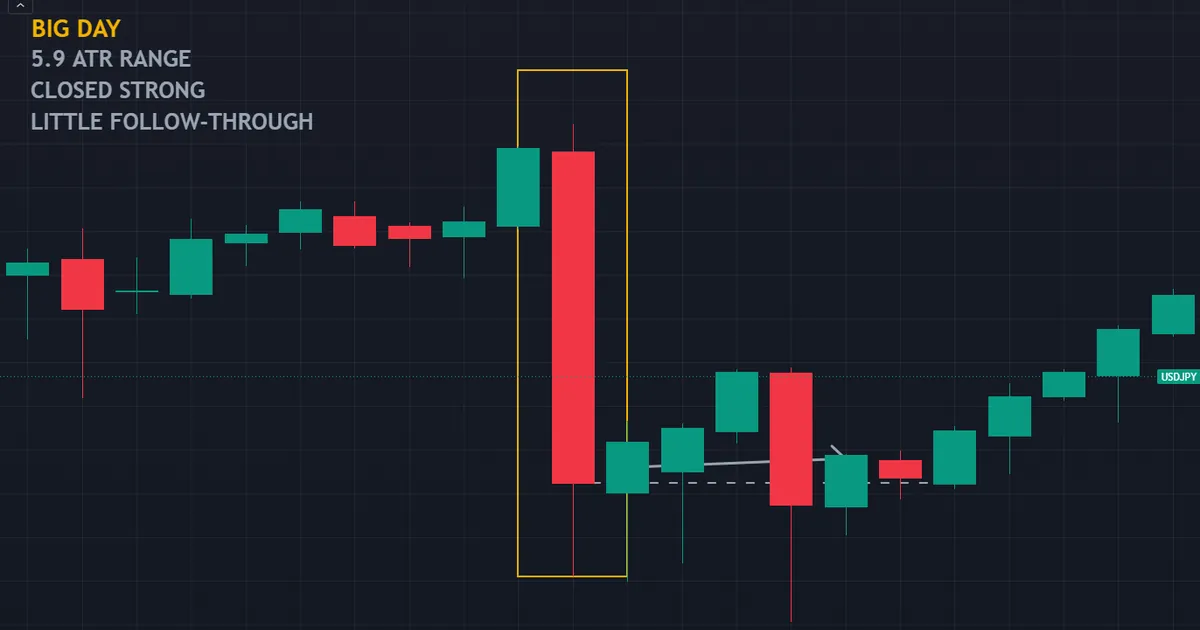
Chances here are real, and they arrive in clumps. Below sits USDJPY on daily bars around 29 April 2026, one of the huge sessions that a set-piece event can produce.
What the Bar Shows
Three measured values sum it up. The day’s range hit 5.94 times the pair’s average true range. The body filled 73 percent of that range, and the close landed down near the low.
So the move was real, not just a long wick. Anyone in the trade before it saw a whole session of movement land in one go.
What Happened Afterwards
What came next was thin. Over the days that followed, price crept back up by about 0.36 times average true range. The market went almost nowhere once the event had passed.
That shape repeats again and again. Big days cluster around set-piece events. The quiet stretches in between still charge you spread if you trade through them.
The lesson is to be choosy. Trade every day just because the market is open, and an odd edge turns into a fixed cost.
The Case Against, Point by Point
Now the other half of the answer. Four things explain most of the gap between what the market offers and what most retail accounts get.
Leverage Is the Big Hazard
Currency moves are small in percentage terms, so brokers add leverage to make them worth trading. Rules in Europe and the United Kingdom cap it at thirty to one on the big pairs. Some places allow far more.
At thirty to one, a three percent move against a fully used account wipes it out. Nobody plans to use it all. Margin calls still land, because trade size creeps up over time.
Read our explainer on leverage in forex before choosing an account setting. The cap you accept shapes the worst day you can have.
The Cost Drag Nobody Counts
Spread looks tiny per trade and piles up hard across a year. Three trades a day at one pip each, over two hundred days, costs six hundred pips.
Set that beside a fair yearly goal. The cost line then looks like a rival, not a rounding error. That is what it is.
Faster styles suffer worse. Our guide to scalping in forex works through the arithmetic at a few pips per trade.
What the Broker Notice Says
Rules in Europe, the United Kingdom and Australia force brokers to publish one number. It is the share of retail accounts that lost money on their contracts for difference. Those figures tend to sit between seventy and eighty-five percent.
Take that number for what it is. It covers one broker’s retail clients over a set period. It spans all such products, not just currency day trading, and it says nothing about any one person.
Take it seriously all the same. For all its limits, it is the only big-sample figure anyone must publish, and it points one way.
The Folklore Worth Discarding
You will see a claim that ninety-five percent of traders fail. No study backs it up, and nobody can point to where it came from.
Use the broker notices instead. They come from firms under rules, they cover real accounts, and they get refreshed. The folk figure never does.
The Always-Open Trap
An open market sounds like a gift until you test your own patience. A market that never shuts offers a trade at every hour of frustration.
Set your window, then treat the rest of the clock as shut. Our guide to risk per trade covers the sizing half of the same habit.
Setting Up the Account Before You Trade
Most of the answer lives in the setup, not the strategy. Three choices, made once, shape every trade that follows.
Pick the Leverage Yourself
Brokers hand you the highest setting they may offer. Change it. A lower cap does not stop you trading; it stops one oversized position from ending the account.
Ask what margin your normal trade uses. If a single position ties up a large slice of the balance, the setting is too high for the way you trade.
Know the Real Cost of a Round Turn
Write down what one full trade costs you in pips. Add the spread you see in your hours and any commission your account charges.
Then set a rule from it. Skip any idea whose target is under about ten times that number, because the drag leaves too little behind.
Fix the Risk Before the First Trade
Pick a percentage per trade and leave it alone. One percent suits most people, and half a percent suits anyone still learning.
Work the lot size from stop distance each time. That habit keeps risk steady even when the stop moves from twenty pips to sixty.
Download the complete indicator database
Put these concepts on your charts. One email unlocks the full library of 1,380+ indicators with compiled MT4 and MT5 files, plus my TradingView scripts. No paywall, no spam, unsubscribe any time.
Get free access to my indicator database
One email unlocks 1,380+ free MT4, MT5 and TradingView indicators — the complete library. No single-tool download; you get the whole database.
Common Mistakes and the Fixes
Six errors turn a fine market into a bad time. Each has a plain fix.
- Accepting maximum leverage. Fix: set the account leverage low deliberately, so a sizing error cannot become an account-ending one.
- Trading outside the active hours. Fix: write your window down in your own timezone and treat the rest of the clock as market closed.
- Judging cost by headline spread. Fix: compare spread against the pair’s typical range in your window, then pick on the ratio.
- Believing the folklore numbers. Fix: read the published provider disclosures instead, and note what they do and do not measure.
- Trading every session because it is open. Fix: require a written reason before each trade, since opportunity clusters rather than spreads evenly.
- Testing a method without costs. Fix: apply spread, commission and slippage to every backtest before drawing any conclusion.
Four of the six sit on the account, not the chart. That is why two traders with the same method end up miles apart.
A Quick-Reference Checklist
Work through this before deciding whether the market fits you.
| Question | What a good answer looks like |
|---|---|
| Can you trade an active session? | Three or more focused hours inside London or the overlap |
| Is your leverage setting deliberate? | Chosen low on purpose, not left at the maximum |
| Do you know your round-turn cost? | Written in pips, including commission |
| Does your pair move enough? | Typical range in your window many times your cost |
| Is risk per trade fixed? | A set percentage, with lot size worked from stop distance |
| Is there a daily stop? | Loss limit and trade cap written down in advance |
| Do you log every trade? | Entry, exit, actual fill and the reason, every time |
Three or more weak answers means wait. The market will still be here next quarter. The account might not.
What a Fair First Three Months Looks Like
Expectations do a lot of damage early on. Here is a plainer way to frame the start.
Month One: Learn the Clock
Trade one pair and one session. Watch how the spread moves through the day and note the hours when the pair barely budges.
Keep the size tiny. The goal is a record of your own behaviour, not a return.
Month Two: Add the Rules
Write the plan down and follow it exactly. Mark each trade as followed or broken, apart from whether it made money.
Count the broken ones each week. That number tells you more than the balance does.
Month Three: Read the Log
Look for patterns in your own data. Which hour do your losses cluster in, and which pair costs you the most in spread?
Change one thing, then run another month. Change three at once and you learn nothing about any of them.
Verdict: Good Market, Hard Game
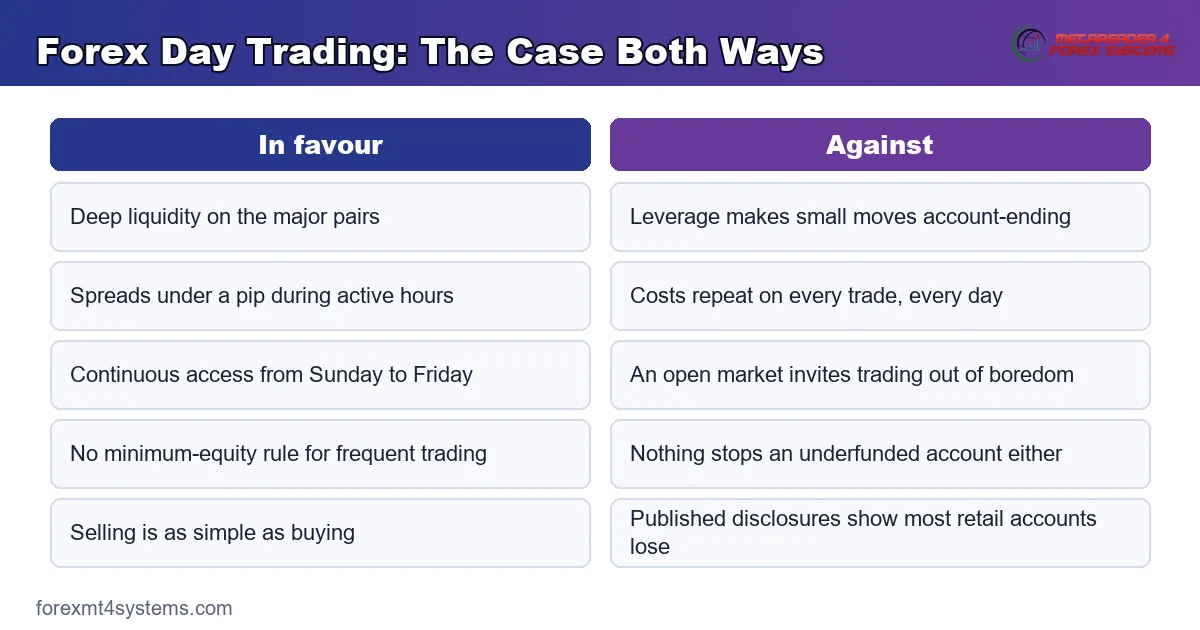
Weigh both halves and the answer is clear. It is not a comfy one.

That panel puts it in short form. The market is good. The typical retail result is not. Almost all of the gap comes from choices the trader makes.
Who It Suits
People with steady hours inside a busy session do well here. Add low leverage, a written plan and the nerve to skip quiet days. The strong points then become usable.
Cash matters too, though less than people think. A small account traded well beats a big one traded at full size, because it is percentage risk that compounds.
Who Should Look Elsewhere
Anyone who cannot lock in set hours should look at a slower style. Our guide to day trading in forex spells out the daily load in detail.
Anyone drawn in mainly by leverage should pause too. Wanting big trades on a small balance is a taste for thrills, not a plan.
What Would Change the Verdict
Two things shift the odds in a way you can measure. Lower leverage shrinks your worst day. Fewer trades cut the cost drag on all the rest.
Neither needs a better method. Both are settings you pick before the market opens, so both are worth real thought.
Related Concepts
A side by side view sharpens the answer. Our comparison of day trading forex versus stocks covers hours, costs, gap risk and the equity rules that do not bite here.
Prop firm routes pull in day traders above all. Our look at why traders fail prop challenges shows the same errors turning up under test rules.
Strength tools help you pick a pair. The currency strength indicators archive gathers tools that weigh currencies rather than pairs.
FAQ
Is forex better than stocks for day trading?
It is different in three ways that matter. Currency markets run continuously through the week, quote very tight spreads on the majors, and impose no minimum-equity rule for frequent trading. Equities offer more instruments, published volume and no financing charge if you close before the session ends. Neither market is superior; the fit depends on your hours, your capital and which costs you would rather pay.
How much money do I need to day trade forex?
No regulator sets a floor for spot currency trading, so the constraint is practical. Risking one percent on a thirty-pip stop needs enough capital for that position size to be worth the effort. Many people start smaller than that and treat the first year as tuition rather than income, which is a reasonable approach.
Do most forex day traders lose money?
The published disclosures from regulated brokers show that most retail contract-for-difference accounts lose money over the reporting period, generally in a range between seventy and eighty-five percent. Those figures cover all such products rather than currency day trading alone, and they describe accounts rather than people. They are still the best large-sample evidence available.
Which pairs suit intraday trading?
The majors, mostly. EURUSD, GBPUSD, USDJPY and AUDUSD combine tight spreads with enough movement during their home sessions. Exotic pairs show tempting ranges and charge spreads several pips wide, which removes most of the apparent advantage before you begin.
Does the pattern day trader rule apply to forex?
No. That rule comes from United States securities regulation and applies to margin accounts trading stocks and options. Spot currency trading sits outside it, so no minimum equity threshold blocks frequent intraday trading. Individual brokers may still set their own minimums.
Is the twenty-four-hour market an advantage?
Only if you use it selectively. Continuous access lets you pick hours that fit your life, which genuinely helps. The same feature offers an entry at every moment of boredom or frustration, so the advantage depends entirely on whether you define a window and respect it.
How many hours a day does it really take?
Three focused hours inside one active session covers most methods, plus half an hour of prep and review either side. Sitting at the screen for twelve hours does not help, because the quiet stretches offer little and tire you out for the parts that matter. Pick the window that fits your life and protect it.
Does the big move always come from news?
Not always, though set-piece events do produce a large share of outsized days. Flows around month end, option expiries and thin holiday sessions can move price sharply with no headline attached. Check the calendar for the scheduled ones, then accept that some large days simply arrive without warning.
Should I use an automated system instead?
Software removes hesitation and fatigue, which genuinely helps. It does not remove spread, slippage or the difference between test fills and live fills. A robot automates a process rather than creating one, so build and check the process first. Any test that skips real costs will flatter it badly.
Can I day trade forex profitably as a beginner?
Some people reach consistency and many do not, which the published account figures reflect plainly. Beginners improve their odds by trading one or two pairs, using low leverage, keeping a written plan and reviewing every trade. Treat the first months as skill building rather than income, and judge the approach across a long run of sessions. Results are not guaranteed; past performance is not indicative of future results.
External references
- For background on this concept, see Triennial Central Bank Survey FX Turnover at the BIS.
- For broader market context, see Turnover at Investopedia.

About the author
Written by Dominic Walsh, a Forex trader and MT4/MT5 indicator, Expert Advisor and script developer. Every tool on forexmt4systems.com is tested on live charts before release and ships with ready-to-use compiled MT4 (.ex4) and MT5 (.ex5) files. Learn more about the trader and developer behind this site.
How we build, test and correct every tool: Editorial & Testing Policy. Trading carries risk; see the disclaimer.