
What is day trading in forex? It means opening and closing every position inside the same trading day, so you finish flat and hold nothing overnight.
That single rule shapes everything else. It removes the swap charge and the weekend gap, then hands you the full weight of intraday noise in exchange.
What Is Day Trading in Forex, Exactly
Day traders work the hours, not the weeks. Positions typically last from twenty minutes to several hours, and the platform shows no open trades by the evening.
Targets scale with that clock. Twenty to eighty pips covers most objectives on a major pair, with stops sized to match.

Above sits EURUSD on hourly bars, the timeframe most day traders live on. One candle equals one hour, so a full session fits comfortably on a single screen.
The Rule That Defines the Style
Flat by the close is not a preference. It is the definition, and everything sensible about the style follows from it.
Because you carry nothing overnight, no swap lands on the account. You also skip the Monday gap, which can open well away from Friday’s last price.
The trade-off arrives immediately. You must accept whatever the session gives you, since tomorrow will not rescue a position you no longer hold.
What Day Trading Is Not
People confuse this style with scalping constantly. The two differ in target size, and that difference changes the whole cost picture.
A scalper takes a few pips many times. Our guide to scalping in forex walks through why costs dominate at that speed.
Day trading sits one step slower. Two to six trades a day, with targets in the tens of pips, keeps the cost share manageable.
How a Trading Day Actually Runs
Good sessions look boring from the outside. The work happens before the market gets interesting.
- Prepare before the open. Mark yesterday’s high and low, check the release calendar and write your loss limit down.
- Set a bias, not a prediction. Decide which direction you would rather trade, then wait for the market to agree.
- Trade the active window. Take positions when spreads are tight and depth supports your size.
- Manage to a plan. Move the stop only at pre-decided points, never because the candle looks frightening.
- Close everything before the rollover. Flatten by late afternoon in New York, then log the day while it stays fresh.

Notice how little of that involves finding a setup. Preparation and closure take more discipline than entries ever do.
Which Sessions Actually Move
The market runs around the clock, yet the hours differ enormously. Treating them as equal is the fastest way to pay spread for nothing.
The Asian Hours
Tokyo dominates the first block of the day. Yen crosses and the Australasian pairs see genuine flow, while EURUSD and GBPUSD often drift in a narrow band.
Ranges tend to stay contained here. Traders who fade the edges of that range do reasonably; breakout traders usually wait.
The London Session
London opens and volume jumps. This is the largest single centre for currency dealing, and European pairs typically post their widest ranges during these hours.
Moves often start with a sweep. Price runs the Asian high or low, then either continues or reverses hard, which is why the first hour deserves patience.
The New York Session
American data lands in the early New York hours. Releases arrive on a schedule, so the calendar tells you when conditions will change.
Liquidity thins through the afternoon. By the last hours before rollover, spreads widen and moves lose conviction.
The Overlap Everyone Waits For
London and New York trade together for a few hours each day. Depth peaks, spreads sit at their tightest, and most large intraday ranges form inside that window.
Check the clock rather than guessing. Our forex market hours tool shows which centres are open right now, wherever you sit.
Deeper session detail lives in our guide to forex trading sessions, including how the handovers behave.
The Handovers Between Sessions
Transitions matter as much as the sessions themselves. When Tokyo hands to London, the Asian range often breaks within the first hour.
The London to New York handover behaves differently. Depth rises rather than falls, so moves that start there tend to run further than early-morning attempts.
Late in the New York afternoon everything thins out. Spreads widen, ranges shrink, and the same setup that worked at midday stops paying.
Context From the Slower Chart
One timeframe rarely tells the whole story. The chart below shows the same EURUSD market and window as the first image, drawn on four-hour bars.

Four hourly candles become one here. Nothing about the market changed between the two pictures, so the difference you see is purely resolution.
Why the Slower View Earns Its Place
Structure that looks decisive on the hourly chart often sits mid-range on the four-hour. Checking the slower view stops you from selling straight into support.
Use it for direction, not for timing. Set your bias from the four-hour, then execute on the hourly where the levels are precise.
A Worked Session
Say the four-hour chart shows a clear rising sequence, so your bias is long. On the hourly, price sweeps the Asian low during the London open and snaps back.
You buy the reclaim, risking thirty pips for a sixty-pip objective. Two hours later price reaches the target and you close, leaving nothing open into the afternoon.
One trade, one decision, done. Days like that are the goal, and they happen far less often than the charts suggest afterwards.
The Costs You Pay, and the One You Skip
Every style pays something. Day trading pays a moderate amount, which is exactly why it suits so many people.
Spread and Commission
Assume a round-turn cost near one pip on a liquid major. Against a fifty-pip target, that removes two percent of the objective.
Now compare it with the same cost against a five-pip target. The drag jumps to twenty percent, which is the whole argument for slowing down.
The Swap You Never Pay
Positions held past the rollover hour incur a financing charge or credit. Because day traders close first, that line never appears on the statement.
The saving matters more than it sounds on high-interest pairs. Our guide to swap in forex explains where the number comes from.
The Cost of Time Itself
Screen hours carry a price nobody prints on a statement. Four focused hours a day, five days a week, adds up to a part-time job.
Count that cost honestly before you commit. A method that needs your full attention from eight until noon has to justify the hours as well as the risk.
Choosing Pairs for Intraday Work
Instrument choice does half the job. A pair that barely moves during your hours cannot produce an intraday trade however good your analysis is.
Match the Pair to Your Hours
Currency pairs come alive when their home centres open. EURUSD, GBPUSD and EURGBP wake up with London, while AUDUSD, NZDUSD and the yen crosses do their work during the Asian block.
Trading a European pair at three in the morning London time wastes spread. The chart still draws candles; they simply have nothing behind them.
Check the Range Before the Cost
Compare average hourly range against your round-turn cost. A pair moving forty pips in your window with a one-pip cost gives you room; a pair moving eight pips does not.
Exotic crosses fail this test badly. Their ranges look tempting, then the spread of five or more pips removes most of the advantage.
Fewer Pairs, Watched Properly
Two or three instruments are plenty. Watching twelve charts produces the illusion of opportunity and the reality of shallow attention.
Learn how your chosen pairs behave at each hour. That knowledge compounds, and it never appears on any indicator.
Intraday Noise Is the Real Opponent
The overnight gap disappears, and something else takes its place. Within a single session, price wanders far more than most beginners expect.
Stops Sit Inside the Noise Band
A thirty-pip stop on EURUSD sounds generous. During an active London hour, price can cover that distance twice without changing direction at all.
Size the stop from measured volatility rather than from comfort. Average true range over the last twenty bars gives you an honest starting number.
Releases Rearrange the Session
Scheduled data moves price sharply, and the direction frequently surprises. What matters is not the number itself but the distance between the number and what the market already expected.
Check the schedule before you trade. Our economic calendar lists the releases and the times they land.
Liquidity Is Not Constant
Spreads widen around releases and into the rollover hour. Your stop still executes, though the fill can sit some way from the level you chose.
Plan around those windows. Standing aside for ten minutes costs nothing, while a bad fill during a spike costs real money.
Building a Day Trading Plan You Can Repeat
A plan does not create an edge. It makes an existing one executable, and it makes the absence of one visible very quickly.
Write the Boring Parts First
Start with hours, instruments and risk. Those three decisions constrain everything else, and none of them requires any market opinion.
Then add your entry conditions in plain language. If a rule needs a paragraph of qualifiers, it is really a feeling wearing a costume.
Define Invalidation Before Entry
Decide where the idea stops being true, then place the stop there. Sizing follows from that distance rather than from what you would like to make.
Never move the level because price approached it. A stop that travels is not a stop; it is a wish with a ticket number.
Include the Rules for Stopping
Most plans describe how to trade and forget how to stop. Add a daily loss limit, a trade cap and a closing deadline.
Those three lines do more for a year of results than any entry refinement. They work precisely because they apply when judgement is weakest.
How to Review the Day
Review turns sessions into information. Skip it and you repeat the same day for months without noticing.
Log the Fill, Not the Intention
Record the price you actually got, alongside the price you wanted. The gap between them is your real slippage, and guessing it never works.
Add the reason for entry in one sentence. Vague reasons at the time become obvious problems on review.
Grade Process, Not Outcome
Mark each trade as followed or not followed, separately from profit or loss. A good trade can lose and a rule-break can win, so mixing the two teaches the wrong lesson.
Count the rule-breaks weekly. That number predicts your next drawdown better than any performance figure.
Review Weekly, Change Rarely
Daily review invites overreaction, since a single session carries almost no signal. Weekly review across twenty or thirty trades starts to mean something.
Change one rule at a time when you do adjust. Altering three things at once teaches you nothing about which one mattered.
Download the complete indicator database
Put these concepts on your charts. One email unlocks the full library of 1,380+ indicators with compiled MT4 and MT5 files, plus my TradingView scripts. No paywall, no spam, unsubscribe any time.
Get free access to my indicator database
One email unlocks 1,380+ free MT4, MT5 and TradingView indicators — the complete library. No single-tool download; you get the whole database.
Common Mistakes and the Fixes
Six errors account for most bad day-trading months. Each has a mechanical answer.
- Trading every hour. Fix: define your window, usually the London or overlap hours, and stay out of the rest.
- Holding past the close to avoid a loss. Fix: treat flat by the close as a hard rule, because breaking it converts a day trade into an accidental swing.
- Sizing from the target instead of the stop. Fix: work the lot size from stop distance and a fixed percentage of risk.
- Ignoring the release schedule. Fix: read the calendar at the start of the session and mark the times to avoid.
- Adding to a losing position. Fix: allow one entry per idea, and treat a second entry as a new trade with its own stop.
- Reviewing only the losses. Fix: log every trade with entry, exit, reason and fill, then review the whole set weekly.

Half of those failures involve time rather than analysis. That balance surprises people, and it holds across most trading logs.
Tools That Earn Their Place Intraday
Chart tooling helps at the margin. It never replaces the two decisions that matter, which are when you trade and how much you risk.
Levels Beat Signals
Prior day high, low and close do more work than most oscillators. They mark places where orders genuinely sat, so price reacts there for a reason.
Add the session highs and lows from Asia. Those two lines explain a surprising share of London-open behaviour.
One Volatility Measure
Average true range converts your stop from a guess into a measurement. Read it on the hourly chart, then size the stop as a multiple rather than a round number.
Recheck it weekly. Volatility regimes shift, and a stop that fitted last month can sit inside the noise this month.
Resist the Stack
Five indicators disagreeing produces paralysis, not confirmation. Two tools measuring different things beat six measuring the same thing in different colours.
Strip the chart back periodically. Anything you cannot explain in one sentence probably earns nothing.
A Quick-Reference Checklist
Work through this before the session, not during it.
| Check | Standard to meet |
|---|---|
| Trading window defined | Specific hours written down, in your own timezone |
| Release calendar read | High-impact times marked and avoided |
| Bias set from a slower chart | Four-hour or daily direction noted before the open |
| Levels marked | Prior day high, low and close on the chart |
| Risk per trade fixed | Percentage decided, lot size worked from stop distance |
| Daily loss limit set | Number written down before the first trade |
| Close time agreed | Flatten deadline set ahead of the rollover hour |
An unchecked row is a reason to sit out. That standard sounds severe, and it protects more capital than any entry filter.
What Goes Wrong Across a Session
Bad days rarely come from one catastrophic trade. They accumulate through small decisions that each looked reasonable at the time.
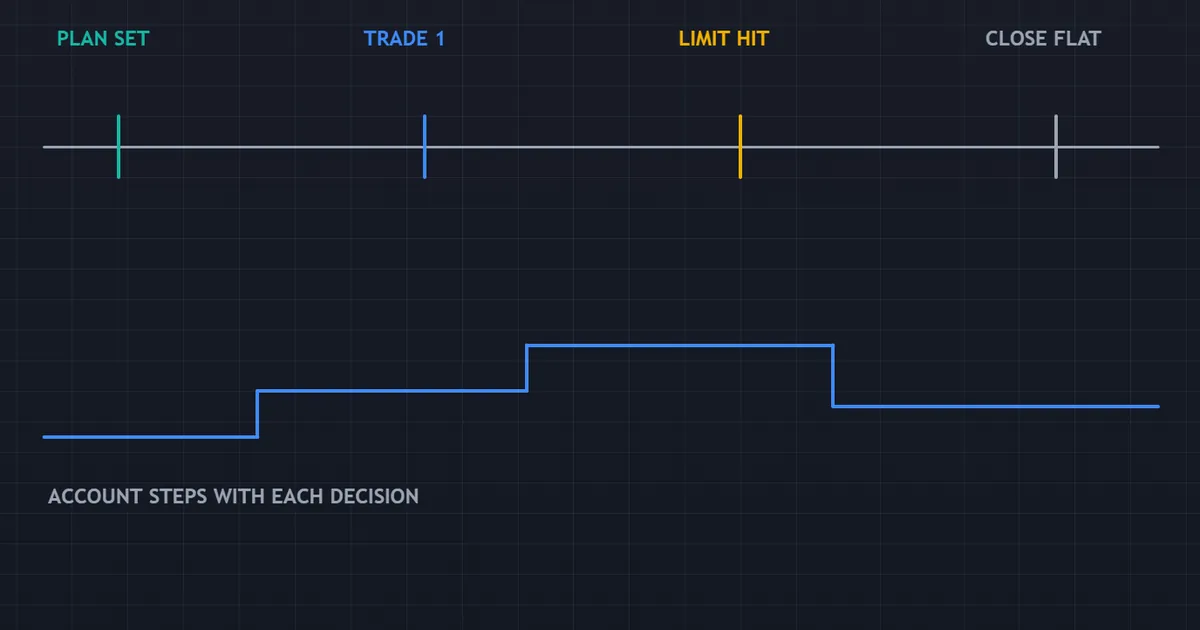
The panel above marks the decision points across a single session. Each label sits where a rule was either followed or quietly abandoned.
The Drift From Plan to Reaction
Traders start the day with a plan and finish it reacting. The change happens gradually, usually after the second losing trade.
Notice the shift while it is small. A written trade cap forces the question before the account answers it for you.
The Overtrading Spiral
Missing a move creates pressure to catch the next one. That pressure lowers your standards, and lower standards produce more losses.
Set a hard trade limit, then respect it. Our guide to the daily loss limit covers how to choose a level you will actually honour.
The Late Hold
A losing position near the close tempts everyone. Holding it overnight converts a controlled day trade into an unplanned swing trade with a stop nobody sized for it.
Close it and move on. The rule exists precisely for the moments when following it feels expensive.
Related Concepts
If the daily screen time looks unmanageable, step out one level. Our guide to swing trading in forex covers multi-day holds and the swap costs that come with them.
For a straight verdict on the market itself, read our assessment of whether forex is good for day trading, including the parts brokers rarely advertise.
Tooling matters less than routine, though it helps. The indicator library collects the trend, level and volatility tools that suit intraday work.
FAQ
How much capital do I need to day trade forex?
Enough that a sensible risk percentage produces a position size worth trading. Risking one percent of a very small account on a thirty-pip stop leaves a micro lot, which is fine for learning and poor for income. Forex has no minimum equity rule of the kind that applies to pattern day traders in United States equities, so the constraint is practical rather than regulatory.
Which hours should a day trader use?
Most people do best during the London session and the London to New York overlap. Spreads sit at their tightest there and ranges are widest, so a given stop distance buys more movement. Traders in Asian timezones often work the Tokyo hours on yen and Australasian pairs instead, where flow genuinely exists.
Do day traders pay swap in forex?
No, provided every position closes before the rollover hour. Swap applies only to positions still open at that point, so a strict day trader never sees it. A trade held past the deadline picks up the charge or the credit like any other overnight position.
How many trades should I take in a day?
Fewer than you want to. Two to five positions suits most intraday methods, because good conditions do not repeat endlessly within one session. A written cap works better than willpower, since the urge to trade rises exactly when the quality of opportunities falls.
What timeframe should a day trader use?
Most people run two charts. A four-hour or daily view sets direction, and a fifteen-minute or hourly view handles timing. Adding a third timeframe rarely helps, because conflicting signals across three resolutions produce hesitation rather than clarity. Pick the pair of timeframes that matches your holding period, then leave the arrangement alone for a few months.
Does day trading avoid weekend gap risk?
Yes, and that is one of its genuine structural advantages. Nothing stays open across Friday’s close, so a Monday opening away from Friday’s last price cannot touch you. Swing and position traders carry that exposure every week, which is why their stops need more room and their position sizes need to be smaller.
Is day trading better than swing trading?
Neither style is superior. Day trading removes swap and gap risk and demands daily screen time. Swing trading needs less attention per day and accepts overnight exposure plus financing costs. Frequency changes the cost burden and the psychological load, not the quality of your edge.
Can I day trade forex part time?
Yes, if your available hours overlap with an active session. Someone free between six and nine in the evening in Asia can work the London open properly, while someone free at midday in London gets the overlap. Trading whichever hours happen to be convenient, regardless of activity, is where part-time attempts usually fail. Judge any approach across a long run of sessions rather than a good week. Results are not guaranteed; past performance is not indicative of future results.
External references
- For background on this concept, see at Corporate Finance Institute.
- For broader market context, see Day Trading on Wikipedia.

About the author
Written by Dominic Walsh, a Forex trader and MT4/MT5 indicator, Expert Advisor and script developer. Every tool on forexmt4systems.com is tested on live charts before release and ships with ready-to-use compiled MT4 (.ex4) and MT5 (.ex5) files. Learn more about the trader and developer behind this site.
How we build, test and correct every tool: Editorial & Testing Policy. Trading carries risk; see the disclaimer.