
Markets get scared on a regular schedule. When they do, money moves in a pattern old enough to have a name.
Safe haven currencies are the ones that tend to catch that money. This guide covers which they are, why they hold that status, and the times the pattern simply did not show up.
What Safe Haven Currencies Are
Start with a plain definition. A haven is an asset that holds its value, or gains, while riskier assets fall.
The Working Definition
Nothing here concerns long-run returns. A haven does one job, and it does that job on bad days.
So the test is simple. Did this currency rise on the days when stocks fell hard and credit tightened?
Three currencies pass that test more often than the rest. The yen, the franc and the dollar make up the usual short list.
Why Gold Sits at the Top
Gold is not a currency, yet every haven discussion starts there. It answers to no central bank and it pays no yield.
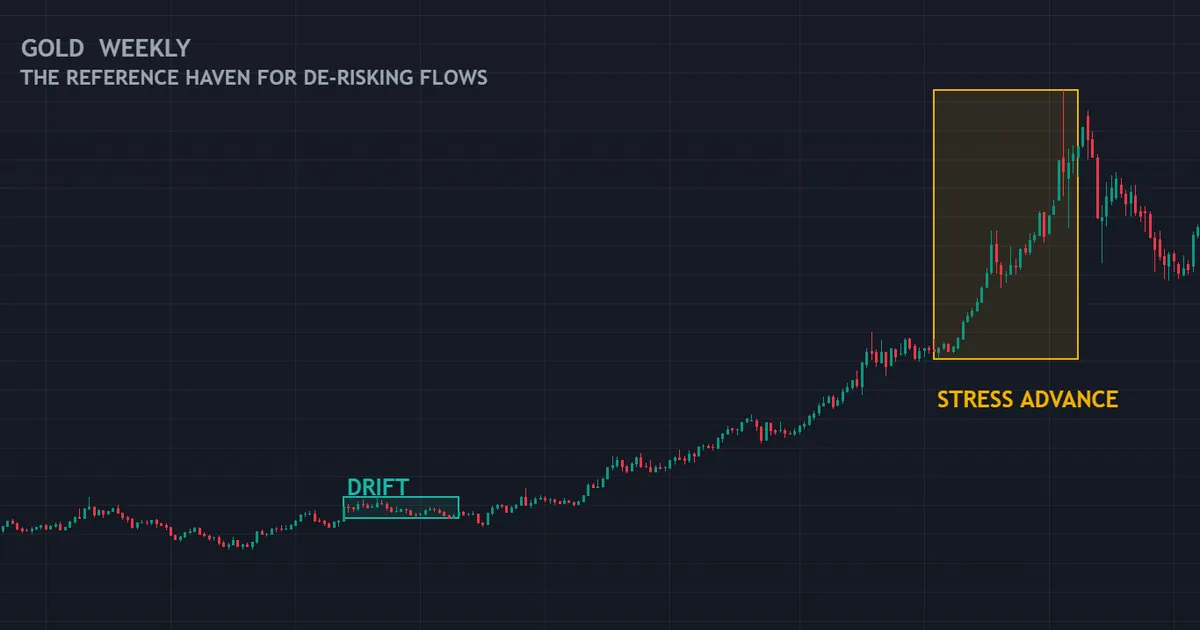
The weekly chart above shows the long view. Steady drifts, then sharp advances that cluster in stressed periods, describe its normal behaviour.
Traders use gold as the reference leg. If a currency rises while gold rises, the move looks like flight. If it rises while gold falls, something else drives it.
A Tendency, Not a Law
Here is the point most articles skip. Haven status is a habit, not a rule, and habits break.
Each of the three has failed to act as a haven at some point. So treat the pattern as a prior, and check it against the tape every time.
What Gives a Currency Haven Status
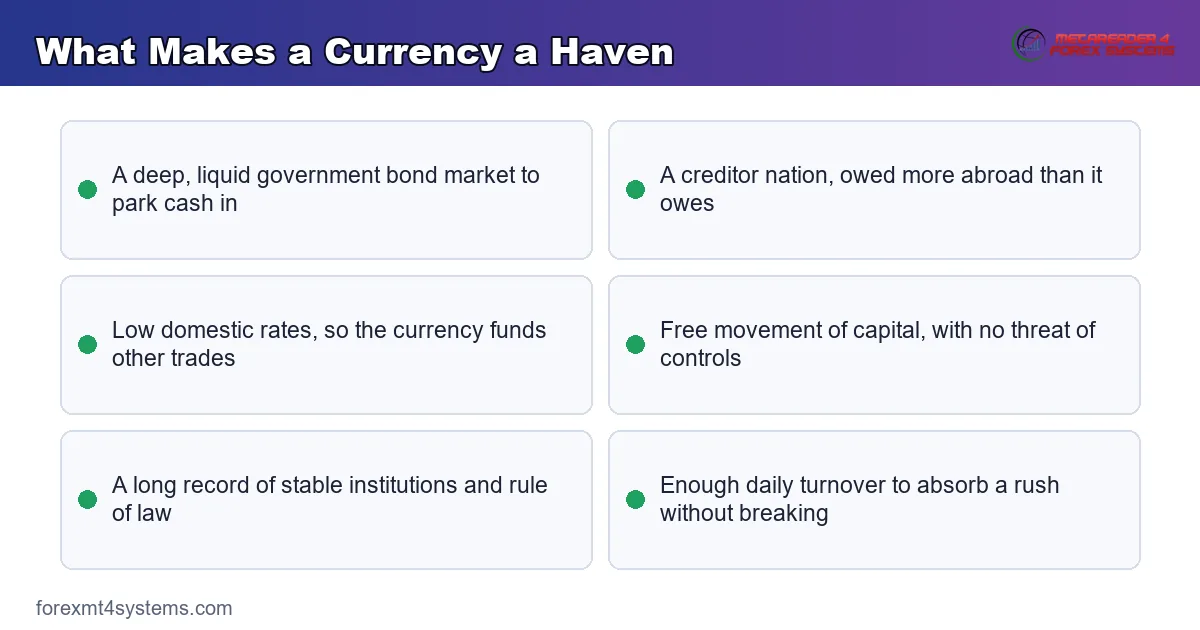
The label is not a matter of taste. Six features do the work.
A Deep Bond Market
Frightened money needs somewhere to sit. A large, liquid government bond market gives it that place.
Buying those bonds means buying the currency first. So the bond market pulls the currency along with it.
Creditor Status
A nation that owns more abroad than it owes has a built-in bid. In a crisis its investors bring money home, which lifts the currency.
Japan and Switzerland both fit that description. So does the pattern of repatriation that shows up whenever markets turn.
Low Domestic Rates
Cheap money gets borrowed and spent elsewhere. That makes a currency the funding leg of countless trades around the world.
Unwind those trades and the borrowing gets repaid. Our guide to the carry trade unwind covers that mechanism in full.
Open Capital Accounts
Money only runs to a place it can leave again. Capital controls, or even the threat of them, kill haven status quickly.
Scale matters too. A currency needs enough daily turnover to absorb a rush without breaking.
The Three Usual Names
Each of the three earns its status differently. Those differences matter far more than the shared label.
The Japanese Yen
Japan runs low rates and holds a large net creditor position. Both features point the same way.
Traders borrow yen cheaply to buy higher-yielding assets. When fear arrives, those trades close and the yen gets bought back.
So a yen rally in a panic reflects mechanics rather than a vote of confidence in Japan. That distinction explains why the effect can be so fast and so large.
The Swiss Franc
Switzerland pairs a creditor position with a long record of stable institutions. Its bond market is small, though, which limits how much money the franc can absorb.
The franc reacts quickly to European stress in particular. Proximity does much of the work here.
The US Dollar
The dollar earns its place for a different reason. Most global borrowing happens in dollars, so a credit squeeze anywhere creates demand for them.
Add the largest government bond market in the world and the pull gets stronger. Our guide to the dollar index in forex covers how traders track that demand.
What a De-Risking Day Looks Like
Definitions convince nobody on their own. A measured episode does the job better.
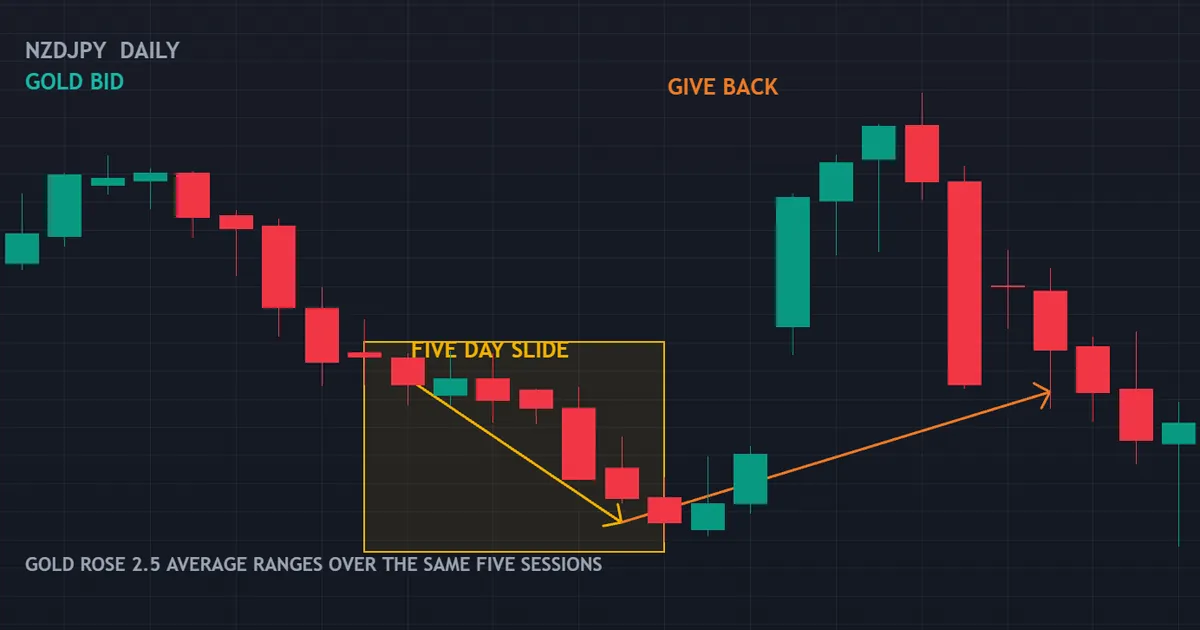
Over 5 days to 2025-09-30, NZDJPY moved 2.0 ATR lower while gold moved 2.5 ATR higher — the classic de-risking signature. Over the following 10 bars NZDJPY gave part of it back by 1.8 ATR.
Reading the Two Legs
Take the legs together. A high-yield currency fell hard against a funding currency, and the reference haven rose across the same five sessions.
One leg alone would prove very little. Currencies fall for domestic reasons all the time.
Both legs moving in the classic pattern is what makes the read useful. Our guide to risk-on and risk-off currencies works through more of these pairings.
The Give-Back
Look at what followed. Price handed back most of the move over the next ten bars.
Haven flows tend to arrive fast and drain slowly. Traders who chase the third day of a move frequently buy the top of it.
Nothing here says a panic always fades. Some run much further, which is exactly why entry timing cannot come from the pattern alone.
Gold, Bonds and the Non-Currency Havens
Currencies form part of a larger group. Knowing the whole set improves the read.
- Gold. The oldest haven, with no issuer and no yield. It also reacts to real interest rates, which muddies the signal.
- Government bonds. The largest destination by volume. Falling yields alongside falling stocks mark a genuine flight to quality.
- The Japanese yen. The funding currency whose repayment drives the fastest moves in a panic.
- The Swiss franc. A small, high-quality market that fills up quickly and draws official attention when it does.
- The US dollar. The funding currency of global credit, bid whenever borrowing gets harder.
- Cash itself. Unglamorous, and the destination when every other haven looks crowded.
Watch two of these at once rather than one. Agreement between gold and a yen cross carries far more weight than either alone.
A Short History of the Idea
Haven status grew out of events rather than theory. A little history explains why the list looks the way it does.
Before Floating Rates
For decades after the war, most major exchange rates sat fixed against the dollar. Fear had nowhere to show up in a currency price.
That system ended in the early 1970s. Once rates floated, flows started moving prices, and the pattern became visible.
The Franc Builds a Reputation
Switzerland spent the twentieth century as a byword for stability. Neutrality, low inflation and a private banking industry all fed the same story.
Money arrived whenever Europe looked shaky. The reputation stuck, and it still shapes flows today.
The Yen Joins Later
Japan’s haven behaviour belongs mostly to the past thirty years. Rates near zero turned the yen into the world’s favourite funding currency.
Every carry trade built a future yen buyer. That mechanical link, rather than any view about Japan, drives the sharp rallies.
The Dollar in Two Crises
In 2008 a crisis that began in American housing sent the dollar higher. Banks everywhere needed dollars to fund their books, and demand beat the bad news.
In March 2020 the same dash for dollars appeared again. For a few days even gold and government bonds fell, because investors wanted cash above everything.
Currencies That Are Not Havens
The other side of the list matters just as much. These currencies tend to fall when fear rises.
The Commodity Group
The Australian, New Zealand and Canadian dollars all track global growth expectations. Lower growth means lower commodity demand, so these currencies get sold in a scare.
Higher local interest rates add to the effect. They make these currencies popular carry targets, and carry targets get dumped first.
Emerging Currencies
Smaller markets amplify everything. Wider spreads, thinner books and the risk of capital controls all push the same way.
Moves here run further than the majors and reverse less cleanly. Position sizing needs to reflect that.
The Awkward Middle
The euro and the pound sit in neither camp. Both trade mostly on their own policy news, with only a mild risk tilt.
The euro does have a funding role of its own, which shows up in some episodes. Consistency, however, is not one of its features.
When the Haven Bid Fails
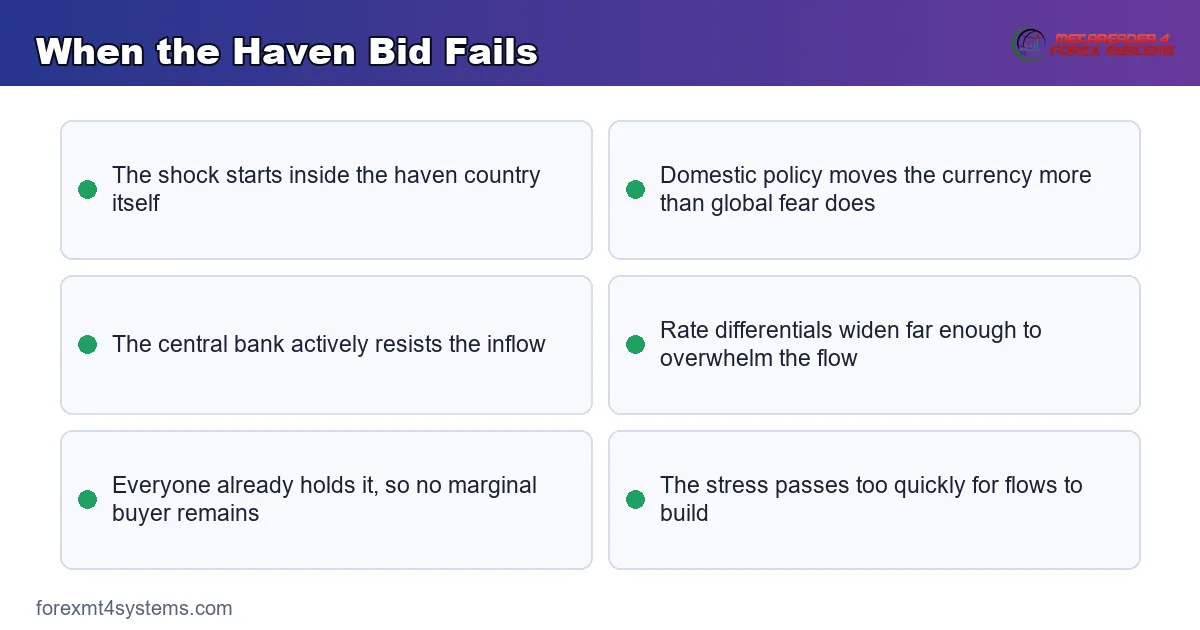
This section is the reason the article exists. Six conditions break the pattern.
The Shock Starts at Home
A haven only works when the trouble sits elsewhere. Bad news about the haven country itself removes the whole logic.
Traders learned that lesson more than once with the dollar. Domestic funding scares have pushed it both ways in different episodes.
Rates Overwhelm Fear
A wide and widening rate gap can beat the haven flow outright. The yen spent long stretches falling through nervous markets when its rate disadvantage grew fast enough.
That period taught a useful lesson. Haven status describes a tendency, and a strong enough opposing force simply overrides it.
Everyone Already Owns It
A crowded haven has no marginal buyer left. Positioning matters here exactly as it matters everywhere else.
Our guide to risk-on and risk-off covers how to check whether a move has already run.
How Havens Behave Through the Day
Timing shapes these moves as much as the news does. Three patterns repeat.
The Asian Session
Yen crosses move hardest while Tokyo trades. Japanese investors act on overnight news, and the books are thinner than in London.
A risk event during American hours therefore often lands in the yen the next morning. Watch the first two hours of the Asian session for the follow-through.
The European Hours
The franc responds to European news in European time. Its biggest moves cluster around policy meetings and regional headlines.
Liquidity in the franc thins outside those hours. So the same order can move price much further at the wrong time of day.
The Weekend Gap
Bad news over a weekend arrives all at once on Sunday. Haven pairs can open some distance from Friday’s close, with no trading in between.
No stop protects against that hole. Decide the size of any weekend haven exposure before the Friday close, not after the gap.
Havens Inside a Portfolio
Most damage from this topic comes from stacking the same bet. Three checks prevent it.
Count the Real Positions
Long yen, short a commodity cross and long gold form one trade wearing three hats. Under stress they rise and fall together.
Count exposures by theme rather than by ticket. Three tickets on one theme means triple the size you planned.
Hedging Versus Sizing
Traders sometimes add a haven long as insurance. That works, in the sense that the hedge pays when the rest hurts.
Cutting size does the same job for less money. Ask which one you can actually manage before adding another moving part.
Six Questions Before You Call It a Flight
Run this list before deciding that safety flows explain a move.
- Did gold rise on the same days, rather than merely in the same week?
- Did government bond yields fall as well?
- Did the move show up across several risk pairs, or only one?
- Could a scheduled release explain it instead?
- Has the move already run for several sessions?
- Does the haven leg have a domestic story of its own this week?
Two clear answers beat six vague ones. If most of the list points elsewhere, the risk story probably does not apply.
Comparing the Three
The differences drive the trade selection. Here they are side by side.
| Currency | Source of haven status | Reacts fastest to | Main weakness |
|---|---|---|---|
| Japanese yen | Low rates and creditor position | Carry trade unwinds | Loses the bid when rate gaps widen sharply |
| Swiss franc | Creditor status and stable institutions | European stress | Small market, and an explicit policy target |
| US dollar | Reserve status and dollar funding | Global credit squeezes | Fails when the shock originates at home |
| Gold | No issuer, no yield | Loss of confidence in paper assets | Also driven by real interest rates |
Notice the last column. Every one of them carries a condition under which the pattern stops working.
Download the complete indicator database
Put these concepts on your charts. One email unlocks the full library of 1,380+ indicators with compiled MT4 and MT5 files, plus my TradingView scripts. No paywall, no spam, unsubscribe any time.
Get free access to my indicator database
One email unlocks 1,380+ free MT4, MT5 and TradingView indicators — the complete library. No single-tool download; you get the whole database.
The Franc Is Also a Policy Target
One of the three deserves a separate warning. Switzerland has acted directly against its own currency more than once.
The Floor Years
Between 2011 and 2015 the Swiss National Bank capped the franc against the euro. It defended that floor by creating francs and buying foreign currency.
The cap ended without warning in January 2015. The franc surged, spreads blew out, and many retail accounts finished the day owing money.
Negative policy rates followed for years afterwards. The intent was plain: make the franc less attractive to hold.
What That Means for a Trader
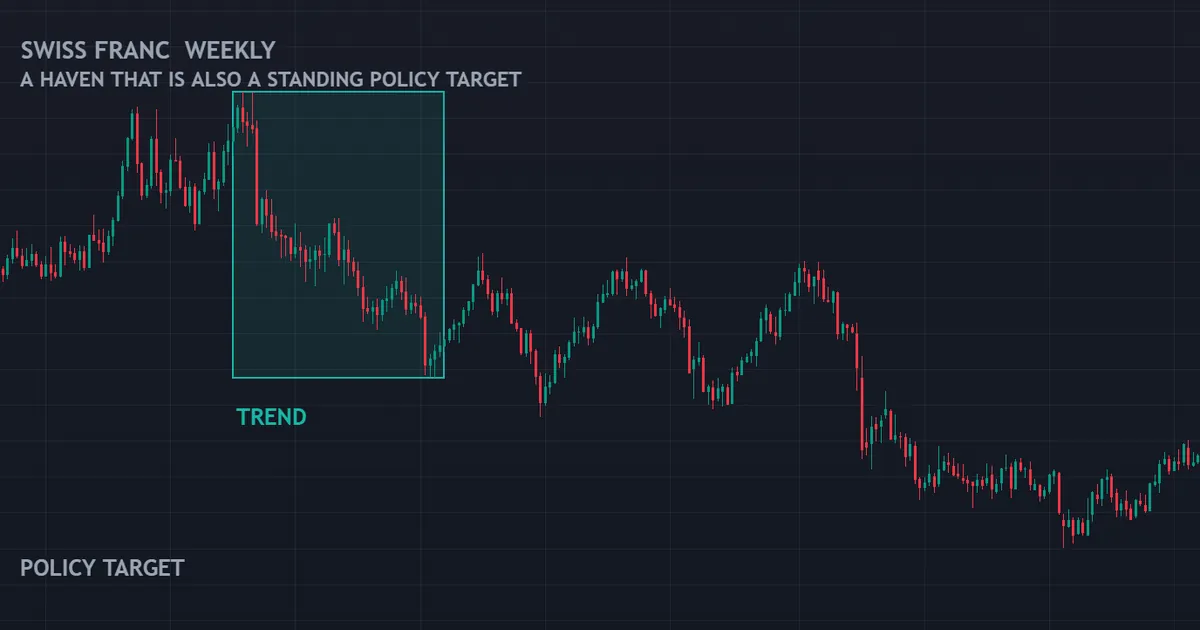
Treat the franc as a haven with an official counterparty. A rally can meet resistance that has nothing to do with other traders.
The weekly chart above covers the years since that episode rather than the floor itself. Long directional stretches show up on it, and so do the patches where Swiss policy leaned against the currency.
Position sizing carries the load here. Our guide to position sizing covers how to plan for a gap you cannot trade through.
How to Use This in Practice
Haven behaviour is context, not a strategy. Three uses hold up.
As a Confirming Read
Check gold and a yen cross before each session. Agreement between them tells you the risk climate in seconds.
Our note on the VIX in forex adds a third read from the equity option market.
As a Correlation Warning
Havens rise together during stress, and everything else falls together. Three separate trades can quietly become one.
Our free forex correlation matrix shows which of your open pairs currently move as a group.
As a Cost Check
Holding a funding currency long usually means paying to carry the position. Our free swap calculator shows what that costs across a week.
Longer-horizon methods live or die on that number. Our forex trading strategies section covers approaches built around it.
Where the Label Gets Abused
Marketing likes this idea, because fear sells well. Two claims deserve a flat rejection.
The Crisis Basket Pitch
Some services sell a fixed basket as protection against any downturn. Shocks differ, and a basket built for the last one rarely fits the next.
The Certainty Pitch
Others present haven flows as something close to a rule. Every example above carries a condition under which the flow stops, and those conditions arrive without notice.
The Short Version
Three points cover the whole subject. Money under stress moves toward deep bond markets, creditor nations and low-rate currencies.
The yen, the franc and the dollar fit that description, while gold acts as the reference leg. Each of them has failed the test at least once, so the pattern belongs in your sizing rather than in an entry rule.
Common Mistakes
Four errors show up again and again. Each one has a short fix.
Treating the Pattern as a Rule
Haven flows describe a tendency measured across many episodes. Any single week can go the other way entirely.
Buying the Third Day
Panics move fastest at the start. Entering late means buying from the people who bought early.
Reading One Leg
A yen rally alone might reflect Japanese policy news. Check gold, a cross and a bond market before calling it a flight.
Forgetting the Carry Cost
Long positions in low-rate currencies usually bleed a small amount every night. That cost adds up across a slow month.
FAQ
Which currency is the strongest haven?
No single answer covers every episode. The yen tends to move fastest when carry trades unwind, the dollar leads when global credit tightens, and the franc reacts hardest to European stress. Match the currency to the type of shock rather than picking a favourite in advance.
Is gold a currency?
No, though it trades like one on most platforms. Gold has no issuer, no central bank and no yield, which is exactly why money moves into it when confidence drops. Traders use it as the reference leg for any haven read because it carries no domestic policy story of its own.
Does the dollar always rise in a crisis?
Not always. Its haven role comes from global dollar borrowing, so a squeeze in funding markets lifts it regardless of American conditions. When the shock starts inside the United States, or when the response floods the world with dollars, the pattern can reverse. Check the tape rather than assuming.
Why did the yen fall during some nervous periods?
Rate differentials overwhelmed the haven flow. When Japan held rates near zero while other central banks raised theirs quickly, the cost of holding yen grew large enough to dominate. Haven status describes a tendency, and a strong enough opposing force overrides it.
Can I build a strategy purely on haven flows?
Not sensibly on its own. The pattern tells you which way money tends to run under stress, and it says nothing about when the stress starts or how long it lasts. Use it to choose which pairs to avoid, to size positions, and to expect wider ranges. Entries still need to come from price.
Do havens work in every kind of crisis?
No, and the type of shock decides which one responds. A credit squeeze favours the dollar, a carry unwind favours the yen, and a European problem favours the franc. A shock that hits everything at once can push investors into plain cash instead, which briefly leaves every haven behind.
Is the euro ever treated as a haven?
Occasionally, and only in a limited way. Low euro rates have made it a funding currency in some periods, which produces the same repayment effect seen in the yen. That behaviour comes and goes with policy, so it stays far less dependable than the three main names.
How should I judge whether this helps my trading?
Record the risk climate beside every trade for a few months, then split your results by that column. Compare how your method behaved on calm days against stressed ones, and look at the size of your average loss in each group as well as the number of trades. Fifty trades hint at a pattern, and several hundred start to support a conclusion. Results are not guaranteed; past performance is not indicative of future results.
External references
- For background on this concept, see Safe Haven Currencies in the BabyPips Forexpedia.
- For broader market context, see The Swiss Franc on Wikipedia.

About the author
Written by Dominic Walsh, a Forex trader and MT4/MT5 indicator, Expert Advisor and script developer. Every tool on forexmt4systems.com is tested on live charts before release and ships with ready-to-use compiled MT4 (.ex4) and MT5 (.ex5) files. Learn more about the trader and developer behind this site.
How we build, test and correct every tool: Editorial & Testing Policy. Trading carries risk; see the disclaimer.