
The liquidity grab vs liquidity sweep debate confuses most new smart money traders. Both events poke beyond a level and reverse, yet they work at very different scales. A grab is a surgical single-candle wick that snaps straight back. Meanwhile, a sweep is a broader run that trades through one or more levels before it turns.
This guide draws a clean line between the two with real levels, session windows, and worked examples in both directions. So by the end, you will label any raid correctly, know which one signals the cleaner reversal, and stop shorting breakouts that only looked like traps.
Liquidity Grab vs Liquidity Sweep at a Glance
Both terms come from smart money concepts, the framework popularized by Michael Huddleston, the Inner Circle Trader. Also, both describe engineered stop runs above highs or below lows. Yet the grab stays quick and shallow, while the sweep runs deep and deliberate.
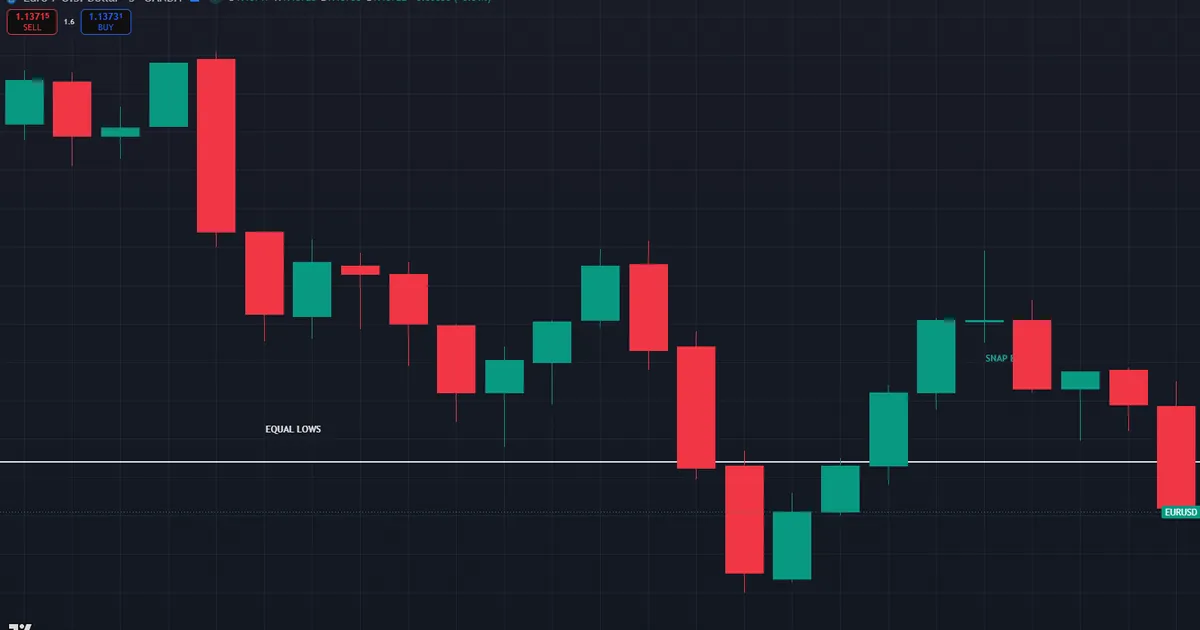
The chart below shows a textbook grab. EURUSD prints relative equal lows near 1.1375 on the five-minute chart during a Tuesday London open. Then one candle stabs down to 1.1368, only seven pips through the lows, and closes right back at 1.1377. Price rejects hard and turns up. That single wick is the liquidity grab.
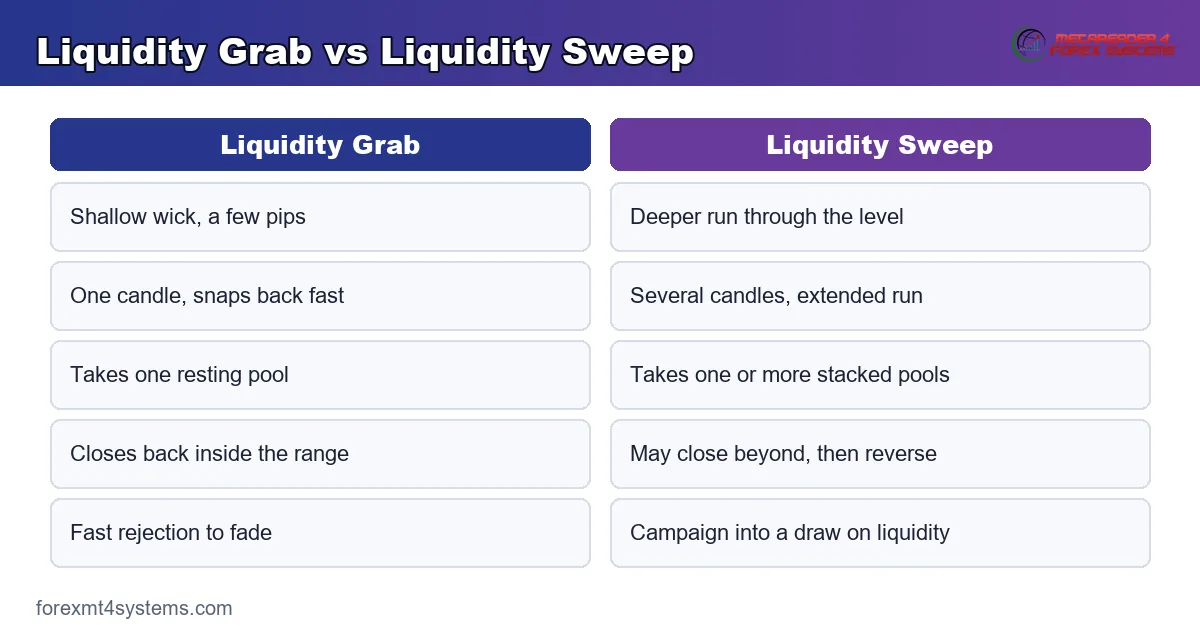
| Feature | Liquidity Grab | Liquidity Sweep |
|---|---|---|
| Penetration | Shallow wick, a few pips | Deeper run through the level |
| Duration | One candle, snaps back fast | Several candles, extended run |
| Levels taken | Usually one pool | One or more stacked pools |
| Body close | Closes back inside | May close beyond, then reverse |
| Typical read | Fast rejection signal | Campaign into a draw on liquidity |
Read the frame left to right. First, the equal lows sit as an obvious magnet below the range. Then the raid candle spears them, grabs the resting sell stops, and rejects inside the same five minutes. Notice how little ground the wick covers. A grab is precise, not violent.
What Counts as a Liquidity Grab
A liquidity grab is the surgical version of a stop run. Price wicks just past a known level, triggers the orders resting there, and reverses almost immediately. The move rarely closes a full body beyond the level. Instead, the candle leaves a long wick and a body back inside the range.
Two details keep the label honest. First, the level must be real: relative equal highs, a prior session high, or the previous day high. Second, the rejection must be fast. A genuine grab snaps back within one or two candles, because the algorithm only needed those resting stops as fuel.
Think about whose orders sit there. Above equal highs rest a cluster of breakout buy orders plus the protective stops of early sellers. So the grab detonates that pool, fills larger sell orders against the crowd, and turns. Hence the speed: once the fuel is gone, price has no reason to stay elevated.
Where Grabs Appear Most
Grabs favor obvious, clean levels. Relative equal highs and equal lows are prime targets, because retail eyes see them and place orders around them. Session highs and lows attract the same crowd. Also, the previous day high and low act as magnets, since many traders anchor their bias to yesterday’s extremes.
Timeframe matters too. Most grabs read cleanest on the five-minute and fifteen-minute charts, where a single wick stands out. On the one-hour chart the same event may look like a small upper shadow. So drop down to see the raid, then step back up to judge its context.
Why the Snap-Back Is So Fast
Speed is the grab’s signature. The algorithm only needed the resting orders as fuel, and once filled, it has no reason to hold price beyond the level. So the candle closes back inside almost at once. Traders who wait for a close, rather than reacting to the wick, sidestep the fake and read the rejection cleanly.
What Makes a Liquidity Sweep Different
A liquidity sweep is the same idea at a larger scale. Rather than nipping one level, price runs through a stretch of liquidity, often several pools stacked in a row. The move can take four or five candles and displace with real conviction before it reverses.
Scale changes the read. A sweep frequently targets a specific draw on liquidity, such as the previous day low or a cluster of equal lows built over hours. Then, once that objective is met, the market shifts and delivers the reversal you were waiting for. The concept graphic below contrasts the shallow grab with the deeper sweep.
Why Sweeps Run Deeper
Depth has a purpose. Large participants need size filled, and one small pool rarely holds enough resting orders. So the algorithm runs a stretch of stacked pools to gather the liquidity it needs. Each broken low or high adds fresh stops to the fuel, which is why a sweep can accelerate through several levels before it stalls.
Displacement usually accompanies the deeper run. The candles that complete a sweep tend to carry large bodies and close beyond the levels they take. Then, at the objective, momentum flips hard. That combination of a deep run plus a sharp shift separates a true sweep from a level that simply gave way to a trend.
Use this quick routine to classify any raid in real time.
- First, mark the level being tested and name it: equal highs, session high, or previous day high or low.
- Then measure the penetration in pips against the average candle range on that timeframe.
- Next, count the candles spent beyond the level before the reversal begins.
- Also check for displacement: a grab rejects without it, while a sweep often shifts structure on the way out.
- Finally, confirm whether one pool or several stacked pools were taken.
Score a shallow, single-candle, single-pool event as a grab. Score a deep, multi-candle, multi-pool run as a sweep. The buy-side and sell-side liquidity map tells you which pools the algorithm is likely hunting next.
Where Each Raid Sits in the SMC Workflow
Neither event trades in isolation. Both sit inside a top-down routine that starts on the higher timeframe and finishes on a small execution chart. Get the order right and these raids become entries rather than surprises.
Begin with context. On the four-hour or one-hour chart, mark the range and decide the likely draw on liquidity. Our guide to the draw on liquidity shows how to pick that target with discipline. Then identify the point of interest the market must reach to get there, usually a pool of equal highs and equal lows resting at a range edge.
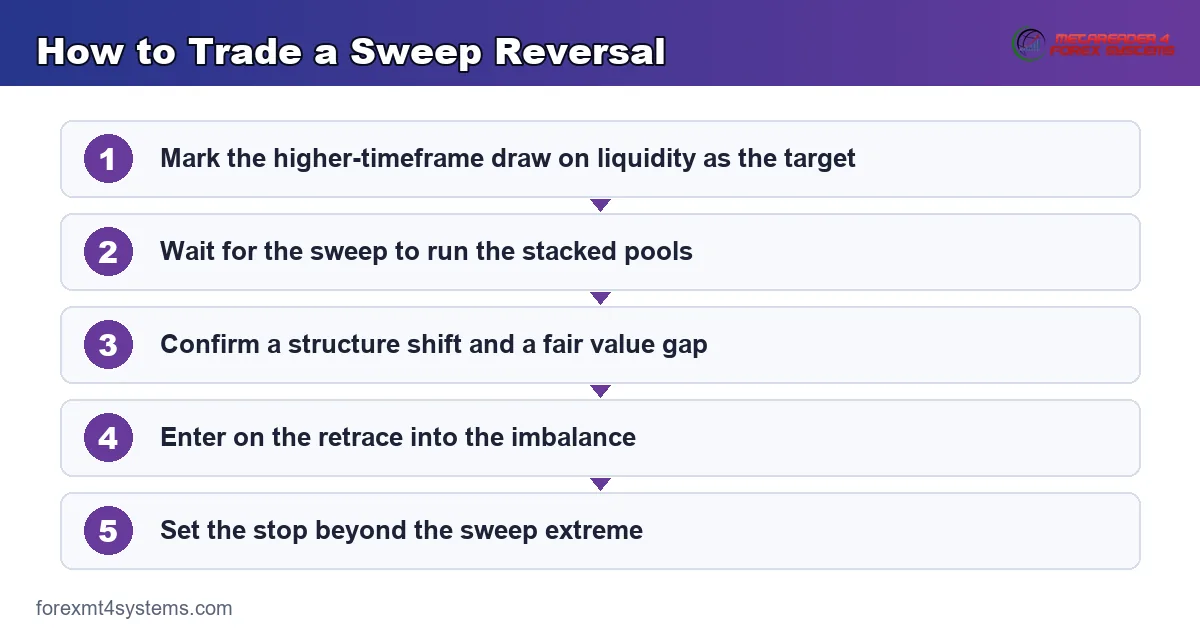
Drop to the trigger next. On the five-minute or fifteen-minute chart, wait for the grab or sweep to hit that pool. A grab gives a fast rejection you can fade quickly. Meanwhile, a sweep asks for a structure shift and a fair value gap before you commit. Then enter on the retrace into the imbalance, with your stop beyond the raid extreme.
Session timing filters the noise. Indeed, the cleanest raids land in the London kill zone, roughly 2:00 to 5:00 a.m. New York time, and the New York morning, 8:30 to 11:00 a.m. You can confirm those windows against live forex market hours before you sit down. Raids printed in the dead Asian hours reverse far less reliably, so stamp every setup with its session first.
Filter by Freshness and Direction
One more filter separates good raids from noise. Ask whether the raid runs into a fresh pool or into old, already-tapped liquidity. Fresh pools that formed during the current session carry the most fuel. Meanwhile, a level that price has already visited twice offers thinner reward, because much of the resting order flow is gone. So prioritize raids that hunt untouched highs and lows over ones that revisit stale ground.
Direction discipline finishes the routine. A grab against the higher-timeframe trend deserves caution, since the dominant flow may simply absorb your fade. Instead, favor raids that align the reversal with the four-hour bias. When the small-frame turn and the large-frame draw point the same way, the setup earns full risk rather than a scout position.
Worked Example: Fading a Grab on EURUSD
Start with the grab from the opening chart and trade it fully. EURUSD builds relative equal lows at 1.1375 across the late Asian range. Sellers keep failing at the same floor, so a pool of sell stops and breakout orders stacks just below it. The level is clean, named, and obvious.
At 3:10 a.m. New York time, inside the London kill zone, the raid fires. One five-minute candle spears down to 1.1368, seven pips through the lows, and closes back at 1.1377. That is the grab: shallow penetration, a single candle, one pool taken, a fast rejection inside the range.
Then the entry assembles. A long waits on the retrace toward the 1.1373 to 1.1376 zone, just above the swept lows. The stop sits below the 1.1368 wick, roughly seven pips of risk. Meanwhile, the first target rests at the London high near 1.1402, with the previous day high beyond it. Notice how tight the risk stays, because the grab defined the invalidation for you.
The follow-through confirmed the read. Price tapped 1.1375 once more, rejected, and climbed to 1.1401 over the next hour without ever closing a body back below the lows. That is the grab working as designed: a quick raid, a clean rejection, and a controlled move into the opposing pool.
Whose Orders Each Raid Consumes
Both events map to real orders, and naming them sharpens your read. Above a high sit breakout buyers plus the stops of early sellers. Below a low rest breakout sellers plus the stops of early buyers. So every raid is a transfer: the crowd on the wrong side funds the reversal.
The difference is quantity. A grab needs one pool, so it takes one and turns. A sweep needs more, so it chains several pools and only reverses once the tank is full. Hence the depth of a raid hints at how much size the larger player wanted, and how far the reversal may travel afterward.
This order-based view also explains the retest. Trapped traders anchor on their entry and hope for breakeven. So the pullback into a broken level meets a wall of relieved participants who exit right there. Thus retests reject cleanly when the raid was real, which is exactly why patient entries on the retrace beat chasing the initial rejection candle.
Worked Example: A Sell-Side Sweep on GBPUSD
Now flip the direction and step up a timeframe. GBPUSD drifts lower through the Asian session on the fifteen-minute chart. Three lows stack close together: 1.3367, then 1.3365, then the Asian low at 1.3361. Each one rests a small pool of sell stops beneath the market, and together they form an obvious target.
At 8:35 a.m. New York time the raid begins. Price does not merely wick the first low; it runs. Four bearish candles push through all three pools in sequence and reach 1.3361, closing bodies below 1.3365 on the way. That extended run through stacked levels is a sell-side liquidity sweep, not a grab. The chart below shows the three pools, the run, and the reversal that follows.
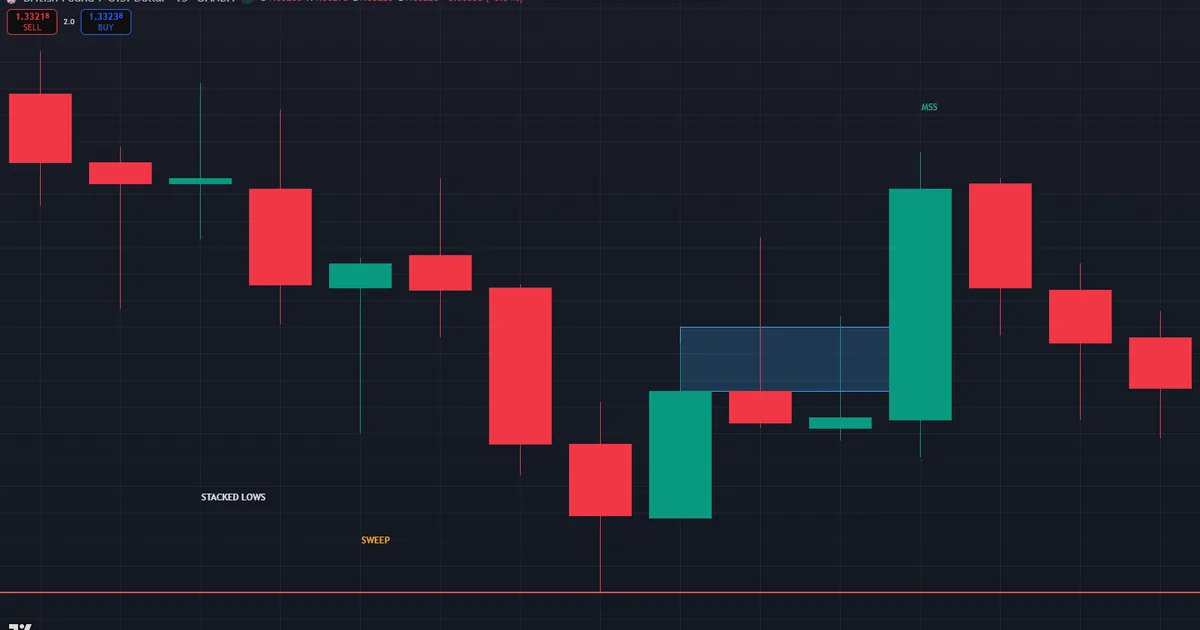
Then the market turns. A strong bullish candle closes back above 1.33744, shifting structure to the upside, and leaves a fair value gap between 1.33686 and 1.33710. That displacement is your confirmation. The sweep met its objective, and the algorithm reversed.
Now the trade assembles step by step. Entry waits at the 1.33686 to 1.33710 imbalance on the pullback. The stop tucks under the 1.3361 sweep low, roughly 12 pips of risk. Meanwhile, the first target sits at the session high near 1.33776, with the previous day high beyond it. Notice the discipline: no long existed until the sweep, the shift, and the retest lined up in order.
Download the complete indicator database
Put these concepts on your charts. One email unlocks the full library of 1,380+ indicators with compiled MT4 and MT5 files, plus my TradingView scripts. No paywall, no spam, unsubscribe any time.
Get free access to my indicator database
One email unlocks 1,380+ free MT4, MT5 and TradingView indicators — the complete library. No single-tool download; you get the whole database.
Common Mistakes and How to Fix Them
The grab-versus-sweep confusion produces the same errors over and over. The graphic below gathers the most common ones, and each correction follows beneath it.
Fading every wick as a grab
A wick beyond a level is not automatically a grab. So confirm the level matters and the rejection is fast before you fade it. Random wicks in mid-range chop trap fast fingers.
Shorting a sweep too early
A deep run can extend further than you expect. Instead of front-running it, wait for the structure shift and the fair value gap that mark the true reversal. Patience turns a guess into a plan.
Ignoring the draw on liquidity
Both raids aim somewhere. Skip that target and you will fade a grab that was actually the first leg of a sweep toward deeper pools. Always name the objective before you act.
Forgetting the session stamp
A raid in the dead Asian hours reverses far less often than one in a kill zone. Note the session on every setup, and demote raids that print in thin books.
Confusing size with strength
A violent candle is not proof of a reversal. What matters is what the move took and where it stalled. Grade the raid by the pools it cleared, not by how scary the candle looked.
Pre-Trade Checklist
Run this list before you act on any raid. It takes seconds and filters most bad trades.
- The level is named: equal highs or lows, session high or low, or previous day high or low.
- The penetration and candle count classify the event as a grab or a sweep.
- A clear draw on liquidity sits beyond the raid as the objective.
- The higher timeframe bias agrees with the reversal direction.
- Displacement or a fast rejection confirms the turn, not just a wick.
- An active session, London or New York, produced the raid.
- Entry, stop, and target are mapped before the retest arrives.
Failure Walkthrough: When a Grab Never Snaps Back
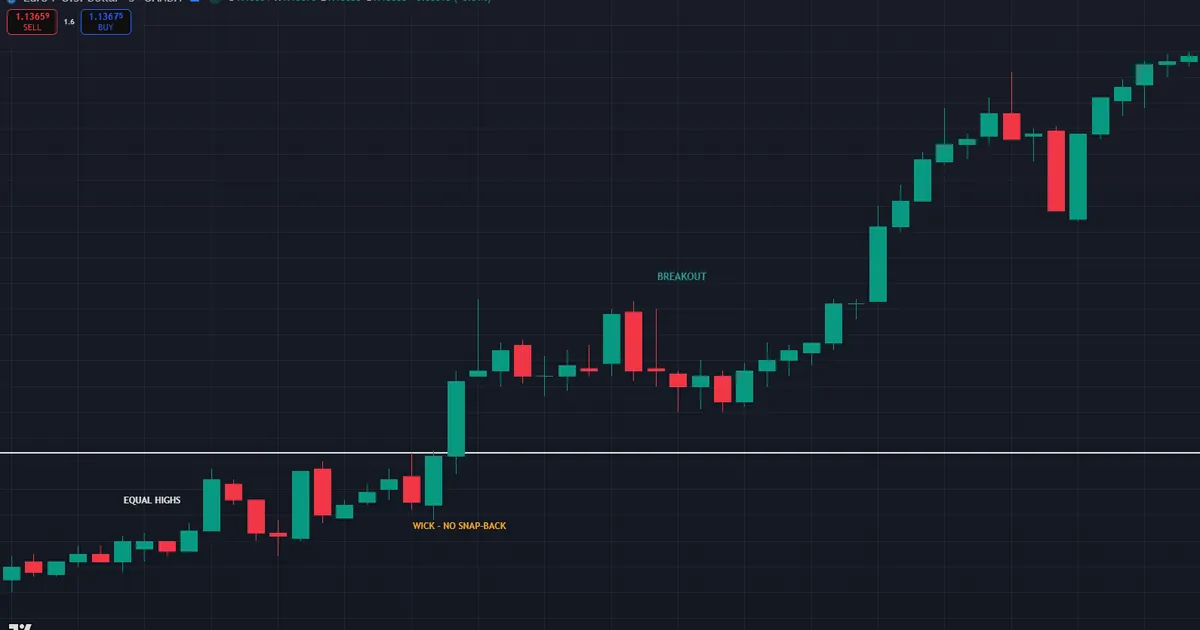
Now study the failure case, because it teaches more than the wins. EURUSD trades up to relative equal highs at 1.14144 on the five-minute chart. A candle wicks to 1.14180 and pulls back, so a trader marks it as a grab and shorts the retest, expecting a fast rejection lower.
Then the snap-back never comes. Instead, price consolidates just under the highs for several candles, then a strong body closes at 1.14356, well beyond the level. That was never a grab. It was genuine expansion, and the equal highs were a springboard rather than a ceiling. The chart below shows the wick, the failed short, and the breakout that ran the stops above. This is exactly the trap that stop hunting sets for eager reversal traders.
The Invalidation Rule
The invalidation rule keeps the damage small. Once a candle body closes and holds beyond the level you faded, the reversal idea is void. So exit immediately, without averaging and without hope. A grab that fails to snap back within two candles is telling you the real move is the other way.
Afterwards, log three facts in your trade journal: the penetration depth, the candle count beyond the level, and whether displacement appeared. Failed fades cluster around shallow reads and missing displacement, and your own records will surface that pattern faster than any course.
There is a second failure worth knowing. Sometimes a genuine sweep reverses, but the retrace never returns to your imbalance. Price shifts structure, then runs to target without a clean pullback. So you watch the whole move from the sidelines. That miss is not a loss, and chasing it usually is. Instead, mark the level, note that the entry never triggered, and wait for the next qualified raid rather than jumping in late.
Related Concepts to Study Next
A few neighboring ideas complete this map. The full guide to liquidity sweep trading expands the sweep side into a complete entry model with more examples. Meanwhile, the buy-side and sell-side framework you met earlier explains which pools the algorithm hunts and why. Stack the three ideas, then let the smart money indicators mark pools and shifts automatically while you focus on execution.
Practice cements the difference faster than theory. So replay one London open on a major pair and label every raid aloud as a grab or a sweep. Then grade each call against what followed: did the shallow wick snap back, or did the deep run reverse at a named draw on liquidity. Twenty minutes of that drill teaches the eye more than another hour of reading. Over a week, the distinction stops feeling subtle and starts feeling obvious, because you will have watched dozens of both play out in real time.
FAQ
Is a liquidity grab the same as a stop hunt?
Roughly, yes. A grab is a small, fast stop hunt that targets one pool and rejects immediately. The wider term stop hunt covers any engineered run on resting orders, whether shallow like a grab or deep like a sweep.
Which is more reliable to trade, a grab or a sweep?
Neither is inherently better. A grab offers a fast, tight entry when the level matters. Meanwhile, a sweep with displacement gives more confirmation but a wider stop. So match the event to your timeframe and risk tolerance.
Can a grab turn into a sweep?
Yes. What starts as a shallow wick can extend into a multi-pool run if the first pool was not the real objective. So always identify the draw on liquidity before you fade the first poke.
Do I need displacement to trade a sweep?
It helps a great deal. A sweep followed by a structure shift and a fair value gap confirms the reversal far better than the raw run alone. Without displacement, a deep run can simply keep going.
What timeframe shows grabs and sweeps best?
Execution charts like the five-minute and fifteen-minute reveal the raid clearly, while the one-hour or four-hour chart supplies the pool being targeted. Read both together so a small-frame raid always has higher-timeframe context.
Should I trade every grab or sweep I spot?
No. Most practitioners require a named draw on liquidity, higher-timeframe alignment, and confirmation before acting. Even then, position sizing and stops matter more than the label. Results are not guaranteed; past performance is not indicative of future results.
External references
- For background on this concept, see Stop-Limit Order at Investopedia.
- For broader market context, see Liquidity at Corporate Finance Institute.

About the author
Written by Dominic Walsh, a Forex trader and MT4/MT5 indicator, Expert Advisor and script developer. Every tool on forexmt4systems.com is tested on live charts before release and ships with ready-to-use compiled MT4 (.ex4) and MT5 (.ex5) files. Learn more about the trader and developer behind this site.
How we build, test and correct every tool: Editorial & Testing Policy. Trading carries risk; see the disclaimer.