
Swing trading vs day trading forex is not a contest between a better method and a worse one. Both read the same market; they simply read it at different speeds and pay different bills.
This guide sets the two side by side on cost, screen time and exposure. No verdict appears at the end, because the right answer depends on your week rather than on the charts.
Swing Trading vs Day Trading Forex in One Sentence
A day trader opens and closes inside the same session. A swing trader holds across sessions, usually for several days.
Holding time creates every other difference. Costs, screen time, stop distance and overnight exposure all follow from that single choice.
Neither approach owns an advantage in the market itself. Price does not know how long you intend to stay.
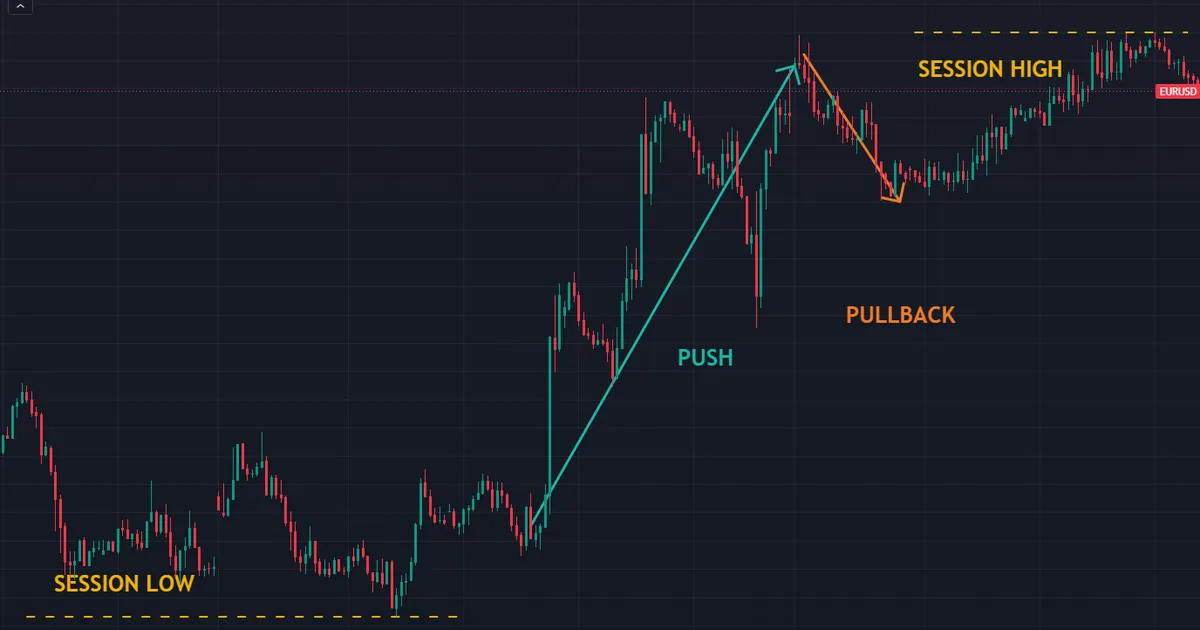
The chart above shows EURUSD on hourly bars. Intraday traders make their decisions at this size, where each session produces several distinct moves.
What a Day Trader Actually Does
Positions open and close within hours. Nothing carries into the next session, so the overnight problem never arises.
Stops sit close, often within a fraction of the daily range. That tightness allows a larger position for the same money at stake.
Frequency rises accordingly. Several trades per day becomes normal, and each one pays the spread.
What a Swing Trader Actually Does
Positions stay open across sessions, typically for two days to two weeks. Direction comes from the daily chart, and timing comes from the four-hour chart.
Stops sit beyond the swing that defines the idea. Wider distance means a smaller position for the same money at stake.
Frequency drops sharply. A few trades per month per pair becomes normal, and financing replaces spread as the recurring cost.
The Same Market, Shown Twice
Both charts in this guide show EURUSD over one window. Only the bar size changes between them, and the market underneath stays identical.
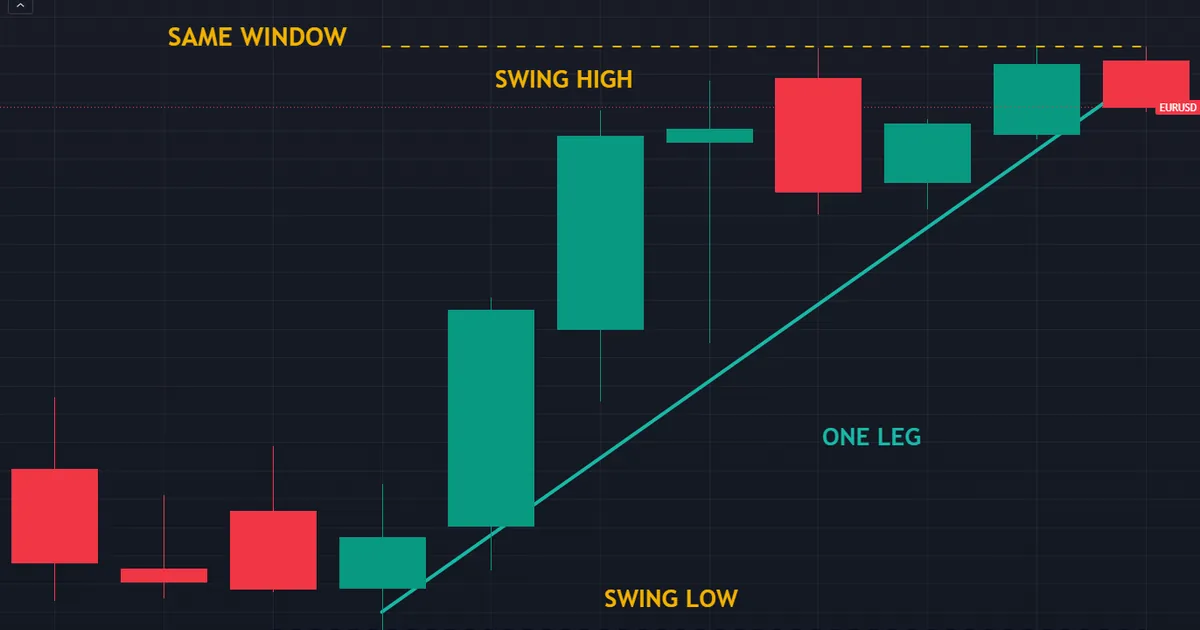
What the hourly chart presents as a run of separate pushes and pullbacks, the daily chart presents as one leg. Neither view lies, and both describe the same price series.
Why the Same Chart Produces Opposite Reads
A downtrend on hourly bars can sit inside a rising daily structure. Two traders describing that market will disagree, and both can be right.
So the reference chart belongs in every plan you write. A trade idea without a stated bar size cannot be reviewed properly afterwards.
Our guide to multi-timeframe analysis covers how to pair two charts without letting one overrule the other.
What Each View Hides
The daily chart hides the journey. A calm-looking candle can contain a move that would have removed a tight intraday stop three times over.
The hourly chart hides the destination. A clean intraday trend can run straight into a daily level that ends it within the hour.
Use both, then, and give each one a job. Whichever style you pick, the higher chart supplies context and the lower chart supplies timing.
How the Two Differ, Point by Point
Six dimensions cover almost every practical difference. Work through them before choosing.
- Holding period. Hours on one side, days to weeks on the other.
- Trade frequency. Several per day against a few per month per pair.
- Stop distance. Tight and intraday against wide and structural.
- Dominant cost. Spread and commission against overnight financing.
- Overnight exposure. None at all against nightly, including weekends.
- Screen time. Continuous during a session against short daily checks.
Notice that none of those rows names an edge. Because frequency changes the cost burden rather than the method’s quality, no dimension here makes one style better.
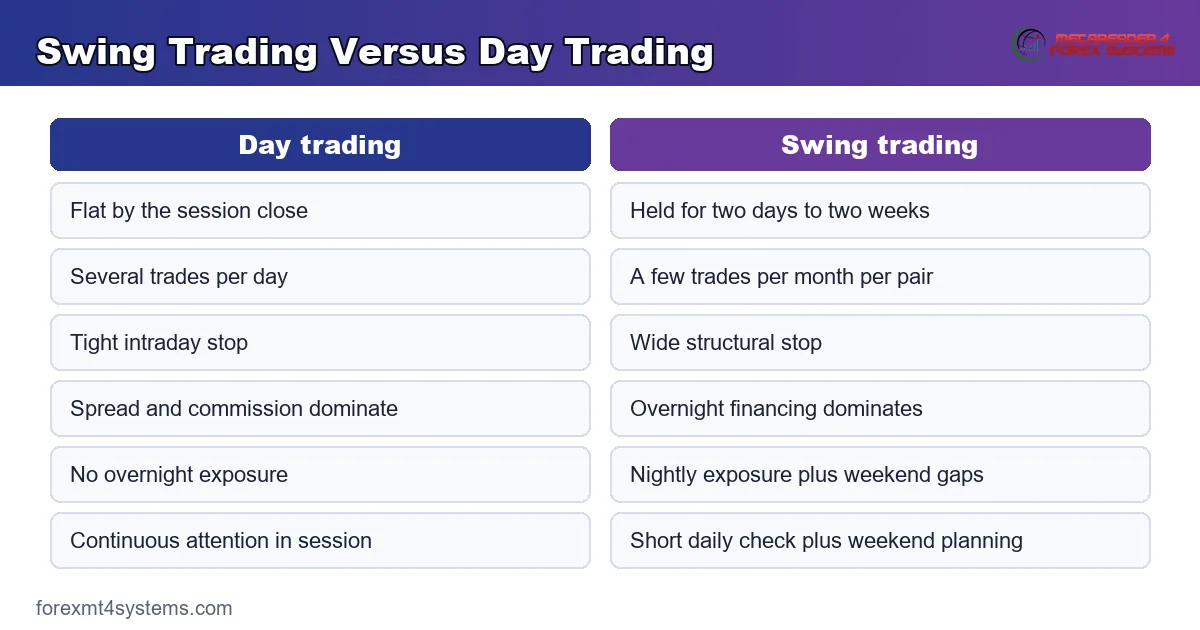
Read the list as a set of trade-offs. Each row you find comfortable pushes you toward one side, and most traders discover the answer in their calendar rather than in their charts.
Where Account Rules Change the Answer
Funded and evaluation programmes often restrict holding behaviour. Some forbid carrying positions over the weekend, and a few forbid overnight holds entirely.
Those rules effectively remove one style from the table. A trader on such a programme has to work inside the session whether they prefer it or not.
Read the rulebook before choosing a horizon. Our summary of prop firm rules covers where these limits usually appear.
What Stays the Same at Both Speeds
Speed changes plenty, and it leaves the fundamentals untouched. Four things behave identically whichever horizon you pick.
Structure Still Sets Direction
Higher highs and higher lows describe an uptrend on any bar size. The reference chart shifts, and the definition does not.
So the reading skill transfers cleanly. A trader who can mark swing points on hourly bars can mark them on daily bars the same afternoon.
Every Trade Still Needs an Invalidation
A price that proves the idea wrong belongs in both plans. Only the distance changes between the two styles.
Without that level, a fast trade turns into a slow one by accident. That single failure causes more damage than any style choice ever does.
Sizing Still Comes From the Stop
Fixed money at stake divided by stop distance produces the position. Wider stops give smaller positions, and tighter stops give larger ones.
The arithmetic never changes. Traders who feel a wide stop as extra danger have usually skipped this step rather than misjudged the style.
Records Still Decide What You Learn
Both approaches need the same fields logged. Entry reason, reference chart, invalidation, size and exit tell you what happened months later.
Sample size differs sharply, though. Fifty trades arrive in a fortnight at one speed and in a year at the other.
One Setup, Treated Two Ways
Take a single pullback inside a rising market. Both styles would notice it, and they would handle it very differently.
The Intraday Treatment
An intraday trader waits for the retracement to stall on hourly bars. The stop then sits just beyond that hourly low.
Distance stays short, so position size rises. The objective usually sits at the next intraday level rather than at the top of the daily leg.
Everything resolves inside the session. Whatever happens overnight belongs to somebody else.
The Swing Treatment
A swing trader rests an order inside the same pullback zone. The stop sits beyond the daily swing low, which sits considerably further away.
Position size drops in proportion. The objective sits at the prior daily extreme, and reaching it may take a week.
Several intraday shake-outs happen along the way. The swing trader either sleeps through them or watches them and does nothing.
Same Chart, Different Bill
The intraday version pays spread on several attempts at the same idea. The swing version pays once and then pays financing nightly.
Neither treatment extracts more from the market by design. They simply convert the same move into different exposure, different cost and different demands on your day.
The Cost Profiles Point in Opposite Directions
Both styles pay real money to the broker. They simply pay it through different channels.
Day Trading Pays Per Trade
Spread and commission apply on every entry and exit. Multiply that by several trades a day, five days a week, and the total grows quickly.
Short targets make the bill hurt more. A thirty pip objective surrenders a bigger share to a two pip spread than a three hundred pip objective does.
Commission behaves the same way where a broker charges it. Both items scale directly with how often you press the button.
Swing Trading Pays Per Night
One entry and one exit spread the transaction cost thinly. Financing then applies every night the position stays open.
That nightly adjustment can land on either side of zero. Holding the higher-yielding currency can credit your account, while the opposite direction charges it.
Rates vary by broker and change when central banks move. Most brokers also apply roughly a triple charge on one midweek day, so a two-week hold pays more nights than it spent.
Which Bill Ends Up Larger
No general answer exists, and anyone offering one is guessing. The totals depend on your frequency, your pairs, your holding period and your broker.
Estimate both for your own plan instead. Our swap calculator handles the overnight side, and your trade count handles the other.
Run the numbers before switching styles. Traders often move to escape one cost and land squarely in the other.
Exposure: the Overnight Question
This difference has no middle ground. One style carries risk while you sleep and the other does not.
What the Day Trader Avoids
Flat at the session close means flat through every overnight surprise. Central bank statements, geopolitical news and weekend gaps all pass by harmlessly.
That certainty carries a price. Moves that develop overnight happen without you, and continuation the next morning arrives at a worse entry.
What the Swing Trader Accepts
An open position rides through everything. Most nights pass quietly, and the exposure barely registers.
Weekends concentrate the danger. Markets close on Friday evening and reopen on Sunday, so anything in between arrives as a single jump.
A stop cannot fill inside that jump, because no price trades between the two points. Our guide to the weekend gap in forex covers how traders size around it.
How Traders Manage the Difference
Some swing traders trim on Friday afternoon. Half the position across the weekend halves the exposure to the jump.
Others accept it fully and size accordingly. They set every position so that a jump of several average daily ranges stays survivable.
Day traders face the mirror problem. Closing at the session end removes the gap and also removes any part of the move that happens overnight.
Margin Behaves Differently Too
An intraday position releases its margin the same afternoon. A multi-day position keeps that margin tied up for the whole hold.
So the number of simultaneous ideas shrinks at the slower speed. Three open swing trades can occupy more margin than a dozen intraday ones ever did.
Plan the book rather than each trade alone. Running out of free margin mid-week forces exits that your chart never asked for.
Download the complete indicator database
Put these concepts on your charts. One email unlocks the full library of 1,380+ indicators with compiled MT4 and MT5 files, plus my TradingView scripts. No paywall, no spam, unsubscribe any time.
Get free access to my indicator database
One email unlocks 1,380+ free MT4, MT5 and TradingView indicators — the complete library. No single-tool download; you get the whole database.
Lifestyle, Screen Time and Temperament
Most style decisions get made here rather than on cost grounds. Be honest about your week before choosing.
When Your Hours Actually Allow Trading
Day trading demands presence during a specific session. If your working day covers the London and New York overlap, that requirement decides the question for you.
Swing trading spreads the workload differently. A weekend planning block and a short nightly pass replace the continuous attention.
Our tool for forex market hours shows which sessions your available time actually overlaps.
The Psychological Load Differs in Kind
Day trading concentrates pressure into short bursts. Decisions arrive fast, and mistakes compound within the same afternoon.
Swing trading stretches the pressure thin. Nothing happens for days, then a position moves against you overnight and you find out at breakfast.
Neither load is lighter. One arrives in concentrated bursts and the other arrives as a slow background hum.
News and Scheduled Releases Land Differently
Day traders meet releases head on. Spreads widen, slippage rises, and a position opened minutes earlier can fill its stop at an unexpected price.
Swing traders meet them mid-hold. A release inside your holding window can erase a structure you spent a week building, and you may find out afterwards.
Both problems have the same first step. Check the calendar before entering, then decide deliberately whether to be in the market for that event.
Neither style removes event risk. One faces it awake and the other faces it asleep.
Feedback Speed Cuts Both Ways
Faster styles produce data quickly. Fifty intraday trades might take a fortnight, so a flawed rule shows up early.
Slower styles hide their flaws longer. Fifty swing trades might take a year, and any conclusion drawn from ten of them says more about the period than the method.
Common Mistakes When Switching Between Them
Most damage happens during the change rather than inside either style. Each mistake below has a straightforward fix.
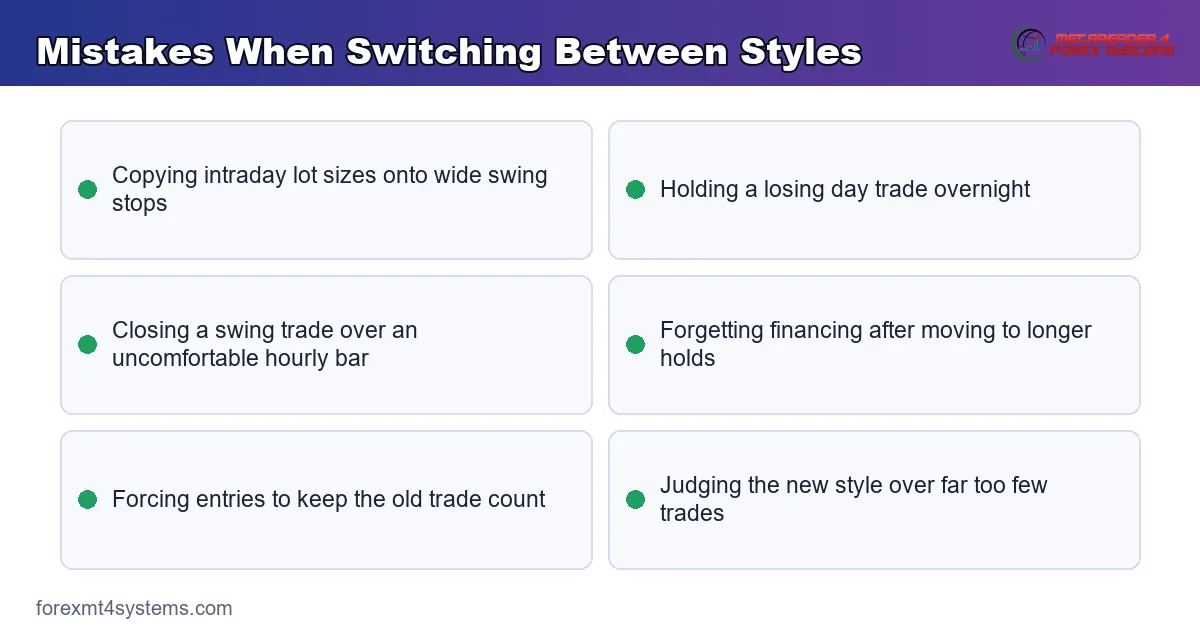
Carrying Intraday Position Sizes Into Swing Stops
Copying a familiar lot size onto a stop three times wider multiplies the money at stake. Divide fixed risk by the actual stop distance every single time.
Holding a Losing Day Trade Overnight
A day trade kept open because it went wrong becomes an accidental swing position with no invalidation level. Name each trade at entry and never rename it afterwards.
Closing a Swing Trade at Lunchtime
Style drift runs the other way too. Judge a multi-day position against its daily invalidation, not against an uncomfortable hourly bar.
Ignoring Financing After Switching Up
Day traders rarely think about swap, because they never pay it. Twelve nights on a modest objective removes a noticeable slice of it.
Expecting the Same Trade Count
Traders moving from intraday to swing often force entries to stay busy. Quiet weeks belong to the slower style, so plan what to do with them.
Judging the New Style Too Early
Ten swing trades might span half a year. Set a sample size before you start, then hold your opinion until you reach it.
Side-by-Side Quick Reference
Keep this table beside you while deciding. Each row states a difference rather than a ranking.
| Dimension | Day trading | Swing trading |
|---|---|---|
| Holding period | Minutes to hours, flat by the close | Two days to two weeks |
| Decision chart | Five-minute to hourly bars | Four-hour and daily bars |
| Trade frequency | Several per day | A few per month per pair |
| Stop distance | Tight, intraday reference | Wide, structural reference |
| Position size | Larger, from the tight stop | Smaller, from the wide stop |
| Dominant cost | Spread and commission per trade | Financing per night held |
| Overnight risk | None | Nightly, including weekend gaps |
| Screen time | Continuous during a session | Short daily check plus weekend planning |
| Feedback speed | Fast, a large sample in weeks | Slow, a large sample in months |
Notice what the table refuses to include. No row compares results, because that figure depends on the trader rather than on the style.
Where Each Style Goes Wrong
Both approaches fail in characteristic ways. Knowing the pattern in advance beats discovering it live.
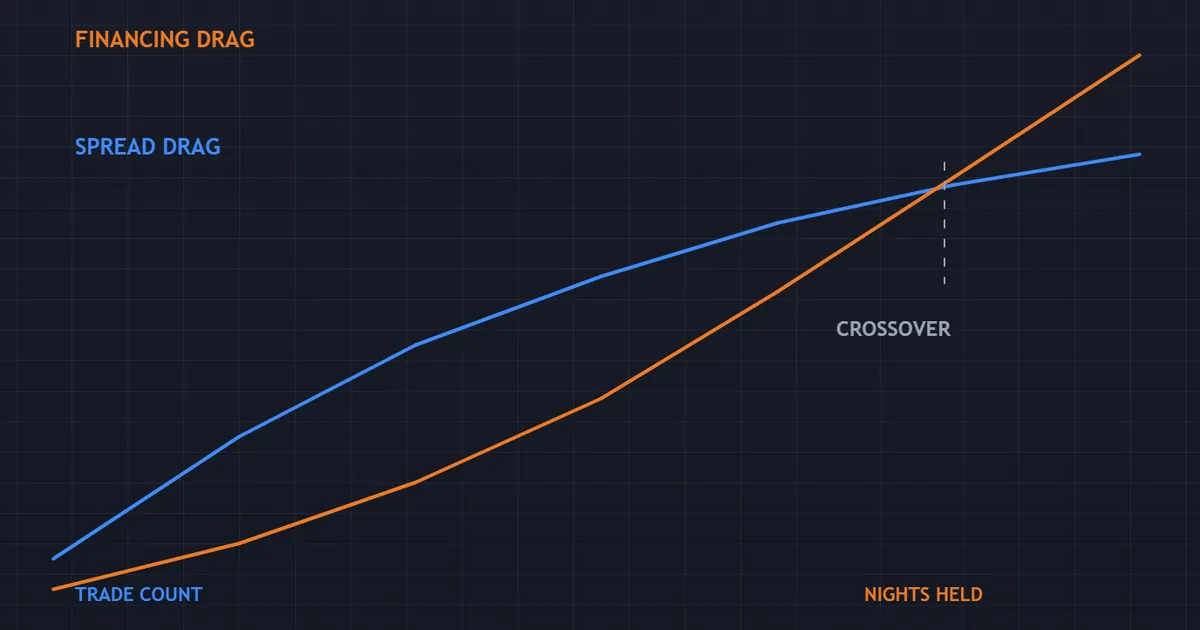
Frequency Turns Into Cost Drag
Trade count multiplies the spread bill. A faster style that trades twice as often needs its average result to cover twice the transaction cost.
Small targets make that arithmetic harsh. So intraday traders end up needing a tighter process simply to stay level with their own charges.
Patience Turns Into Financing Drag
Long holds accumulate nightly adjustments. A position drifting sideways for two weeks pays for every one of those nights while delivering nothing.
The remedy sits in the exit rules, not in the entries. Some traders close anything that has gone nowhere after a set number of bars.
Switching Styles After a Bad Run
A losing stretch makes the other horizon look attractive. That impulse arrives at exactly the wrong moment.
Changing style resets your sample to zero. Whatever the old record was starting to teach you disappears with it.
So set the switching rule while calm. Decide in advance what evidence would justify a change, then require that evidence before acting.
Both Styles Punish an Unstated Plan
Whichever speed you pick, an unwritten rule set produces an unreadable record. Log the style, the reference chart, the invalidation and the size for every trade.
Our trade journal keeps those fields together, and separate tabs stop the two styles blurring into one another.
Related Guides
Definitions come first if either style still feels unclear. Our explainer on swing trading in forex covers the holding period and the charts involved.
Execution follows next. Our walkthrough on how to swing trade forex runs a real resting order from placement through to management.
A slower horizon exists beyond both. Our guide to position trading covers holds measured in months, where financing becomes the dominant cost of all.
FAQ
Which is better, swing trading vs day trading forex?
Neither one wins in general, because they trade the same market at different speeds. Frequency changes the cost burden, the screen time and the psychological load, so the better choice depends entirely on your week.
Is swing trading cheaper than day trading?
It pays less in spread and more in financing. A few trades a month generate a fraction of the transaction charges, though every night held adds or subtracts an interest adjustment.
Which style needs a bigger account?
Swing trading usually does, because wider stops force smaller positions and tie up margin for days. Below a certain balance the position size a wide stop implies falls under the minimum lot a broker accepts.
Can I do both at the same time?
Yes, provided you run them as separate books with separate records. Mixing them in one log hides which approach covers its costs, and it invites style drift in both directions.
Can I swing trade on hourly bars instead of daily ones?
You can, though the legs shrink and the costs stop working in your favour. A shorter objective surrenders a larger share to the spread, so most traders keep the daily chart for direction once holds run past a session.
Does swing trading suit beginners better?
It removes the time pressure, which helps, and it slows the feedback, which does not. A beginner learns faster from frequent small trades, yet also loses faster when costs pile up on a rushed process.
Do the two styles use different indicators?
Not really, because the same tools apply on any bar size. What changes is the reference chart they run on, so a setting tuned for hourly bars usually needs revisiting on daily ones.
Which style handles news better?
Neither handles it better, and they meet it differently. Day traders face widening spreads and slippage in real time, while swing traders can be holding through a release and learn the outcome afterwards.
How do I decide between them?
Start with your calendar, not your charts. Check which sessions your available hours actually cover, decide whether overnight exposure keeps you awake, then estimate both cost profiles for your own plan before committing to either. Results are not guaranteed; past performance is not indicative of future results.
External references
- For background on this concept, see Day Trading at BabyPips Forexpedia.
- For broader market context, see Overnight Position at Investopedia.

About the author
Written by Dominic Walsh, a Forex trader and MT4/MT5 indicator, Expert Advisor and script developer. Every tool on forexmt4systems.com is tested on live charts before release and ships with ready-to-use compiled MT4 (.ex4) and MT5 (.ex5) files. Learn more about the trader and developer behind this site.
How we build, test and correct every tool: Editorial & Testing Policy. Trading carries risk; see the disclaimer.