
ICT weekly profiles are templates for how a trading week tends to unfold: which day sets the extreme, which day reverses, and where the week is likely to close relative to its open. Traders using them build a bias on Sunday and let the week’s shape confirm or invalidate it. This guide covers the main profiles, the day-of-week tendencies behind them, and an honest assessment of how much weight they deserve.
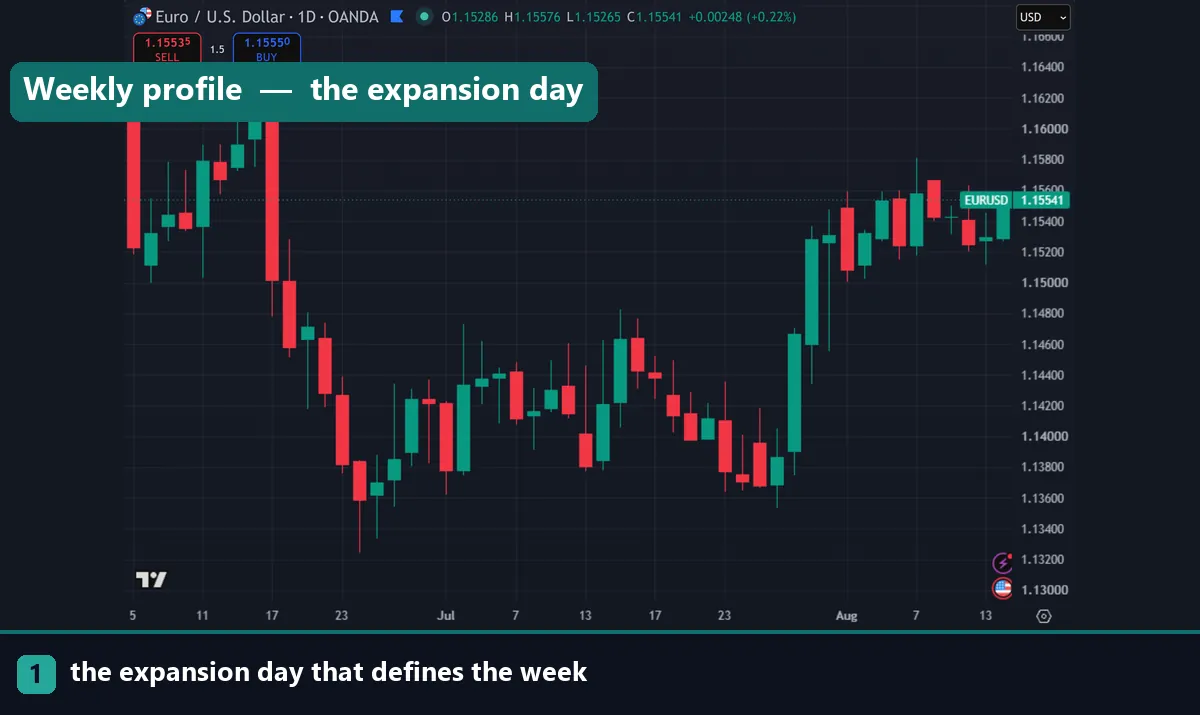
What ICT weekly profiles describe
The idea is that a week is not a random sequence of five days. Institutional flows follow a rhythm — positioning early, executing mid-week, squaring up before the close — and that rhythm leaves a repeatable shape on the chart.
A profile names that shape. Rather than predicting a price, it describes a sequence: where the week’s high or low is likely to form, and when the directional move is likely to run.
The framework comes from the ICT body of work, which builds on older observations about weekly and intraday cycles. Our ICT trading strategy guide covers the wider method.
The day-of-week tendencies
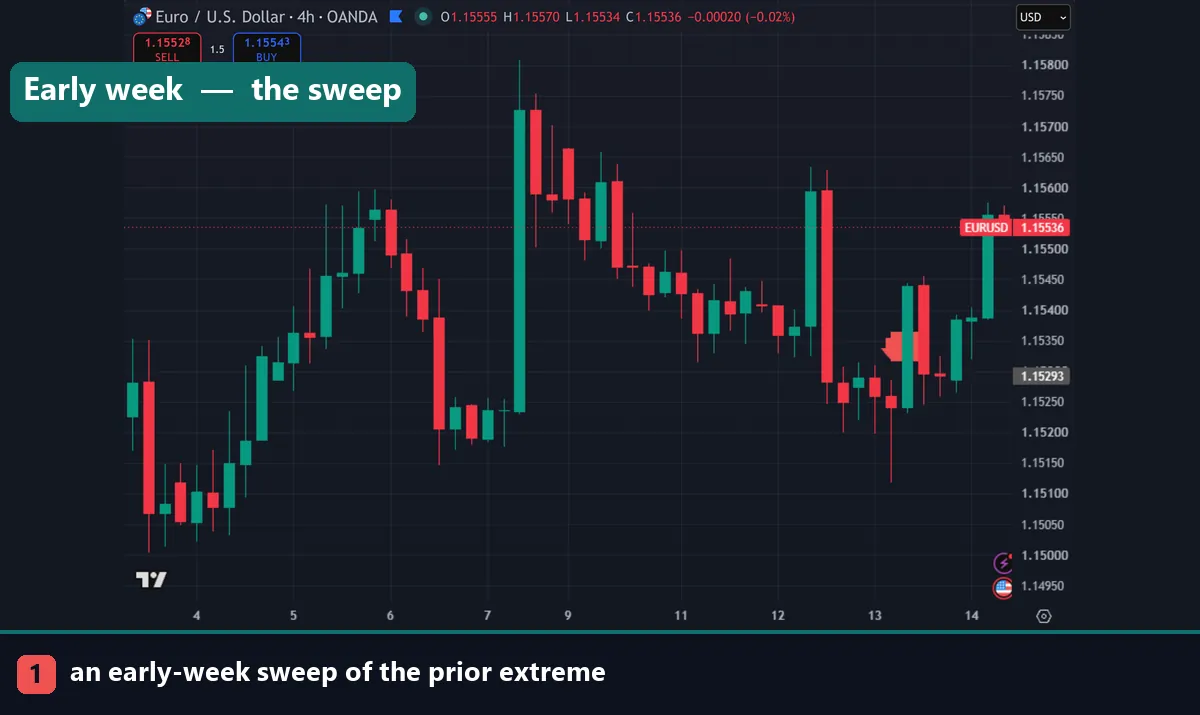
Underneath the profiles sits a simple claim about which days do what.
| Day | Typical role | What traders watch |
|---|---|---|
| Sunday / Monday | Range building, often the week’s low or high | Sunday gap, Monday range as a reference |
| Tuesday | The weekly extreme often forms | A reversal from Monday’s direction |
| Wednesday | Expansion in the week’s real direction | The largest directional move |
| Thursday | Continuation, or the reversal begins | Whether Wednesday’s move extends |
| Friday | Squaring up, retracement into the close | Profit-taking against the weekly move |
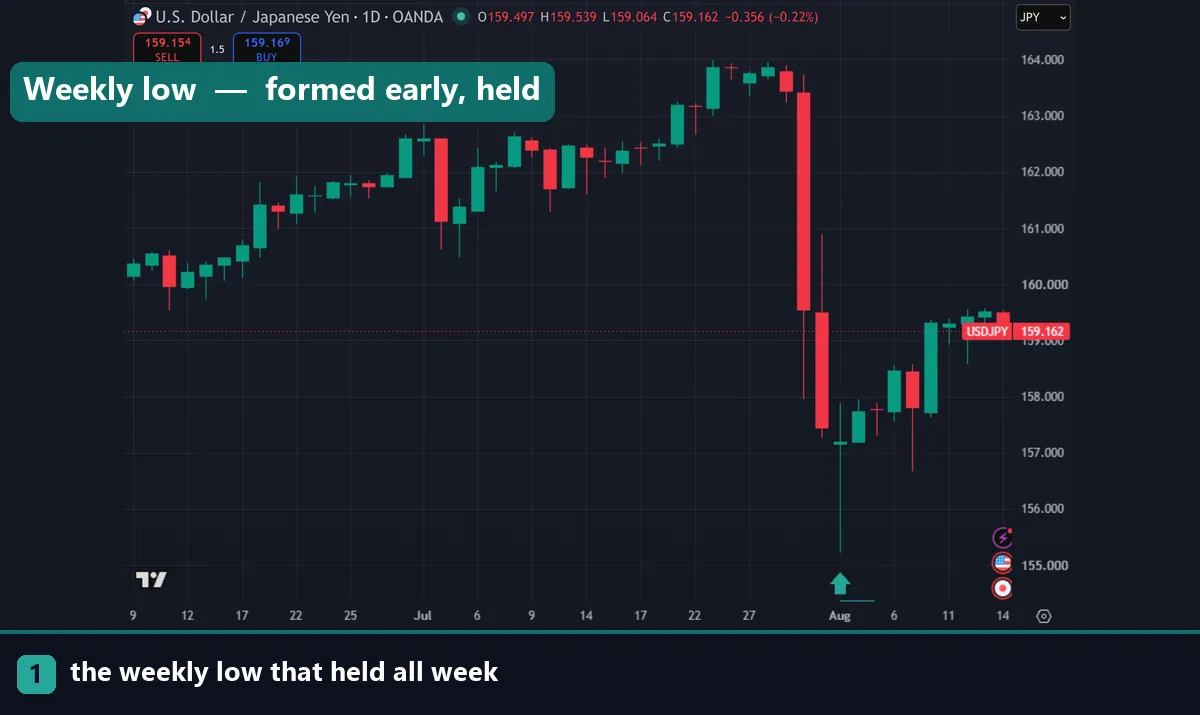
The most-cited element is that the weekly high or low frequently forms on Monday or Tuesday. If that holds, a trader who identifies it early has a reference point for the rest of the week.
The main profiles
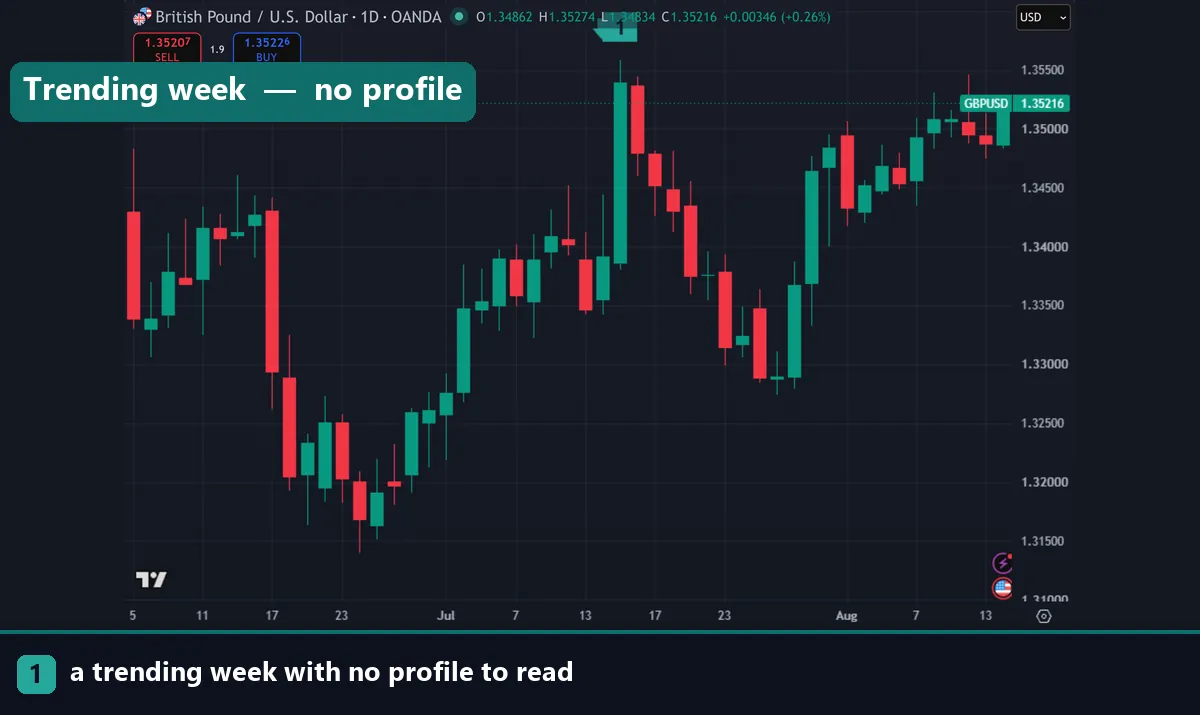
Three shapes cover most of what practitioners describe.
Classic expansion. Monday and Tuesday build a range, price sweeps one side of it, then Wednesday expands hard in the opposite direction and Thursday continues. This is the profile most examples use.
Consolidation then expansion. The first half of the week goes nowhere, and the move arrives late — Thursday or even Friday. Often tied to a scheduled release landing mid-week.
Trend continuation. The week opens in the direction of an established higher-timeframe trend and simply keeps going, with shallow pullbacks. No reversal, no clean profile, and the framework adds little.
That third case matters, because it is the honest admission built into the method: not every week has a profile. A strong trending week does not fit the templates, and forcing one onto it produces bad trades.
How the profile is used
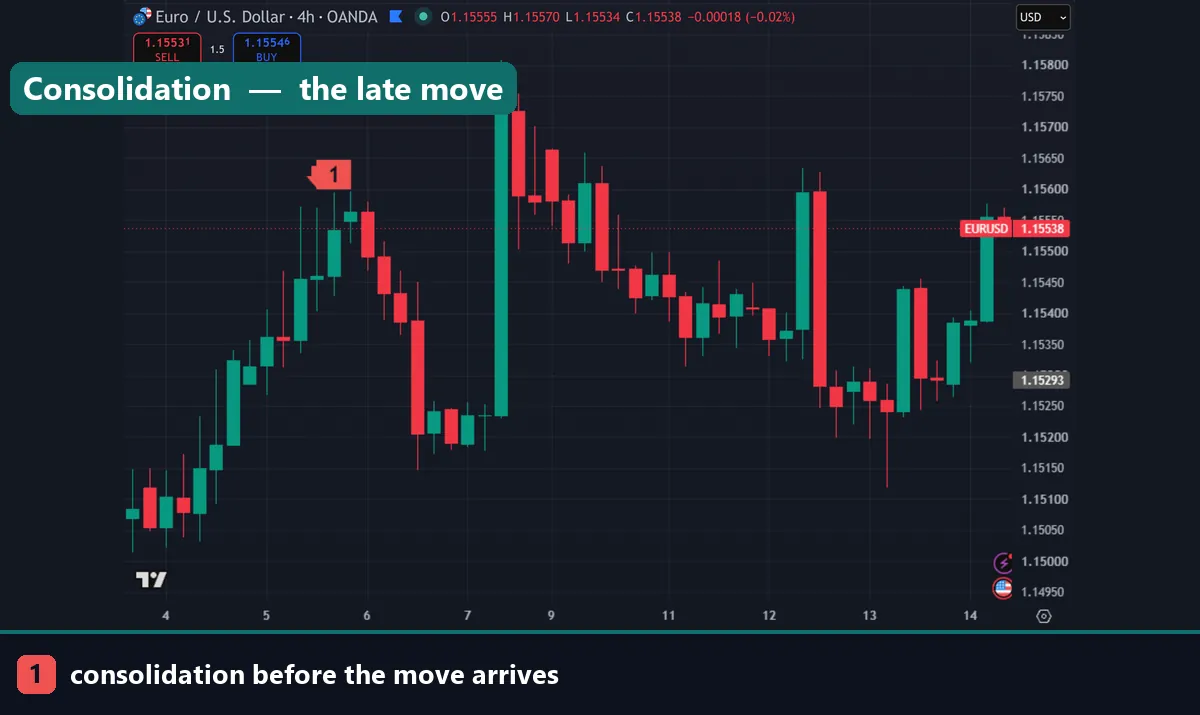
Practitioners work in a sequence rather than trading the profile directly.
First, establish a higher-timeframe bias from the daily or weekly chart. The profile refines a direction you already hold; it does not generate one.
Second, watch Monday and Tuesday for the sweep — price taking out the previous week’s high or low, or the early-week range, then closing back inside. Our liquidity sweep and finding liquidity guides cover reading that.
Third, take entries on the lower timeframe in the direction the sweep implies, using ordinary structure for the trigger.
The profile is therefore a framing device. It tells you what to expect and when to pay attention, and the actual trade still comes from a level and a reaction.
Download the complete indicator database
Put these concepts on your charts. One email unlocks the full library of 1,380+ indicators with compiled MT4 and MT5 files, plus my TradingView scripts. No paywall, no spam, unsubscribe any time.
Get free access to my indicator database
One email unlocks 1,380+ free MT4, MT5 and TradingView indicators — the complete library. No single-tool download; you get the whole database.
An honest assessment
Three points deserve stating plainly.
The tendencies are real but weak. There is genuine structure to the trading week — Monday is quieter, mid-week carries most scheduled data, Friday sees position squaring. But “the weekly high often forms on Tuesday” is a tendency, not a rule, and a tendency that holds slightly more often than chance is not a system.
The profiles are flexible enough to fit anything afterwards. With three templates and the option of declaring a week trending, almost any outcome can be labelled after the fact. That flexibility is what makes the framework hard to test and easy to believe.
News overrides all of it. A central bank decision on Thursday reshapes the week regardless of what Monday and Tuesday did. Check the calendar first, as covered in our forex news factory guide.
Used as a framing device — expect the extreme early, expect expansion mid-week, expect squaring on Friday — the profiles are a reasonable way to organise attention. Used as a prediction of what price will do, they will disappoint.
A workable routine
Four steps. On Sunday, mark last week’s high, low and close, and note the higher-timeframe bias. Through Monday and Tuesday, watch for a sweep of an obvious level rather than trading the range itself. If a sweep occurs, look for entries in the implied direction from Wednesday. And if the week simply trends from the open, drop the profile and trade the trend.
Log which profile each week resembled and whether it helped. After a quarter you will know whether it earns its place in your process, which no amount of reading can tell you.
Common mistakes
Four repeat. Forcing a profile onto a trending week tops the list, since the framework does not apply there. Trading the profile without a higher-timeframe bias comes second. Third, traders label the week after it finished and count that as confirmation. Fourth, they plan a week around a profile without checking which day the central bank meets.
Where to go next
This sits inside a structural framework. Read our ICT trading strategy guide for the method, then ICT times for the intraday windows. For the sweeps the profiles depend on, see liquidity sweep examples and how to find liquidity in chart structure. For further reading, Investopedia explains seasonality at Investopedia, and the calendar effect article on Wikipedia covers the research on day-of-week patterns.
FAQ
What are ICT weekly profiles?
Templates describing how a trading week tends to unfold: which day forms the extreme, when the directional expansion runs, and how the week closes. They frame expectations rather than predict prices.
Which day usually sets the weekly high or low?
Practitioners point to Monday or Tuesday, with the expansion following mid-week. It is a tendency rather than a rule, and plenty of weeks do not follow it.
How do I use a weekly profile?
Establish a higher-timeframe bias first, watch early week for a sweep of an obvious level, then take entries on a lower timeframe in the direction that sweep implies.
Do weekly profiles work?
The underlying rhythm is real but weak, and the templates are flexible enough to fit most outcomes after the fact. Treat them as a way to organise attention, not as a forecast.
What happens in a trending week?
The profiles do not apply. A week that opens in the direction of an established trend and keeps going has no reversal to frame, and forcing a template onto it produces bad trades.
Can I trade from the profile alone?
No. It frames expectations while the trade still needs a level and a reaction, and scheduled news overrides the whole structure. Trading involves risk, results are not guaranteed, and past performance is not indicative of future results.

About the author
Written by Dominic Walsh, a Forex trader and MT4/MT5 indicator, Expert Advisor and script developer. Every tool on forexmt4systems.com is tested on live charts before release and ships with ready-to-use compiled MT4 (.ex4) and MT5 (.ex5) files. Learn more about the trader and developer behind this site.
How we build, test and correct every tool: Editorial & Testing Policy. Trading carries risk; see the disclaimer.