
A 1 minute forex scalping strategy aims for a handful of pips per trade, many times a session. It is the most demanding style in retail trading, and the reason is arithmetic rather than skill: on a six-pip target, the spread takes a quarter of the move before price does anything. This guide gives you a complete rule set, and the cost calculation that decides whether it can work for you at all.
What you are up against
Run this before anything else. Take your average winning trade in pips and divide the round-trip cost into it.
A EURUSD spread of 1.6 pips against a 6-pip target consumes 27% of the move. Against a 30-pip intraday target it is 5%. Against a 200-pip swing it is under 1%.
So a one-minute scalper needs a much higher strike rate than a swing trader simply to break even. That is not an argument against the style, but it is the constraint everything else has to work around, and our bid ask spread calculation guide covers turning it into money.
Two consequences follow immediately. Trade only the tightest-spread pairs, and only during the hours when spreads are tightest.
The 1 minute forex scalping strategy setup
Pairs: EURUSD first, USDJPY second. Both carry the tightest spreads available. Volatile crosses are the wrong instrument here, whatever their range, because the cost scales with the volatility.
Hours: the London and New York overlap, roughly 13:00 to 17:00 UTC in winter. Spreads are tightest and movement is real. Outside that window the same system pays more and gets less, as covered in our forex time zone converter guide.
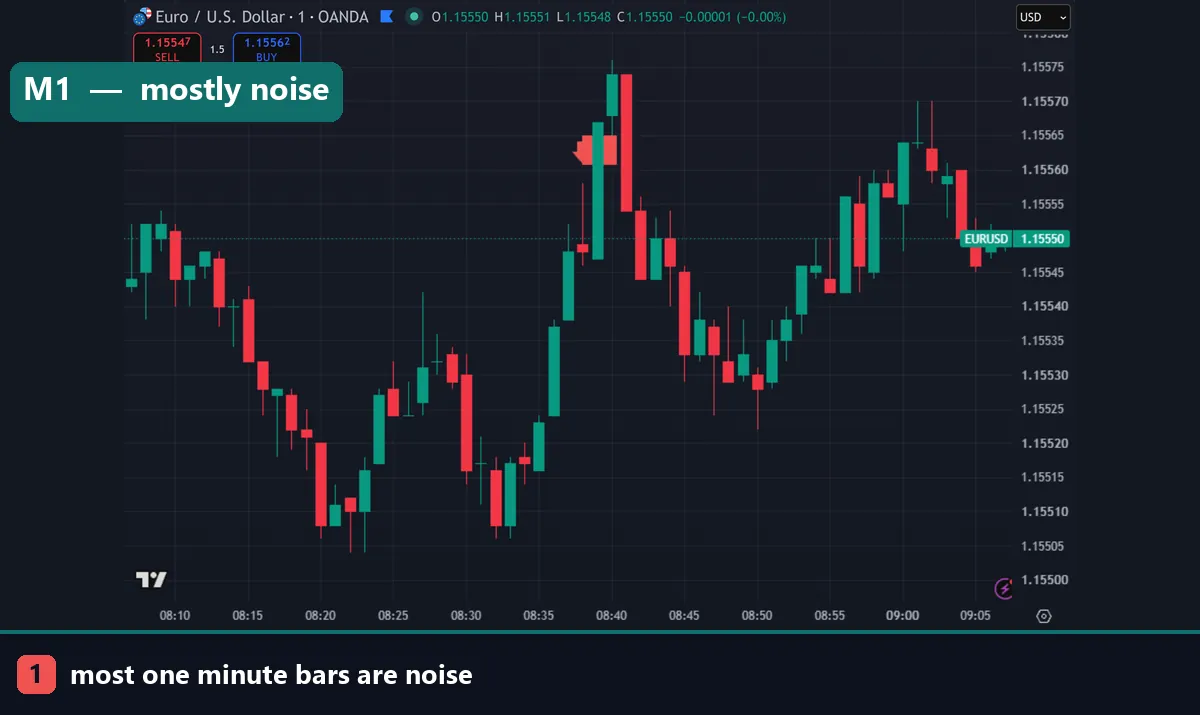
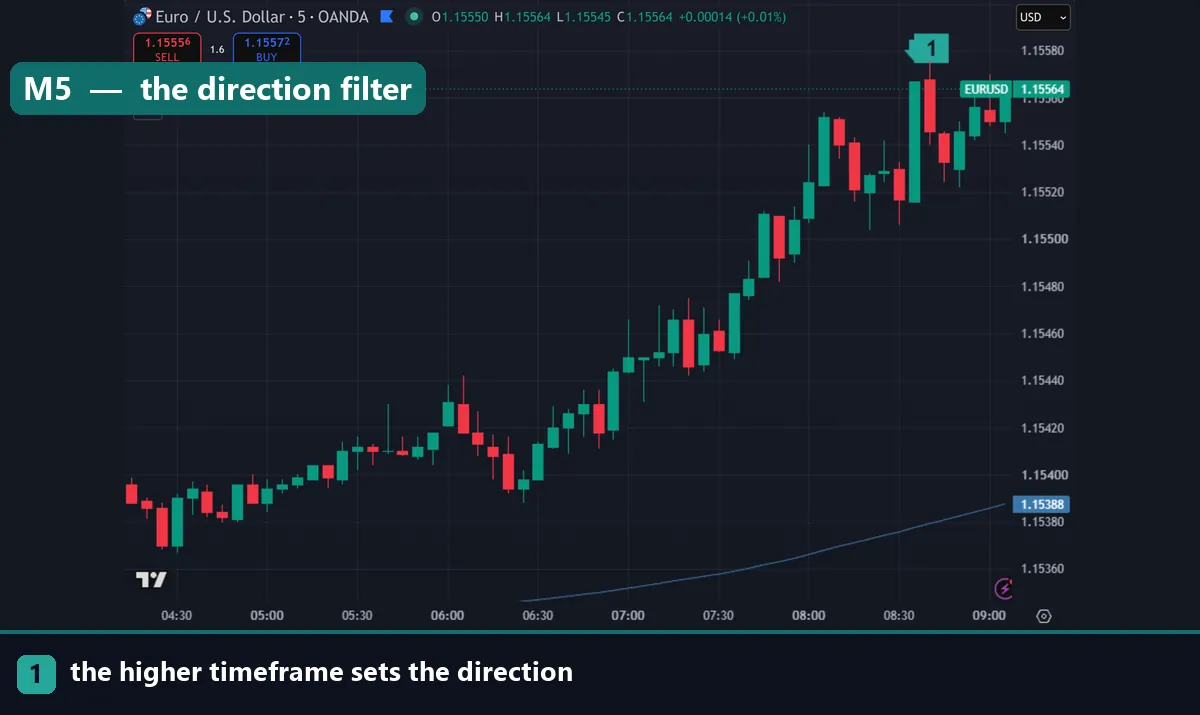
Charts: M1 for entries, M5 or M15 for direction. Trading M1 in isolation means reacting to noise with no frame of reference.
Indicators: a 20 EMA on the M1 chart for pullback location, and a 200 EMA on the M5 for direction. That is all. Extra tools on a one-minute chart add lag, not information.
The rules
Four conditions, all required.
One: direction. On the M5 chart, price must be above the 200 EMA for longs, below it for shorts. No exceptions, and no trading when price is sitting on the line.
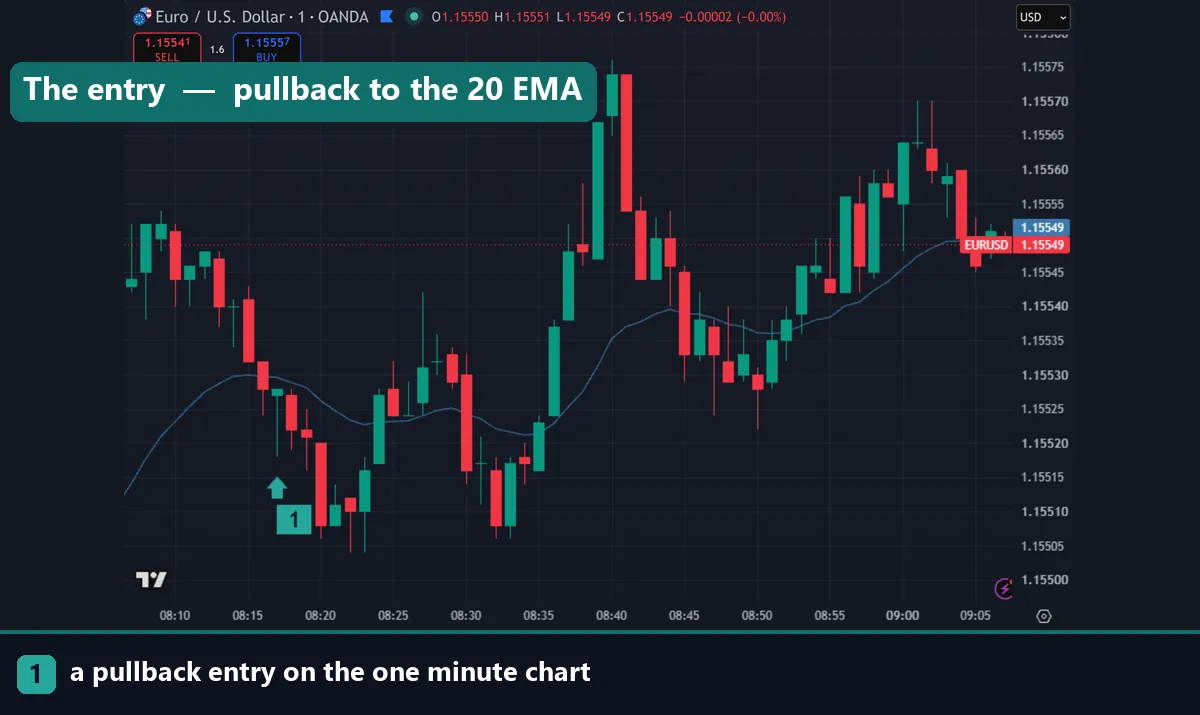
Two: pullback. On M1, wait for price to retrace to the 20 EMA. Do not chase a move already extended away from it.
Three: trigger. Enter when an M1 candle closes back in the trend direction after touching the average. Waiting for the close costs a pip and removes most of the guessing.
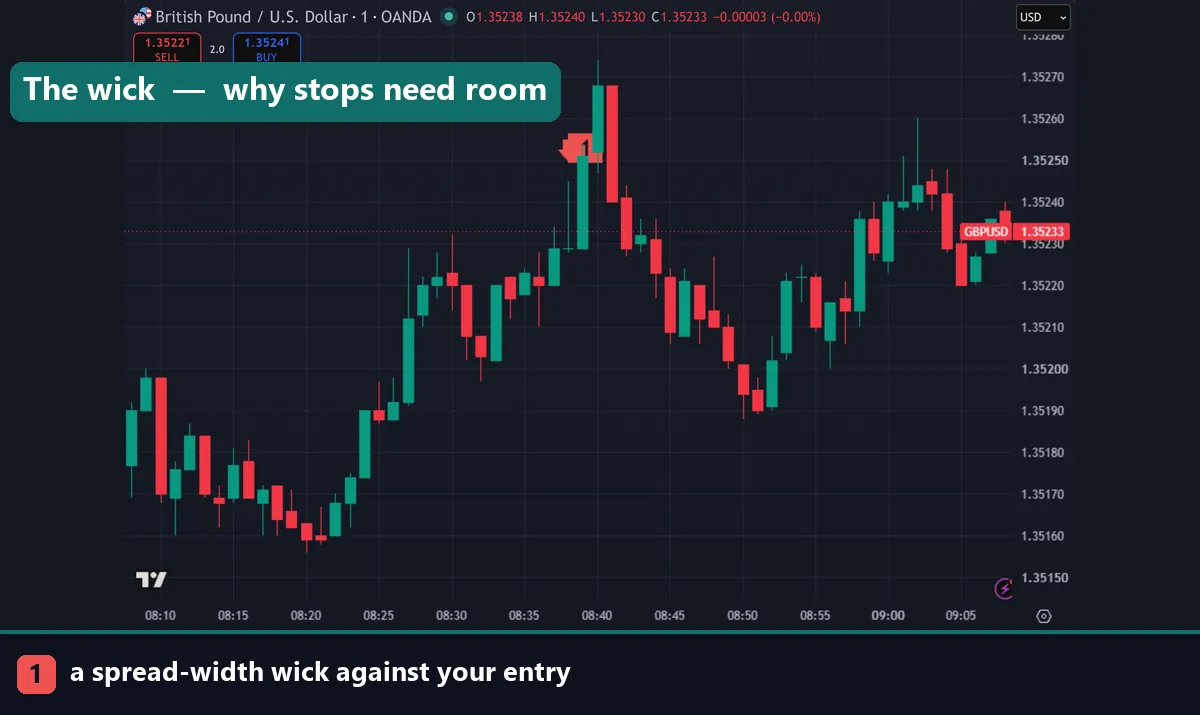
Four: stop and target. Stop goes beyond the swing formed at the pullback, typically 5 to 10 pips. Target at least the stop distance, ideally 1.5 times it. A scalping system with a target smaller than its stop needs a very high strike rate to survive.
Size from the stop using our position sizing calculator. On stops this tight, a micro account matters, as covered in our forex micro account guide.
What stops you trading
Knowing when not to trade matters more here than in any other style.
Scheduled news. Stop ten minutes before any high-impact release and wait until the spread normalises afterwards. A one-minute scalp through a rate decision is a coin flip with a widened spread against you.
A flat 200 EMA. If the M5 average is horizontal and price keeps crossing it, there is no direction to trade with and every signal is noise.
Widened spreads. Check before each entry. If the spread has doubled, the maths has changed and the setup is no longer the one you tested.
After two consecutive losses. Not superstition — a losing pair usually means conditions have shifted, and the discipline stops a bad session compounding.
Download the complete indicator database
Put these concepts on your charts. One email unlocks the full library of 1,380+ indicators with compiled MT4 and MT5 files, plus my TradingView scripts. No paywall, no spam, unsubscribe any time.
Get free access to my indicator database
One email unlocks 1,380+ free MT4, MT5 and TradingView indicators — the complete library. No single-tool download; you get the whole database.
The honest assessment
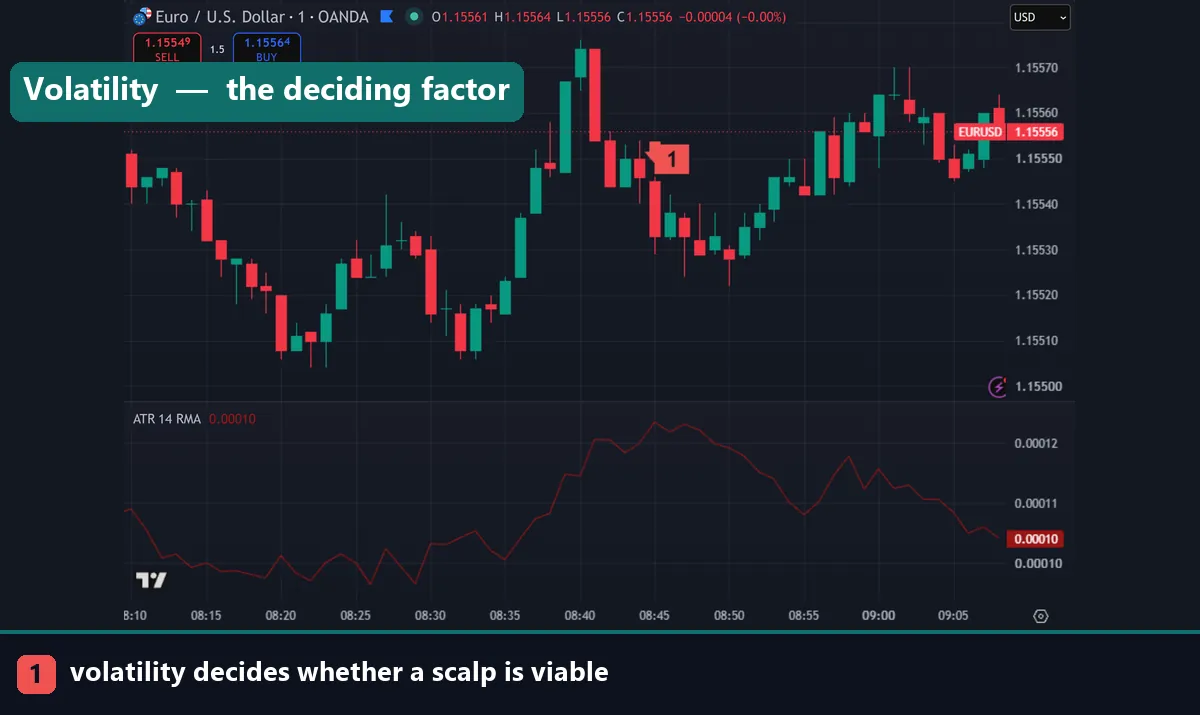
Three things deserve stating plainly.
Execution quality decides more than the rules. Slippage of one pip on a six-pip target is a sixth of the trade. Your broker’s fill quality matters more than any tweak to the entry logic, which is not true of swing trading.
Backtests flatter this style badly. Most testing assumes a fixed optimistic spread and instant fills. Live trading gives you a variable spread that widens exactly when the system wants to trade. Any M1 backtest that looks excellent should be treated with suspicion until it survives a demo account on live spreads.
The workload is real. Watching M1 charts for a four-hour session, making decisions in seconds, is mentally expensive. Most people who try this settle on M5 or M15 eventually, and their results usually improve.
If you want to test it, run fifty trades on demo during the overlap, logging the spread paid on each. That sample tells you whether the edge survives your actual costs, which no backtest can.
Common mistakes
Four repeat. Trading outside the overlap tops the list, where the same system pays a wider spread for less movement. Skipping the higher timeframe filter comes second, which turns the method into noise-trading. Third, traders take targets smaller than their stops and need an unrealistic strike rate. Fourth, they add indicators to the M1 chart, which adds lag exactly where speed matters.
Where to go next
Scalping lives or dies on cost and timing. Read bid ask spread calculation for the maths, then tick scalping for an even shorter-term approach. For the moving average work, see the 20 EMA guide and EMA trading strategies. Faster oscillator settings are covered in MACD scalping settings. For further reading, Investopedia explains scalping at Investopedia, and the scalping article on Wikipedia covers the wider practice.
FAQ
Does a 1 minute forex scalping strategy work?
It can, though cost decides it more than the rules do. On a six-pip target a typical spread takes over a quarter of the move, so the strike rate needed is far higher than for longer holds.
Which pairs suit one minute scalping?
EURUSD and USDJPY, because their spreads are tightest. Volatile crosses look attractive for their range but their wider spreads cancel the advantage on short targets.
What time should I scalp?
The London and New York overlap, roughly 13:00 to 17:00 UTC in winter. Spreads are tightest and the movement is genuine rather than drift.
How many indicators do I need?
Two. A 20 EMA on M1 for the pullback location and a 200 EMA on M5 for direction. Additional tools add lag on a one-minute chart without adding information.
Where do I put the stop?
Beyond the swing formed at the pullback, usually 5 to 10 pips. Keep the target at least equal to the stop, since a smaller target demands an unrealistic strike rate.
Why does my scalping backtest not match live results?
Backtests usually assume a fixed spread and instant fills, while live spreads widen exactly when the system trades. Test on demo with live spreads. Trading involves risk, results are not guaranteed, and past performance is not indicative of future results.

About the author
Written by Dominic Walsh, a Forex trader and MT4/MT5 indicator, Expert Advisor and script developer. Every tool on forexmt4systems.com is tested on live charts before release and ships with ready-to-use compiled MT4 (.ex4) and MT5 (.ex5) files. Learn more about the trader and developer behind this site.
How we build, test and correct every tool: Editorial & Testing Policy. Trading carries risk; see the disclaimer.