
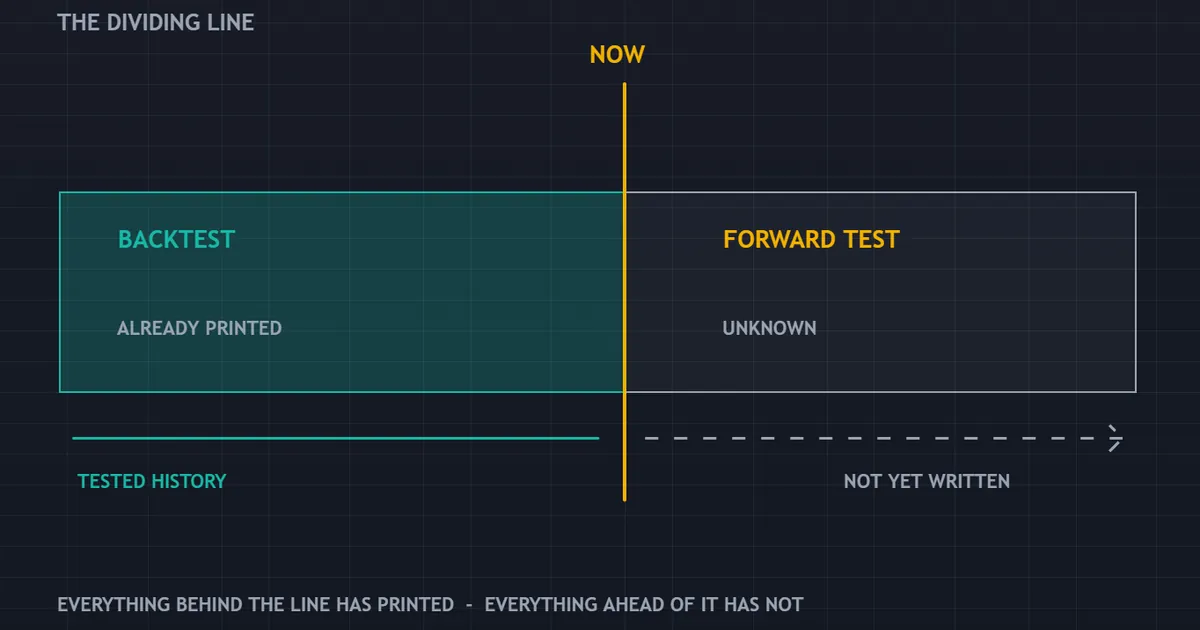
A backtest reads the past. A forward test watches the present, one bar at a time, with no way to skip ahead.
So what is forward testing in practice? It means running a finished, frozen strategy on prices that have not printed yet, then recording every result exactly as it arrives.
What Is Forward Testing, Exactly?
The definition is narrow on purpose. A forward test starts today, uses rules you already fixed, and ends on a date or a trade count you set in advance.
Nothing about the strategy may change while it runs. Change something and the clock restarts, because the results before and after describe two different systems.
Paper, Demo and Small Live
Three versions of the same idea appear in practice. Paper trading logs decisions by hand, a demo account routes them to a simulated server, and a small live account routes them to a real one.
Each version costs more and teaches more than the one before it. Paper trading catches rule ambiguity, demo catches platform problems, and live catches everything else.
Why the Present Tense Matters
History arrives complete. You can see what followed any bar, and that knowledge leaks into judgement no matter how careful you are.
Live bars refuse to cooperate. As a result, hesitation, second-guessing and the urge to widen a stop all show up for the first time.
Our guide to backtesting in trading covers the other half of the pair. Reading both makes the division of labour obvious.
Demo Forward Tests Against Live Forward Tests
Both count as forward testing. They differ in one place that matters enormously, which is the fill.
What the Panel Shows
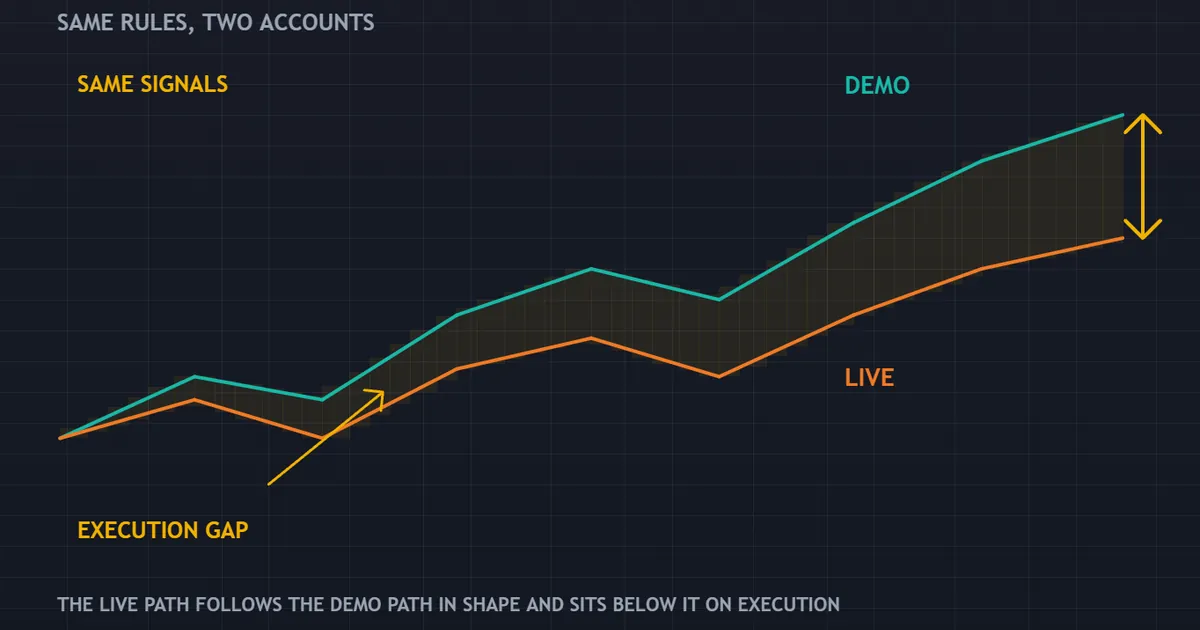
Two paths from the same rules run across that panel. The live path tracks the demo path in shape while sitting a little below it throughout.
The separation is not a mystery. It comes from execution, and it grows with the number of trades.
What a Demo Server Does Differently
Demo servers usually fill at the quoted price with no queue behind it. Nothing rejects your order, nothing widens against you and nothing arrives late.
Live servers do all three. Our guide to slippage in trading explains the mechanism behind the gap.
What a Demo Account Still Proves
Demo work remains valuable despite that limit. It proves the rules are unambiguous, the platform behaves, and the position sizing arithmetic works.
Treat demo as a test of the logic. Treat live as a test of the logic plus the market plus you.
Many traders run both together for a fortnight. Comparing the two records side by side puts a number on the execution gap before any meaningful money rides on it.
The Small Live Account
A live account traded at minimum size solves the fill problem cheaply. Fills, swaps and rollover charges all become real while the money at risk stays trivial.
Size is the only thing you scale down. Every rule, every stop and every entry stays exactly as written.
The Forward Test Routine, Step by Step
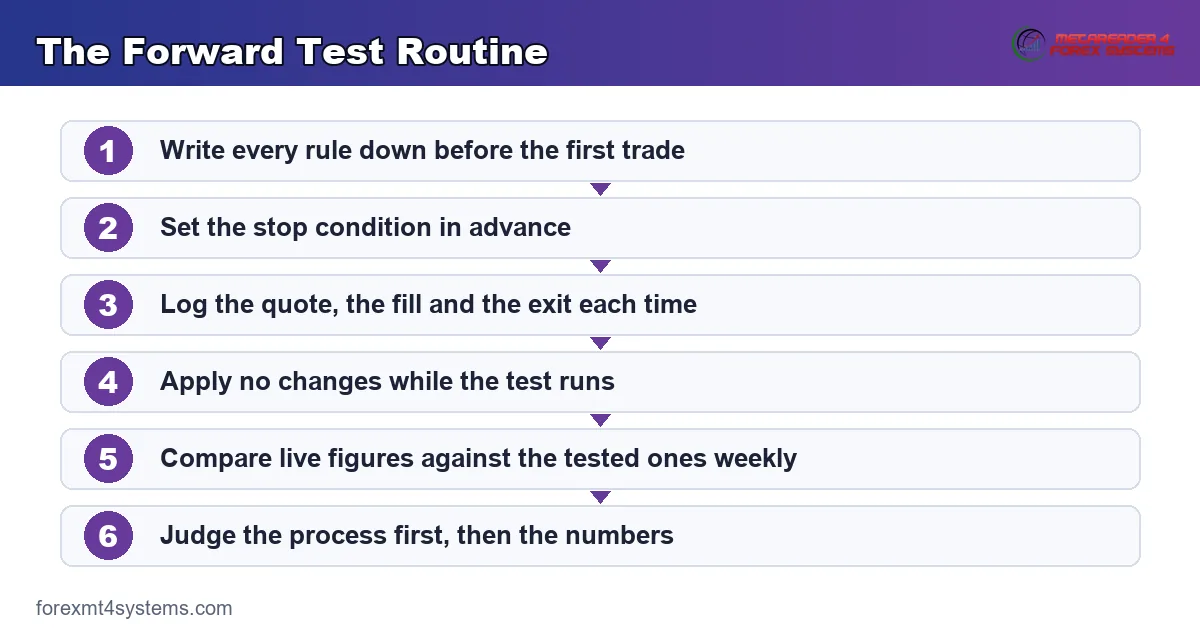
A forward test needs structure or it dissolves into ordinary trading. Six steps hold it together.
Write the Rules Down First
Print the entry, exit, sizing and skip conditions before the first trade. Anything ambiguous will resolve itself in your favour later, which quietly ruins the test.
Set the Stop Condition
Decide in advance what ends the test. A trade count, a calendar date or a maximum decline all work, provided you pick one before you start.
Log Every Trade the Same Way
Record the signal time, the requested price, the fill, the exit and the reason. Add a note when you deviated, because those notes carry the most information later.
Do Not Optimise Mid-Test
Tempting adjustments will appear within a fortnight. Write them on a list for the next version instead of applying them now.
Compare Against the Backtest Continuously
Track the tested figures beside the live ones. Divergence in average win size or trade frequency shows up long before divergence in the result.
Judge the Process, Then the Numbers
Ask whether you followed the rules before asking whether the rules worked. A broken process makes the numbers unreadable either way.
Why Forward Testing Gets Skipped
Almost everyone agrees the stage is sensible. Very few run one properly, and the reasons deserve naming.
Slow and Unglamorous
A backtest delivers ten years of results in ninety seconds. A forward test delivers ten weeks of results in ten weeks.
That contrast makes the tester feel productive and the forward test feel like waiting. So the stage most likely to catch a real problem becomes the stage most likely to disappear.
The Backtest Already Said Yes
A flattering equity curve creates confidence, and confidence dislikes further questions. Traders reason that the market will hardly change in ten weeks, so why wait.
That reasoning runs backwards. A forward test does not check whether the market changed; it checks whether the backtest described anything real in the first place.
Impatience Carries a Price
Skipping ten weeks to reach live trading feels like a saving. In truth it works like a loan, and the interest arrives as an account decline you could have avoided.
Weigh the two sides honestly. Ten weeks of minimum-size trading costs very little, while the alternative costs whatever the untested flaw happens to cost.
How Long Should a Forward Test Run?
Calendar time is the wrong unit, and almost everyone uses it anyway. Trade count answers the question far better.
The Band Where Nothing Is Readable
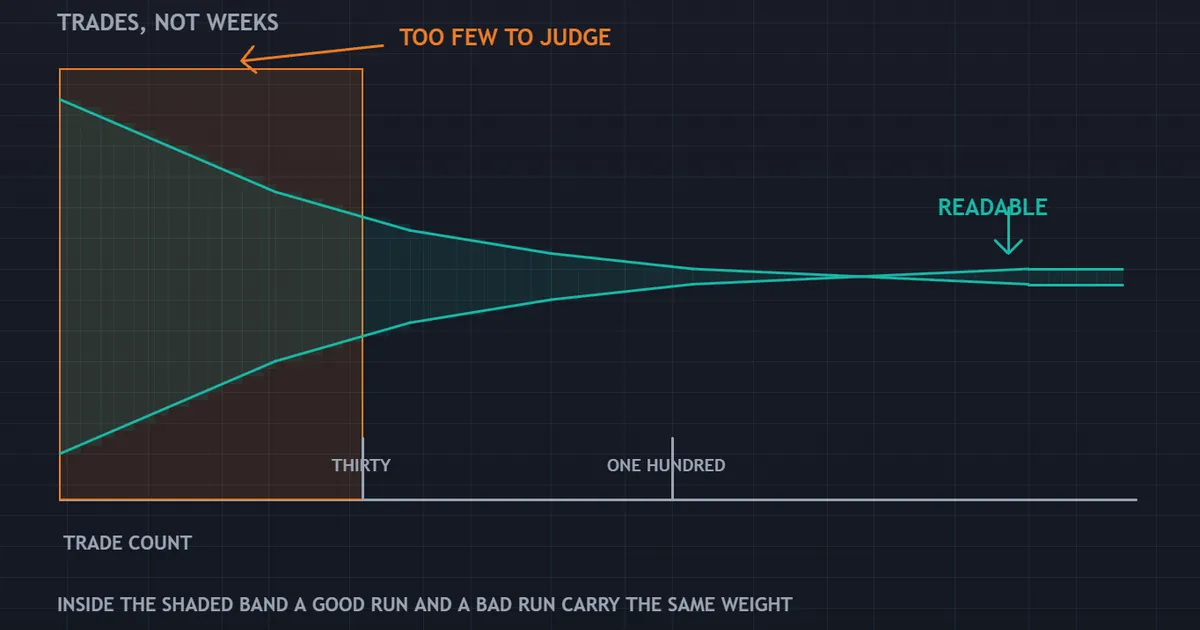
Below roughly thirty trades, the result reflects sequence more than skill. Move three losses to the front of the same set and the picture inverts completely.
That band appears on the panel above. Inside it, a run of profits and a run of losses carry the same evidential weight, which is almost none.
A Workable Target
One hundred trades gives you something worth reading. Two hundred to three hundred narrows the range further, though the returns diminish.
Our guide to backtest sample size puts arithmetic behind those thresholds. The same logic applies forward.
Translate Trades Into Weeks
Divide your target trade count by the frequency the backtest reported. A rule producing ten trades a week reaches one hundred in ten weeks.
A rule producing two trades a month needs four years for the same count. That answer is unwelcome, but shortening the test does not shorten the uncertainty.
Why Small Samples Mislead So Badly
Outcomes cluster by luck long before they cluster by skill. Twenty flips of a fair coin produce a lopsided score surprisingly often.
Trading results behave the same way, only worse, because the sizes of wins and losses vary too. A single outsized winner can carry a mediocre rule for months.
So spread your judgement across the whole sample rather than the last ten trades. Recency feels informative and rarely is.
What to Do With Slow Strategies
Slow systems present a genuine problem with no clean fix. Running the same rules across several uncorrelated instruments gathers trades faster.
Alternatively, accept a smaller live allocation for longer. Both routes trade certainty for time, so pick the one you can actually sustain.
Download the complete indicator database
Put these concepts on your charts. One email unlocks the full library of 1,380+ indicators with compiled MT4 and MT5 files, plus my TradingView scripts. No paywall, no spam, unsubscribe any time.
Get free access to my indicator database
One email unlocks 1,380+ free MT4, MT5 and TradingView indicators — the complete library. No single-tool download; you get the whole database.
What to Measure While the Test Runs
The result is the least useful number early on. Four other measures move faster and say more.
Fill Quality
Record the difference between the price you wanted and the price you received. Twenty entries give you a first reading, and fifty give you a usable average.
Trade Frequency
Count signals per week and compare against the backtest. A live count well below the tested count usually means the tester filled orders your broker would not.
Average Win and Average Loss
Track both separately rather than watching the total. A shrinking average win with an unchanged average loss is an early warning that costs are eating the edge.
Rule Adherence
Log every trade you took outside the rules and every signal you skipped. This is the number most traders refuse to keep, and it explains most disappointing results.
A trade journal makes all four measurements a two-minute habit rather than a project.
What a Forward Test Shows That a Backtest Cannot
Some information exists only in real time. Five items come to mind immediately.
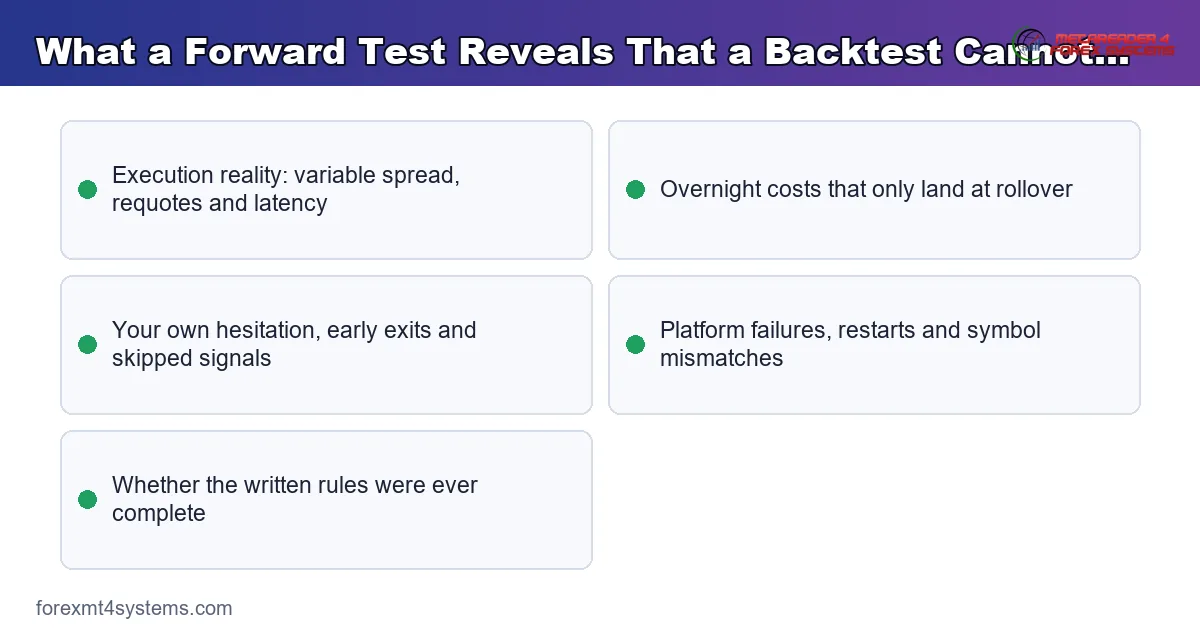
Execution Reality
Variable spread, requotes, partial fills and latency all arrive live. No tester models them, because a tester replays prices rather than routing orders.
Costs That Only Appear Overnight
Swap charges land at rollover and triple on one day of the week. A test that holds positions for days pays them repeatedly.
Our guide to forex trading costs lays out the full bill. Most of it stays invisible in a tester.
Your Own Behaviour
Watching a live loss develop feels nothing like reading one in a report. Hesitation, early exits and revenge entries all belong to this stage.
Platform and Automation Failures
Disconnections, terminal restarts and mismatched symbol names break automated rules in ways no backtest reproduces. Traders running code should read our guide to expert advisors before leaving anything unattended.
Whether the Rules Were Ever Complete
Ambiguity hides well in history because hindsight resolves it. Live bars expose every gap in the written rules within a fortnight.
What a Forward Test Still Cannot Tell You
Honesty about the limits keeps expectations sensible. Three limits stand out.
One Path Through One Market
A forward test samples a single sequence of conditions. Run the same rules across a different quarter and the numbers change, sometimes dramatically.
It Cannot Prove an Edge
A forward test can disprove a strategy convincingly and confirm one only weakly. That asymmetry never goes away, however long the test runs.
Regimes Change Without Warning
A calm quarter teaches you little about a violent one. So a clean forward test through quiet conditions is worth less than its length suggests.
Our comparison of backtesting and forward testing sets out which questions belong to which stage.
Three Strategy Speeds and Their Timelines
Trade frequency decides the whole schedule. Three examples make the arithmetic visible.
The Fast Rule
An intraday rule firing ten signals a week reaches one hundred trades in ten weeks. Execution data therefore accumulates quickly, which suits a strategy whose margin per trade stays thin.
Costs matter most in this bracket. A fast rule pays the spread repeatedly, so live figures separate from tested ones sooner.
The Medium Rule
A swing rule firing three signals a week needs roughly eight months for the same count. Most traders will not wait that long, and the usual compromise runs the rules across several instruments at once.
Pick instruments that behave differently. Four correlated pairs deliver four copies of one trade rather than four independent tests.
The Slow Rule
A position rule firing twice a month needs four years to reach one hundred trades. No honest shortcut exists here.
Accept the uncertainty openly instead of pretending it away. Trade a small size indefinitely and treat every conclusion as provisional.
| Signals per week | Weeks to fifty trades | Weeks to one hundred trades | Practical approach |
|---|---|---|---|
| Ten | Five | Ten | Run the full test before sizing up |
| Five | Ten | Twenty | Run the full test and expect a quarter to pass |
| Three | Seventeen | Thirty-three | Add uncorrelated instruments to gather trades |
| One | Fifty | One hundred | Trade small indefinitely and keep measuring |
| One every two weeks | One hundred | Two hundred | Accept that certainty will never arrive |
Forward Testing an Automated Strategy
Automated rules bring their own failure modes. A robot removes hesitation and adds plumbing in its place.
Run It Where It Will Live
Test on the same terminal, the same broker and the same connection you plan to use afterwards. A rule tested on a home laptop and deployed on a hosted server amounts to two separate tests.
Keep the Terminal Logs
Save the journal and the expert log, not only the trade history. Rejected orders, invalid stop levels and disconnection messages explain gaps that a trade list never will.
Compare Signal Counts First
Count how many signals the code produced against how many the tester produced over the same span. A shortfall usually points at filters, symbol suffixes or trading hours rather than at the market.
Watch the Weekend and the Rollover
Gaps, swap charges and the rollover hour break more automated tests than strategy logic does. Check carefully what the code does when the market reopens on Sunday evening.
Common Forward Testing Mistakes
Six habits waste the whole exercise. Each one is common enough to name.
- Changing the rules mid-test. Every change restarts the clock, so the sample never accumulates.
- Stopping early after a good run. Twenty profitable trades prove very little about the next twenty.
- Stopping early after a bad run. The same logic applies in reverse, and abandoning too soon discards work.
- Testing on demo only. The one thing a demo cannot show is the one thing forward testing exists for.
- Trading a size that frightens you. Fear changes decisions, so the test measures your nerves rather than the rules.
- Keeping no log. Without records, the post-mortem becomes a memory exercise and memory flatters everyone.
Notice how many of these come from impatience. Forward testing rewards the trader willing to be bored.
From Forward Test to Live Size
Passing a forward test earns a size increase, not a leap. Three steps keep the transition sane.
Recalculate the Expectancy Live
Use the fills you actually received rather than the tested ones. Our free expectancy calculator turns those records into a per-trade figure.
Scale in Stages
Double the size, then trade another block of trades before doubling again. Problems that hide at small size tend to appear as orders grow.
Keep the Test Running
Nothing says the forward test has to end when live size begins. Traders who keep measuring notice decay early, which is the whole point.
Set a review date every quarter and compare the newest block of trades against the original record. If the average result per trade has drifted well below the tested figure, cut the size back rather than waiting for certainty.
Charting the rules visually helps here. Our MT5 indicators library shows the same conditions drawn on a live chart while the test runs.
A Forward Test Checklist
Run through this before the first trade and again at the end. It takes two minutes.
| Check | Why it matters |
|---|---|
| Are the rules written down and unambiguous? | Ambiguity resolves itself in your favour |
| Have you set the stop condition in advance? | Otherwise the test ends when you feel like it |
| Is the target a trade count rather than a date? | Trades carry the information, weeks do not |
| Are you recording quote, fill and exit for every trade? | Execution is the reason the test exists |
| Is the position size small enough to stay calm? | Fear changes decisions and corrupts the sample |
| Have you logged the trades you skipped? | Adherence explains most surprising results |
| Did anything change during the test? | A change restarts the sample from zero |
FAQ
Is forward testing the same as paper trading?
Not quite. Paper trading is one form of forward testing, where you log decisions manually without routing orders anywhere. Demo accounts and small live accounts are the other two forms. All three run forward on prices that have not printed yet, which is the defining feature, but only the live version tests execution properly.
How many trades does a forward test need?
Aim for one hundred as a working floor and treat anything under thirty as unreadable. The exact figure depends on how far your average win sits from your average loss: a strategy with tightly clustered outcomes settles faster than one whose result depends on a few large winners. Sequence matters at small samples, so patience buys clarity.
Can I forward test on a demo account only?
You can, and it will answer some questions well. Demo work confirms that the rules are complete, the platform behaves and the sizing arithmetic holds. What it cannot show you is slippage, requotes, widening spreads or your own reaction to a real loss, and those are usually the reasons a tested strategy disappoints.
Should I stop a forward test that starts badly?
Only if you set that stop condition in advance. Deciding to quit mid-run because the first ten trades disappointed you turns the test into a coin flip you called early. Set a maximum decline before the first trade, honour it, and treat everything above that line as data you agreed to collect.
Does a forward test replace a backtest?
No, they answer different questions and belong in sequence. A backtest asks whether the rules ever had a chance across many years and many conditions. A forward test asks whether they survive real execution and real behaviour now. Skipping the backtest wastes months; skipping the forward test risks money on an untested assumption.
Can I forward test several strategies at once?
Yes, and it usually makes good use of the waiting time. Run each one in its own account or sub-account so the records stay separate, keep the sizing rules identical across them, and resist reallocating between them mid-test. Two clean records at the end beat one clean record and a vague memory of the other.
What if my broker changes something during the test?
Note it in the log and carry on, unless the change touches execution directly. A wider spread schedule, a new commission structure or a symbol change all alter the thing you are measuring. When that happens, treat the trades before and after as two samples rather than quietly merging them.
How do I know when the forward test has passed?
Define the pass criteria before you start, then judge against them rather than against how you feel. Reasonable criteria include reaching the trade count, staying inside the maximum decline you set, showing a per-trade result that survives real costs, and matching the tested trade frequency closely. Review how often it wins alongside the average size of those wins, because the two only mean something together. Results are not guaranteed; past performance is not indicative of future results.
External references
- For background on this concept, see Statistical Significance on Wikipedia.
- For broader market context, see Mechanical Trading in the BabyPips Forexpedia.

About the author
Written by Dominic Walsh, a Forex trader and MT4/MT5 indicator, Expert Advisor and script developer. Every tool on forexmt4systems.com is tested on live charts before release and ships with ready-to-use compiled MT4 (.ex4) and MT5 (.ex5) files. Learn more about the trader and developer behind this site.
How we build, test and correct every tool: Editorial & Testing Policy. Trading carries risk; see the disclaimer.