
ICT macros are short, fixed windows of a session, often around twenty minutes long, when the market algorithm tends to deliver a sharp, purposeful move. Michael Huddleston, the Inner Circle Trader (ICT), teaches that price is delivered on a schedule, and these windows are the clearest slots on that schedule. So this guide explains what ICT macros are, when each one runs in New York time, and how to use them without forcing a trade.
You will learn the full list of daily macros, the mechanics behind a macro delivery, a worked walkthrough, and the honest ways a macro window traps eager traders. By the end, you can watch the clock and the chart together instead of guessing.
What ICT Macros Are
An ICT macro is a scheduled burst of algorithmic delivery. Inside the window, price often runs from one liquidity pool toward another in a fast, one-sided move. Outside it, price tends to drift, consolidate, or wait. Hence the macro concept treats time as a filter, not just price.
The idea rests on a simple claim: institutional order flow follows a rhythm. Banks and funds work large orders in bursts, and those bursts cluster at repeatable minutes of the day. So the macro windows mark when the market is most likely to move with intent rather than noise.
The chart below shows a EURUSD 5-minute chart. Before the 09:50 New York window, price drifted near 1.13700. When the 09:50 to 10:10 macro opened, price made a sharp V-reversal off 1.13680, then delivered up to 1.13823, running into a buy-side pool above the earlier range.

Reading the EURUSD 5-minute chart
Notice how flat the chart looks before the window. Price barely moved for twenty minutes, and most traders had lost interest. Then the clock hit 09:50 and delivery began almost on cue.
The move itself was clean and directional. A single displacement candle opened the run, left a fair value gap behind, and price barely paused before reaching the pool above. Truly, the window compressed the day’s clearest move into roughly eighteen minutes.
Compare that to the hour before and after. Both stretches drifted with small, overlapping candles and no clear direction. So the contrast between the quiet hours and the macro is the very edge the concept tries to capture, since it tells you when to watch closely and when to relax.
Also, weigh what the chart never sold you. The macro named a likely time and a likely direction, yet it never promised the exact size of the run. Price could have stalled halfway, so the target still depended on where liquidity actually rested.
The eight daily macro windows
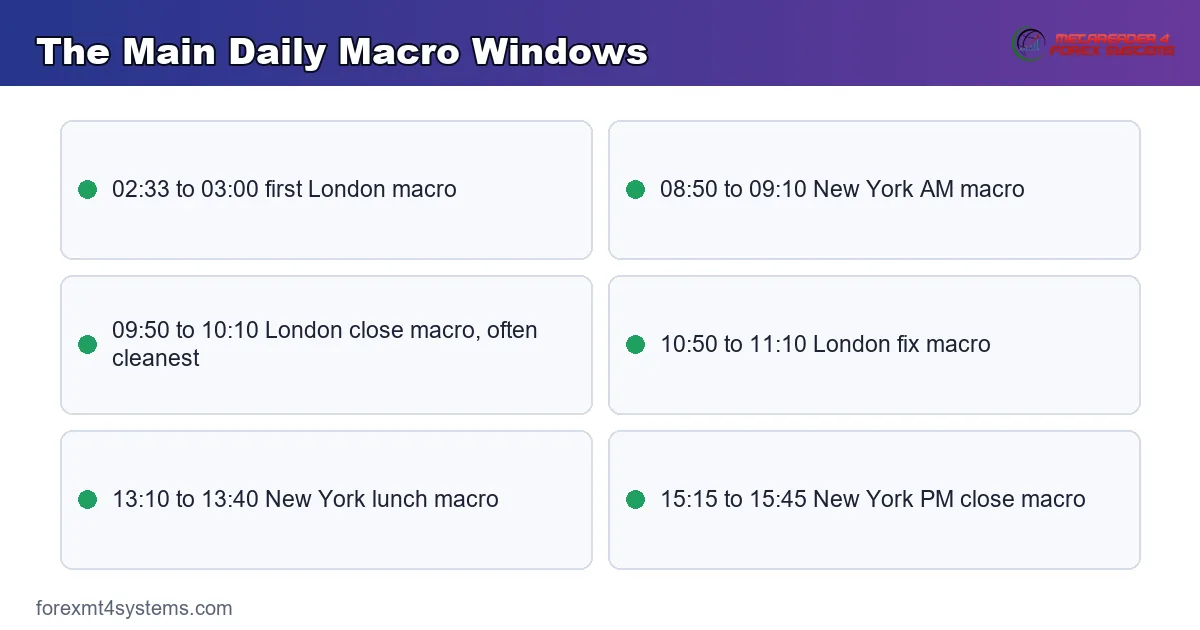
ICT traders track a handful of macros across the London and New York sessions. Here are the commonly cited windows, all in New York time.
- 02:33 to 03:00, the first London macro after the open.
- 04:03 to 04:30, the second London macro before the New York overlap.
- 08:50 to 09:10, the New York AM macro around the equity open.
- 09:50 to 10:10, the London close macro, often the day’s cleanest push.
- 10:50 to 11:10, the London fix macro tied to the daily benchmark.
- 11:50 to 12:10, the New York AM close macro before lunch.
- 13:10 to 13:40, the New York lunch macro that reopens the afternoon.
- 15:15 to 15:45, the New York PM close macro into the session end.
You do not trade all eight. Most traders pick the two or three that suit their schedule and pair each with clear structure. So the list is a menu, not a mandate.
The Time Theory Behind ICT Macros
The macro concept grows from a larger idea in the ICT curriculum: price is delivered on time, not at random. Michael Huddleston argues that an algorithm distributes price in repeatable cycles, and the macros are the fine slots inside those cycles. So the theory treats the clock as data, the same way most traders treat price.
Macros and the ninety-minute cycle
ICT breaks the day into blocks of roughly ninety minutes. Each block tends to accumulate, then manipulate, then distribute, before it resets. The macros usually land near the manipulation and distribution phases, which is why delivery clusters there rather than in the quiet accumulation.
Think of the cycle as the tide and the macro as the wave. The ninety-minute block sets the broad direction, while the macro delivers the sharp push inside it. Hence a macro that agrees with its parent cycle carries far more weight than one that fights it.
Why twenty minutes and not two hours
The narrow window is the point. A twenty-minute slot forces you to wait for a specific, testable moment rather than trading all day. So the macro trims screen time and sharpens focus onto the minutes that matter most.
Precision also protects discipline. When you commit only inside a defined window, you stop chasing every wiggle between windows. Thus the tight clock does as much for your behavior as it does for your read of the chart.
How ICT Macros Work
A macro is not a signal by itself. It is a time filter that you place on top of a structural read. Now walk the mechanics, because the window only matters when the chart agrees with it.
- Set the bias first. Decide whether the daily draw on liquidity points up or down before the window opens.
- Mark the pools. Note the nearby session high and low, the previous day levels, and any equal highs or lows.
- Wait for the window. Let the clock reach the macro before you expect delivery.
- Read the delivery. Watch for a sweep of a pool followed by displacement in the bias direction.
- Enter on the retrace. Trade the pullback into the fair value gap the displacement leaves behind.
Each step guards the next. A window with no bias is just twenty minutes on a clock, and a sweep with no displacement is only a probe. Thus the macro earns its weight only when time, structure, and delivery line up together.
Order matters as much as the steps themselves. Set the bias before the window opens, never during the delivery, since a live move tempts you to bend the read to fit the candle. So the plan should already be written when the clock reaches the macro. Then your only job inside the window is to watch for the trigger you defined in advance.
The first graphic below compresses these five steps into one pre-trade card.

Why the algorithm favors these minutes
The windows cluster around real market events. The 09:50 macro sits inside the London and New York overlap, at the peak of daily volume. The 15:15 macro lands as funds position into the close, and the London macros track the European open.
Benchmark fixings add another layer. The 10:50 to 11:10 macro brushes the London fix, when large institutional orders reference a set price. So the macros are not superstition; they map to moments when heavy order flow is most likely. Tools such as the macro ICT indicator can shade these windows on your chart so you never miss one.
Where Macros Sit in the SMC Workflow
Macros supply timing, nothing more. Smart Money Concepts (SMC) traders layer four things in fixed order: higher-timeframe context, a point of interest, lower-timeframe confirmation, and the entry. The macro governs only when that last layer is allowed to fire.
Start on the daily and 4-hour charts, which set the bias and the draw. Next, an H1 chart marks the point of interest in the path of that draw. Then a 5-minute or 1-minute chart times the entry inside the macro, where the delivery is fine enough to read candle by candle.
Timeframe pairing and session timing
Macros demand a low timeframe. A twenty-minute window barely spans four candles on the 5-minute chart, so many traders drop to the 1-minute to read the delivery cleanly. So the macro is the one place where such a fast chart earns its keep.
Session context still rules the read. A macro inside a kill zone carries more weight than one in a dead hour, because the volume behind it differs. The full guide to ICT kill zones maps which windows overlap, and the New York kill zone guide shows the macros in their session home.
Worked Example: A Bearish New York Morning Macro on GBPUSD
Morning macros often deliver the day’s cleanest move, and the chart below walks one from levels to target, step by numbered step.

- First, the context: GBPUSD had chopped sideways in the New York morning, holding a session high at 1.33438.
- Next, the bias: the daily draw pointed lower, so that high looked like resting buy-side liquidity.
- The window: a New York morning macro opened with price pressing that high.
- The trap: price ran to 1.33448 at 09:35, sweeping the session high by a pip and grabbing buy stops.
- The trigger: a fast candle broke lower, leaving a bearish fair value gap between 1.33316 and 1.33339.
- The trade: short the retrace into that gap near 1.33328, stop above the sweep at 1.33470, first target 1.33216.
The raid is the setup, not a flaw. A bearish macro frequently opens with a run above a nearby high, because those buy stops fund the selling that follows. So the routine waits for displacement before any entry fires.
Managing the macro short
Manage the trade along the marked levels. The short near 1.33328 risks about 14 pips to a stop above the sweep, while the first target waits roughly 11 pips below at 1.33216, close to a one-to-one first target. Many traders bank a partial there and trail the rest as the morning delivery continues.
Read the timing as confirmation, not coincidence. The sweep landed at 09:35, early in the New York morning, and the delivery finished inside the macro window. So the whole sequence fit inside the macro, which is exactly the behavior the model predicts. A move that ignored the window would have earned less trust.
Also, note the counterfactual. Had the daily draw pointed up, the same session high sweep would carry little weight, and the clean setup would wait for a run on the low instead. The bias, not the clock, still decides direction.
Download the complete indicator database
Put these concepts on your charts. One email unlocks the full library of 1,380+ indicators with compiled MT4 and MT5 files, plus my TradingView scripts. No paywall, no spam, unsubscribe any time.
Get free access to my indicator database
One email unlocks 1,380+ free MT4, MT5 and TradingView indicators — the complete library. No single-tool download; you get the whole database.
Common ICT Macro Mistakes
Six errors show up in almost every macro journal, and each has a plain fix.
- Trading the window with no bias. Fix: set the daily draw first, then let the macro time the entry.
- Expecting delivery in every macro. Fix: skip windows where structure and pools do not line up.
- Entering the sweep before displacement. Fix: wait for the fast candle, then trade the retrace.
- Using a timeframe too high. Fix: drop to the 5-minute or 1-minute to read the fine delivery.
- Ignoring scheduled news. Fix: check the calendar, since a release inside a macro can override the read.
- Chasing a macro that already ran. Fix: if delivery finished early, wait for the next window.
None of these errors are exotic. Still, each one quietly turns a timing tool into a coin flip, and only a written record makes them visible.
The news trap deserves extra care. A data release often lands near the 08:50 macro, and the first spike can run both ways before settling. Check our free economic calendar before the session, so a red-news macro becomes a stand-aside by default.
The second graphic pairs the six mistakes with their fixes for a fast pre-trade review.
ICT Macro Pre-Trade Checklist
Run these lines before the window opens, in order and without exceptions. Any failed line downgrades the macro or removes it entirely.
- Daily draw on liquidity named as either up or down.
- Nearby pools marked: session high and low, previous day levels.
- Point of interest set in the path of the draw.
- Red-news times checked against the macro window.
- Low timeframe loaded, either 5-minute or 1-minute.
- Sweep of a pool observed inside the window.
- Displacement candle confirmed in the bias direction.
- Entry, stop, and first target written before the fill.
Also, grade each macro before you trade it. Score the bias, the sweep, and the displacement, then reserve full risk for the cleanest windows only. Over a month, those grades show whether your best macros truly outperform the rest in your hands.
Limitations and a Failed Macro
ICT macros fail in specific, predictable ways. Many windows produce no clean delivery at all, and price simply drifts through the twenty minutes. Others deliver so fast on news that no retrace entry ever forms. So a quiet macro is a valid outcome, not a broken tool.
The concept is also unproven in any public dataset. No official study confirms that price moves more inside these exact minutes, and any precise percentage you meet online is a guess. What your own journal can show is a pattern over time: whether your chosen macros deliver often enough to justify watching them.
The windows are discretionary too. Two traders can read the same delivery differently, and hindsight makes every finished macro look obvious. Meanwhile, purpose-built ICT indicators for MT4 and MT5 can shade the windows and mark the pools, which removes one source of noise.
Session choice sets a hard limit as well. The London and New York macros suit European and North American hours, yet a trader in Asia may find them awkward to watch live. So pick the windows that fit your own day, and skip the rest without regret. A macro you cannot watch is not a macro you can trade.
A failure walkthrough: the two-sided macro
The chart below shows the loss that teaches macro discipline fastest. Picture EURUSD at the 08:50 macro with a bearish plan: a session high nearby, the daily draw pointing down. Inside the window price only edges up into a tight two-sided range between 1.13902 and 1.13964, with no clean displacement either way.

That drift is delivery that never came. The clue is the shape: no single displacement candle held, and price stayed pinned in a narrow band. Hence the invalidation rule is simple. When a macro delivers a tight two-sided range with no clean displacement, there is no trade, and forcing one usually books a stop on the whipsaw.
Log the window as a no-delivery session, not a strategy failure. Record how tight the two-sided range stayed, whether news was due, and whether a later, cleaner macro delivered instead. Indeed, one honest failure entry teaches more than a week of easy windows, because it shows exactly when the clock lied.
Watch, too, for the macro that delivers early. Sometimes price runs before the window even opens, then chops sideways once the clock arrives. Chasing that late is a common mistake, since the delivery already happened. So when a move front-runs its window, stand down and wait for the next scheduled slot rather than paying up for a finished run.
There is a practical guard here as well. When a high-impact release sits inside a macro, treat the whole window as off-limits and wait for the next one. So the calendar and the clock work together, and one red print never has to cost you a trade.
Related Concepts for Macro Traders
Several companion reads deepen the routine. The London kill zone guide covers the session that hosts the early macros, while the two big displacement candles inside every window are what actually confirm a delivery. Then the liquidity pools in forex guide catalogs the exact targets a macro runs toward, from equal highs to old session levels. Read together, they turn a list of times into a working intraday model.
Start with one macro, not all eight. Pick the window that fits your schedule, watch it for a month, and journal every delivery it produces. Then add a second window only once the first feels routine. So the macros grow into your process gradually, rather than overwhelming it on day one. That slow build is how most traders keep the tool useful instead of noisy, and it prevents the burnout that comes from staring at every window at once through the whole trading day. Depth on one window beats a shallow watch on all of them, and the honest journal you build over time proves which macro truly deserves your attention.
FAQ
What are ICT macros in simple terms?
ICT macros are short, fixed windows of the day, often about twenty minutes long, when the market algorithm tends to deliver a sharp move. Price frequently runs from one liquidity pool to another inside these minutes. So the macro is a timing filter you place on top of a structural read.
What time are the main ICT macros in New York time?
The most watched macros are 08:50 to 09:10, 09:50 to 10:10, 10:50 to 11:10, and 15:15 to 15:45, all in New York time. The London session adds 02:33 to 03:00 and 04:03 to 04:30. Most traders pick two or three that suit their schedule.
Which ICT macro is the most reliable?
Many traders favor the 09:50 to 10:10 window, because it sits inside the London and New York overlap at peak volume. Still, no macro delivers on its own. It only carries weight when the daily bias and nearby pools agree with the window.
Do I need a special indicator to trade macros?
No, you can mark the windows manually with vertical lines on a low timeframe. An indicator that shades the macros simply saves time and stops you from missing one. Either way, the structural read still decides whether you trade.
Can news ruin a macro trade?
Yes. A high-impact release inside a window can spike price both ways before settling, which wrecks early entries. Check the economic calendar first, then treat a red-news macro as a stand-aside and wait for a cleaner window.
Do ICT macros work on every market?
The timing logic transfers to any liquid market that trades these hours, including gold and index futures. Delivery behavior still differs by instrument, though. So test your chosen macros per market on a demo first. Results are not guaranteed; past performance is not indicative of future results.
External references
- For background on this concept, see Program trading on Wikipedia.
- For broader market context, see Algorithmic Trading at Corporate Finance Institute.

About the author
Written by Dominic Walsh, a Forex trader and MT4/MT5 indicator, Expert Advisor and script developer. Every tool on forexmt4systems.com is tested on live charts before release and ships with ready-to-use compiled MT4 (.ex4) and MT5 (.ex5) files. Learn more about the trader and developer behind this site.
How we build, test and correct every tool: Editorial & Testing Policy. Trading carries risk; see the disclaimer.