
The New York kill zone is the pair of New York time windows when United States volume drives the forex market: the AM session from roughly 08:30 to 11:00 and the PM session from roughly 13:30 to 16:00. Michael Huddleston, the Inner Circle Trader (ICT), teaches that most of the day’s clean intraday moves deliver inside these two blocks. So this guide shows you how to trade each window with a repeatable routine.
You will learn the exact clock for both windows, a step-by-step entry model, two worked walkthroughs, and the honest ways the New York kill zone traps late entries. By the end, you can plan the session in advance and execute inside it without chasing price.
What the New York Kill Zone Is
The New York kill zone is not one block but two. The AM window opens near the 08:30 data releases and runs through mid-morning, while the PM window wakes up after lunch and carries into the 16:00 close. Each window has its own character, yet both share a single job: they add the volume that turns a plan into a move.
Volume is the reason these hours matter. New York is the second-largest forex center after London, and their overlap in the morning stacks two sessions of order flow together. Hence the AM window often delivers the day’s largest expansion, while the PM window offers a cleaner, thinner continuation or reversal.
The chart below shows a EURUSD 1-hour chart. London had set a session low near 1.14199. In the New York window, price swept that low down to 1.14060, then displaced back up and ran to 1.14748.
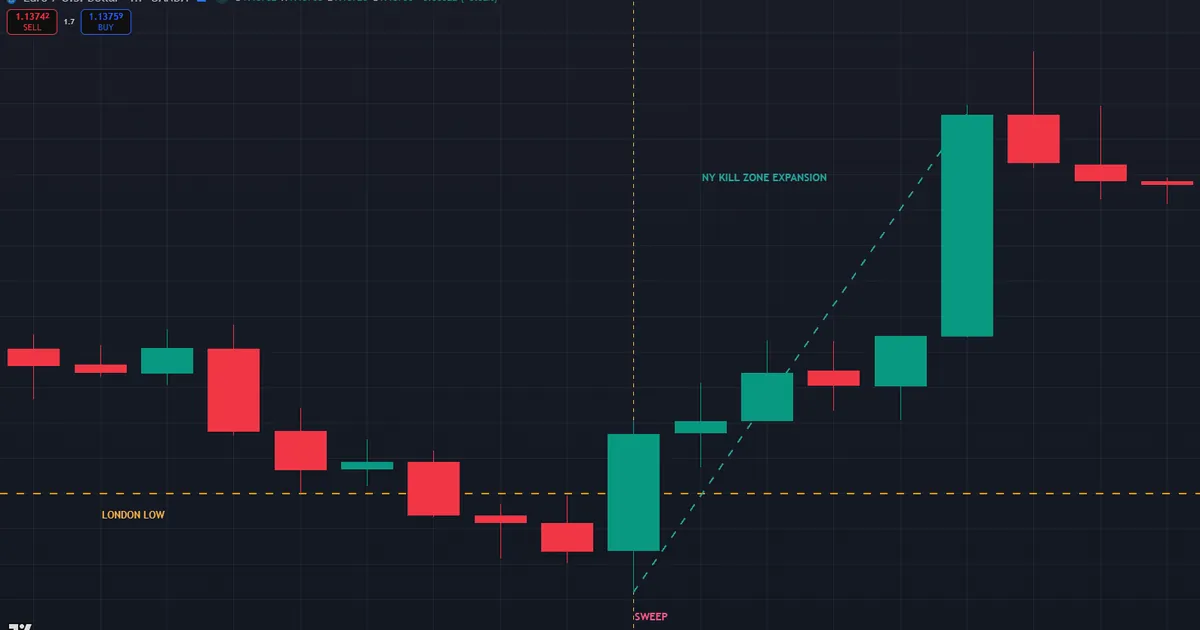
Reading the EURUSD 1-hour chart
Notice the order of events. The early New York candles pushed below the London low and grabbed the sell stops resting there. That poke reversed within two candles. Then a full-bodied bullish candle broke back above the London low and confirmed the expansion.
The sweep is the signature of the window. New York frequently runs the London high or low first, because those pools fund the institutional side of the move. Truly, the low of that sweep became the invalidation point for every long that followed it.
Also, weigh what the chart never sold you. It gave a discount entry and a direction, yet it never promised the run would reach 1.14748. The move could have stalled at the prior day high, so every target rides on structure rather than hope.
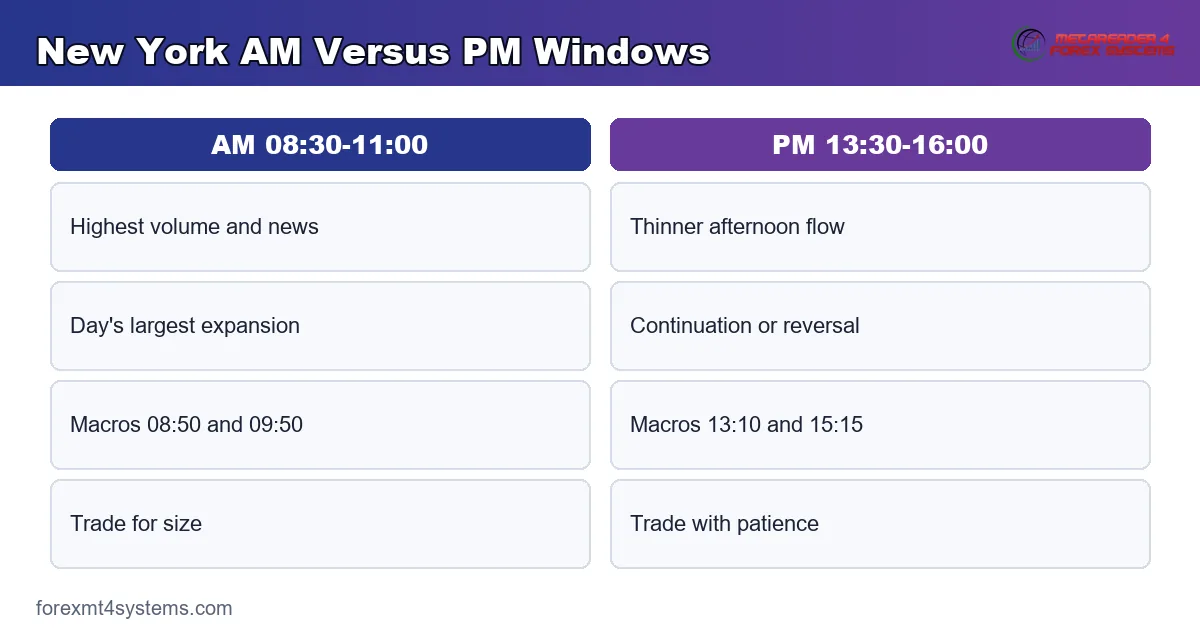
The New York AM window
The AM window from 08:30 to 11:00 is the heavyweight. It opens alongside major United States data and the 09:30 equity open, so volatility spikes early. Then the algorithm often delivers a single decisive move toward the day’s draw on liquidity.
Two macros sharpen the window. The 08:50 to 09:10 macro sets the early tone, while the 09:50 to 10:10 macro frequently carries the cleanest push of the morning. So many traders wait for the second macro before committing size.
The New York PM window
The PM window from 13:30 to 16:00 is quieter but still tradable. It follows the New York lunch hour, when volume thins and price often consolidates. Then afternoon flow returns and either continues the AM move or reverses a tired one.
The PM session has its own macros too. The 13:10 to 13:40 window opens the afternoon, and the 15:15 to 15:45 macro often produces a final push into the close. Plainly, the PM window rewards patience, because its best move usually arrives late.
The 09:30 equity open and the Judas swing
The United States stock market opens at 09:30 New York time, right inside the AM window. That open often injects a burst of volatility into major pairs, especially dollar crosses. So the first move after 09:30 can be a false push before the real direction sets.
ICT calls that false push a Judas swing. Price runs one way to grab stops, then reverses into the true direction of the day. Hence a sharp move at 09:32 is worth suspicion, not immediate pursuit, until displacement confirms which side the algorithm actually chose.
Pair the open with the daily bias to read it. When the bias points up and the open spikes down into a pool, that spike is the discount entry, not a breakdown. Then the retrace back through the pool becomes the setup, and the equity-open noise turns into a gift.
How to Trade the New York Kill Zone Step by Step
Run this routine in order, from the London close through the New York close. Now walk each step, and treat any missing piece as a reason to stand aside.
- Set the higher-timeframe bias. Decide whether the daily draw points up or down before New York opens.
- Mark the reference pools. Note the London high and low, the previous day high and low, and any equal highs or lows.
- Wait for the sweep. Let New York run one of those pools against the bias.
- Demand displacement. Require a fast, full-bodied candle in the bias direction after the sweep.
- Enter on the retrace. Trade the pullback into the fair value gap the displacement leaves.
Each step guards the next. A sweep without displacement is only a probe, and a displacement without a prior sweep often lacks fuel. Thus the pairing of the two events, in that order, is what separates a New York expansion from ordinary chop.
The first graphic below compresses these five steps into one pre-session card.

Confirming the entry inside the window
Let the displacement candle close before you act. Then mark the fair value gap it leaves and wait for price to trade back into it. A limit order at that gap keeps you disciplined, since chasing the expansion candle usually buys the high of the move.
Time the entry to a macro when you can. A retrace that completes near the 09:50 to 10:10 window carries extra weight, because the algorithm tends to deliver there. So the clock and the structure confirm each other rather than working alone.
Where the New York Kill Zone Sits in the SMC Workflow
The kill zone supplies timing, not a full trade. Smart Money Concepts (SMC) traders layer four things in fixed order: higher-timeframe context, a point of interest, lower-timeframe confirmation, and the entry itself. The New York window governs only when that last layer is allowed to fire.
Start on the daily and 4-hour charts, which set the bias and the draw on liquidity. Next, an H1 chart marks the point of interest, often an order block or gap in the path of that draw. Then the M5 or M15 chart times the trigger inside the AM or PM window. The ICT daily bias routine shows how to set that direction before the session.
Timeframe pairing and session timing
Split the work across charts deliberately. The 4-hour names the destination pool, the H1 frames the zone, and the M5 or M15 catches the sweep and displacement. So each chart answers one question, and no chart tries to do two jobs.
Get the clock right before anything else. Daylight-saving shifts can move the New York windows relative to your local time, so a fixed offset can drift out of sync. Our free forex market hours tool converts both windows to your own clock and flags the London overlap.
How London hands off to New York
The two big sessions work as a relay. A move that starts late in London often extends straight into the New York AM window rather than dying at the London close. So the London kill zone guide and this one describe two halves of the same trading day.
Watch the London range as a pool. New York frequently sweeps the London high or low before it commits, exactly as it hunts the buy-side and sell-side liquidity resting there. Hence the handoff is not random; it targets the levels London left behind.
Trading the New York Macros
The macros are the sharpest tool inside the window. Each one is a short block of minutes when the algorithm tends to deliver a run, so timing an entry to a macro adds real confluence. The full mechanics live in the ICT macros guide, yet the New York versions deserve a quick map here.
The AM macros that matter most
The 08:50 to 09:10 macro sets the early tone before the equity open. Then the 09:50 to 10:10 macro frequently carries the cleanest push of the morning, since it lands in the peak of the London and New York overlap. So a retrace that completes near 09:50 often marks a high-odds entry.
Do not force a trade in every macro, though. A macro with no prior sweep and no clear bias is just twenty minutes on the clock. The window matters only when structure agrees with it.
The PM macros and the close
The afternoon opens with the 13:10 to 13:40 macro, which often ends the lunch lull. Later, the 15:15 to 15:45 macro can drive a final push toward the day’s draw before the 16:00 close. Hence the PM window frequently saves its best move for the last hour, which is why patience pays.
Worked Example: A Bearish New York PM Session on GBPUSD
PM sessions often reverse a tired AM move, and the chart below walks one from levels to target, step by numbered step.

- First, the context: GBPUSD had rallied into a premium, pressing toward the session high near 1.34800.
- Next, the bias: the daily draw still pointed lower, so the rally looked like a retracement, not a trend.
- The trap: the New York session pushed to 1.34814, sweeping the session high and grabbing buy stops.
- The trigger: a fast candle broke lower, leaving a bearish fair value gap between 1.34588 and 1.34614.
- The trade: short the retrace into that gap near 1.34600, stop above the sweep at 1.34840, first target the previous day low at 1.34136.
The raid is the setup, not a flaw. A bearish PM reversal frequently opens with a run above the AM high, because those buy stops fund the institutional selling that follows. So the checklist insists on displacement before any entry fires.
Manage the trade along the marked levels. The short near 1.34600 risks about 24 pips to a stop above the sweep, while the first target waits roughly 46 pips below near 1.34136, close to two times the risk. Many traders bank a partial there and trail the rest toward the close using the 15:15 macro as a guide.
Also, note the counterfactual. Had the daily draw pointed up instead, the same previous day high sweep would carry no weight, and the clean setup would wait for a run on the sell-side below. So the AM rally would read as strength, not a trap, and the PM plan would flip to longs. The bias, not the window, decides the direction.
Download the complete indicator database
Put these concepts on your charts. One email unlocks the full library of 1,380+ indicators with compiled MT4 and MT5 files, plus my TradingView scripts. No paywall, no spam, unsubscribe any time.
Get free access to my indicator database
One email unlocks 1,380+ free MT4, MT5 and TradingView indicators — the complete library. No single-tool download; you get the whole database.
Common New York Kill Zone Mistakes
Six errors show up in almost every New York journal, and each has a plain fix.
- Trading the 08:30 news spike blind. Fix: let the first reaction settle, then trade the second, cleaner setup.
- Chasing the AM breakout without a sweep. Fix: wait for a run on a pool first, then demand displacement.
- Forcing a trade during lunch. Fix: respect the 12:00 to 13:00 lull and wait for the PM window to wake up.
- Ignoring the daily bias. Fix: take only the New York move that agrees with the higher-timeframe draw.
- Overstaying past 16:00. Fix: close intraday risk into the New York close rather than holding into thin hours.
- Sizing every window the same. Fix: scale risk to how clean the sweep and displacement look.
None of these errors are exotic. Still, each one quietly turns a structured window into a coin flip, and only a written record makes them visible.
The deepest trap is the 08:30 release. A data print can spike price both ways within a minute, stopping out early entries before the true move begins. Instead, wait for the market to choose a direction, then trade the retrace with the bias.
The second graphic pairs the six mistakes with their fixes for a fast pre-session review.
New York Kill Zone Pre-Session Checklist
Run these lines before 08:30 New York time, in order and without exceptions. Any failed line downgrades the session or removes it entirely.
- Daily draw on liquidity named as either up or down.
- London high and low marked, plus the previous day levels.
- Point of interest set in the path of that draw.
- Red-news times checked before the plan is fixed.
- Sweep of one pool observed, not assumed.
- Displacement candle confirmed in the bias direction.
- Entry, stop, and first target written before the fill.
- Window chosen: AM for size, PM for the reversal.
Also, grade each session before you trade it. Score the sweep, the displacement, and the bias agreement, then reserve full risk for the A-grade windows only. Over a quarter, those grades show whether your best reads cluster where you thought they did.
Limitations and a Failed New York Session
The New York kill zone fails in specific, predictable ways. Some AM sessions deliver the move so fast on news that no clean retrace ever forms. Other PM sessions drift sideways into the close and never sweep a pool. So a blank New York window is a valid outcome, not a missed trade.
The window is also discretionary. Two traders can mark different pools and reach opposite reads, and hindsight makes every finished session look obvious. Meanwhile, purpose-built ICT indicators for MT4 and MT5 can standardize the levels you mark, which removes one source of noise.
Keep expectations honest and qualitative. No public dataset measures how often a New York sweep resolves into a clean expansion, and any precise figure online is a guess. What your own journal can show is a pattern over a month: whether the cleanest sweeps outperform the messy ones in your hands.
A failure walkthrough: the macro reversal
The chart below shows the loss that teaches New York discipline fastest. Picture EURUSD on the 1-hour chart with a bearish plan: a high swept, daily draw down, a short filled on the retrace into the fair value gap near 1.14170. Price drifts down toward 1.13982, right on script. Then the 15:15 macro fires and price rips back above the entry gap.
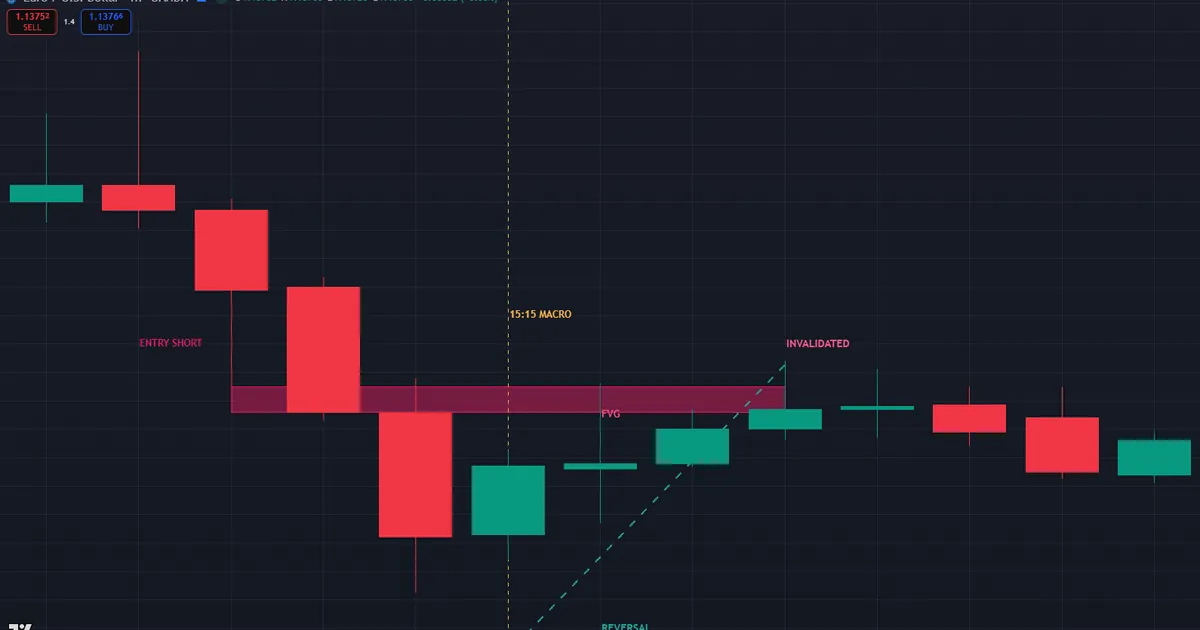
That reversal is displacement against your position. The clue is the close: price closed back above the fair value gap your short leaned on, which flips the read. Hence the invalidation rule is strict. Once price closes past the level your entry used, the trade is wrong and the stop belongs right above the sweep high.
Log the session as a structure failure, not bad luck. Record the macro that reversed it, how far price ran before the flip, and what a re-entry would have required. Indeed, one honest failure entry teaches more than a week of clean sessions, because it shows exactly where the plan bent.
This failure also carries a lesson about time. The 15:15 macro is a known reversal risk, so a PM short that has not reached target by then deserves tighter management. Meanwhile, banking a partial before the macro protects the trade from exactly this flip. So the clock is not only an entry tool; it is a warning system for open risk as well, and treating it that way keeps a good trade from turning into a needless loss right before the close.
Related Concepts for New York Traders
Several companion reads deepen the routine. The ICT Asian range strategy explains the overnight box that both London and New York later hunt, which sets the pools you mark before the open. Then the full guide to ICT kill zones maps all four daily windows in one place, so the AM and PM sessions sit inside the wider schedule rather than standing alone.
Read these three guides as one system. The Asian range builds the liquidity, London takes the first swing at it, and New York often completes the day’s move. Together they turn the clock into a filter that decides not just what to trade, but exactly when to trade it. So a single map of the day beats four disconnected setups.
FAQ
What time is the New York kill zone in New York time?
The New York kill zone runs in two windows. The AM window covers roughly 08:30 to 11:00, and the PM window covers roughly 13:30 to 16:00. Both use New York time, and the AM window usually carries the day’s largest move.
Which New York window is better for beginners?
The AM window offers the most volume and the clearest structure, so many beginners start there. The PM window is thinner and demands more patience. Still, trade only the window you can watch fully, since a half-watched session invites mistakes.
Should I trade the 08:30 news release?
Trading the release itself is high risk, because price can spike both ways within a minute. A calmer approach waits for the first reaction to settle, then trades the retrace in the direction of the daily bias. So the news becomes a catalyst, not the trade.
What are the New York macros?
The macros are short algorithmic windows inside the session, such as 08:50 to 09:10 and 09:50 to 10:10. Price often delivers a sharp move during these minutes. Thus many traders time entries to complete near a macro for added confluence.
Do the New York windows work on gold and indices?
The logic transfers, since pools and displacement exist on any liquid chart. Gold reacts hard to dollar news, and indices concentrate volume around the 09:30 equity open. So test the routine per instrument on a demo before risking capital.
Does the New York kill zone deliver every day?
No. Some sessions never sweep a pool, and news days can void the setup entirely. Treat a blank window as a valid outcome and wait for the next clean sweep and displacement. Results are not guaranteed; past performance is not indicative of future results.
External references
- For background on this concept, see New York Stock Exchange on Wikipedia.
- For broader market context, see After-Hours Trading at Investopedia.

About the author
Written by Dominic Walsh, a Forex trader and MT4/MT5 indicator, Expert Advisor and script developer. Every tool on forexmt4systems.com is tested on live charts before release and ships with ready-to-use compiled MT4 (.ex4) and MT5 (.ex5) files. Learn more about the trader and developer behind this site.
How we build, test and correct every tool: Editorial & Testing Policy. Trading carries risk; see the disclaimer.