
SMC trading mistakes cost more accounts than any single bad setup, because the same errors repeat across every tool in the smart money toolkit. Traders chase zones, ignore the higher timeframe, and force entries where none exist. So this guide walks through the most common SMC trading mistakes, explains why each one hurts, and gives you a clear fix for every trap.
By the end you will audit your own charts against a fixed list of SMC trading mistakes, catch the errors before they cost you, and build habits that survive a losing streak. We keep the advice practical and the tone honest, so you can apply it on your very next session.
What Are the Most Common SMC Trading Mistakes?
Most SMC trading mistakes fall into a few clear buckets. Traders misread bias, mislabel structure, chase liquidity, and skip risk control. So the errors are rarely exotic. They repeat because the smart money framework tempts newcomers into seeing perfect setups everywhere, long before their reading is reliable.
Smart money concepts grew from the delivery ideas of Michael Huddleston, the Inner Circle Trader (ICT), who framed price as an engineered feed between pools of liquidity. That framework is powerful, yet it demands discipline. So the danger is not the theory itself but the way beginners apply it without patience or a plan. For the foundations, our guide to what ICT trading is sets the base you need.
Read the chart below to see a typical mistake in one frame. Price sweeps a high, a trader shorts immediately, and then price rips higher on a change of character. We mark the rushed entry and the point where a patient reader would have waited. So the error stands out against the setup that actually paid.
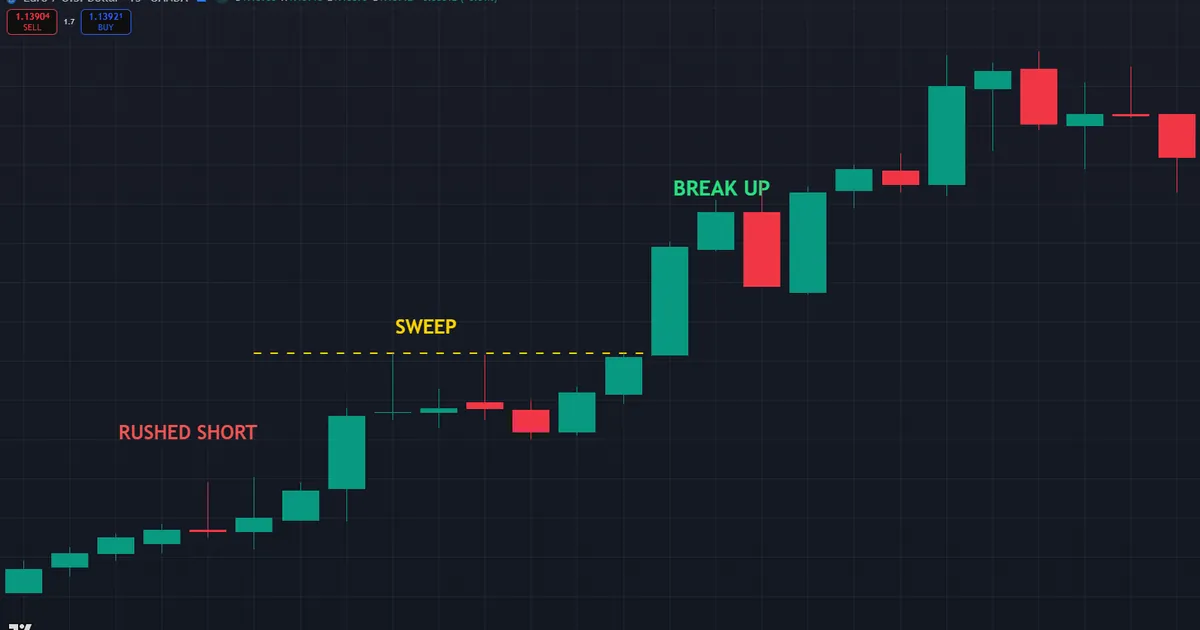
Notice the pattern behind most errors. They share a single root: acting before confirmation. Whether the trade is a rushed sweep, a forced zone, or a counter-trend guess, the fix usually starts with one word. Wait.
Money leaks in two directions, and both matter. Some errors lose money on bad entries, while others give back profit through poor management. So a full audit covers the whole trade, from the moment you spot a setup to the moment you close it. Fixing only your entries, while ignoring your exits, leaves half the leak wide open.
Why These Mistakes Repeat
SMC mistakes repeat for human reasons, not technical ones. The framework looks clean in hindsight, so traders assume it should feel clean in real time. Then boredom, fear, and impatience take over. So a solid plan collapses the moment the chart moves fast, and the same error prints again on the next session.
Hindsight bias deepens the trap. On a replay, every sweep and shift looks obvious, so traders overrate how easy live reading will be. Then the market delivers noise instead of textbook moves, and confidence turns to frustration. So treat the clean hindsight chart with suspicion, and expect live trading to feel far messier than any tidy study screenshot you happen to review after the close.
How to Diagnose Your Own Mistakes
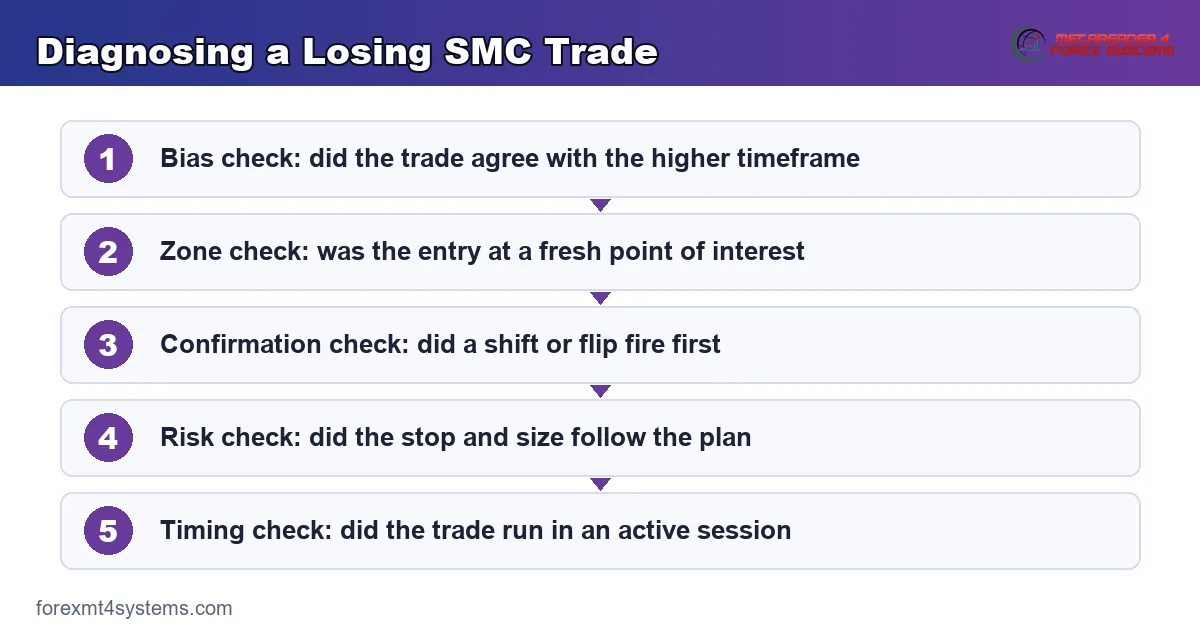
Fixing errors starts with naming them, so run a simple diagnosis on every losing trade. Walk the five checks below and most problems reveal themselves.
- Bias check. Ask whether the trade agreed with the daily and four-hour direction, or fought it.
- Zone check. Ask whether the entry sat at a fresh point of interest, or floated in the middle of a range.
- Confirmation check. Ask whether a structure shift or delivery flip fired before entry, or you jumped early.
- Risk check. Ask whether the stop and size followed your plan, or grew on emotion.
- Timing check. Ask whether the trade ran during an active session, or during quiet, choppy hours.
The branded graphic below turns these five checks into a repeatable audit. Notice how a single loss often fails more than one check. So fixing one habit frequently removes several errors at once, which speeds up your progress.
Journaling Turns Losses Into Lessons
A journal is the single best mistake-killer in trading. Record the pair, the setup, the checks above, and a screenshot for every trade. So over a few weeks your errors cluster into a short, obvious list. A free trade journal tool keeps that record structured, which turns each loss into tuition rather than pure cost.
Review the journal on a schedule, not at random. Once a week, sort your losing trades by which check they failed. So the biggest leak becomes obvious, and you can attack it first. Traders who skip this review keep repeating the same error for months, while those who run it fix one root cause at a time.
Mistake One: Ignoring Higher-Timeframe Bias
The most expensive SMC error is trading against the higher timeframe. A perfect five-minute setup means little if the daily points the other way. So traders who buy a pretty demand zone inside a strong downtrend usually watch price slice right through it.
The fix is a fixed routine. Set direction on the daily and four-hour charts before you touch a lower chart. Then take only the setups that agree with that direction. So the higher timeframe becomes a filter, and half of your worst trades vanish before you ever place them.
There is a subtler version of this error too. Some traders read the higher timeframe correctly, then talk themselves out of it when a tempting counter-trend setup appears. So the discipline is not just marking the bias; it is honoring it under pressure. Write the daily direction at the top of your chart and refuse any trade that fights it.
Mistake Two: Chasing Liquidity Sweeps
Liquidity is central to smart money trading, yet chasing it blindly is a classic trap. A sweep of a high or low tells you stops were taken; it does not prove a reversal. So a trader who shorts the instant a high is swept often gets run over by continued strength.
The fix is confirmation. Wait for price to reject the swept level and print a structure shift back the other way. Our guide to liquidity sweep trading shows how to separate a genuine reversal sweep from a simple continuation. So the sweep becomes a setup, not a signal on its own.
Location matters as much as confirmation. A sweep that happens at a fresh higher-timeframe zone carries far more weight than one floating in the middle of a range. So grade the sweep by where it prints, not just by the fact that it happened. A raid into a key level, followed by a clean rejection, is the setup worth waiting for.
Confusing a Sweep With a Break
A related error blurs a sweep and a real break. A sweep pierces a level and reverses, while a break closes through it and holds. So watch the close, not the wick. A candle that closes firmly beyond the level is a break to respect, while a quick spike and rejection is a sweep to fade with confirmation.
Mistake Three: Mislabeling Market Structure
Structure is the backbone of smart money reading, so mislabeling it wrecks everything downstream. Traders often call a minor pullback a change of character, or miss a real break entirely. So their bias flips at the wrong moments, and every later decision inherits the error.
The fix is a strict definition of a swing. Only count a break when price closes beyond a clear prior swing point, not on a shallow wick. Our guide to the market structure shift sets those rules precisely. So consistent labels give you consistent bias, and the whole read steadies.
Timeframe mixing makes this error worse. A trader reads a bullish break on the five-minute and forgets the one-hour still points down. So the labels clash, and confusion follows. Fix it by always naming the timeframe of every structure call out loud. A five-minute shift inside a one-hour downtrend is a pullback, not a reversal, and naming it that way keeps you honest.
Mistake Four: Forcing Zones That Are Not There
Smart money traders love zones, so they sometimes invent them. Every tiny pause becomes an order block, and every gap becomes a fair value gap worth trading. So the chart fills with weak levels, and the trader takes far too many low-quality trades.
The fix is selectivity. A real zone comes from a sharp, structure-breaking move, not a lazy drift. Our comparison of a fair value gap versus an order block helps you grade the difference. So mark only the zones with force behind them, and let the weak ones go untraded.
A simple test cuts the clutter fast. Ask whether the move that created the zone broke structure and left an imbalance. If it did not, the zone is probably noise. So demand a real reason for every level you draw, and your chart shrinks to a handful of high-quality zones instead of a cluttered mess of weak ones.
Trading in Choppy, Rangebound Conditions
Not every market suits smart money setups. In a tight, newsless range, sweeps and shifts fire constantly and mean little. So the framework works best when price trends or expands, not when it drifts sideways. Traders who force SMC reads onto a dead range collect a stream of tiny losses. Stand aside until price shows a clear direction again.
Worked Example: How One Mistake Snowballs
Now make the damage concrete with a single trade. A trader sees EURUSD sweep session equal highs, near the 1.14204 area, and shorts instantly, sure that a reversal is due. The chart below shows the rushed entry and what followed.
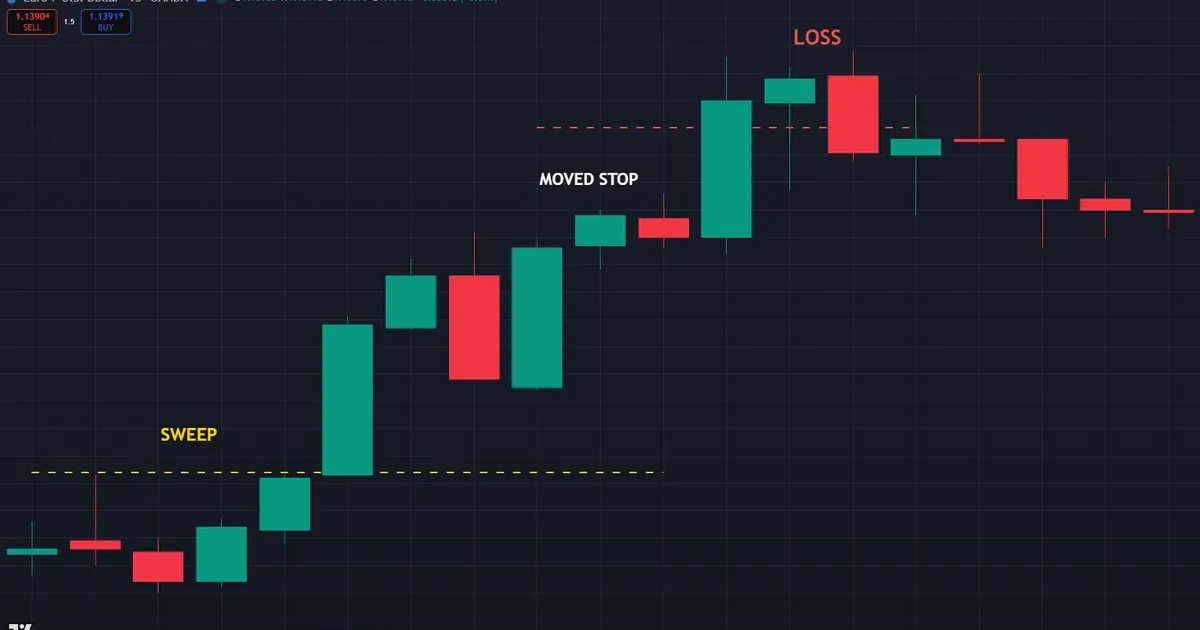
The first error is chasing the sweep with no confirmation. Price does not reject; instead it consolidates and then breaks higher, closing firmly above the swept high. So the short sits underwater within minutes.
The second error compounds the first. Rather than take the small loss, the trader moves the stop higher to around 1.1433 to avoid it, hoping for a return. Then price accelerates up toward the next pool, near the 1.14358 area, and the loss balloons. So one rushed entry, plus one moved stop, turns a tiny mistake into a painful one. Notice how discipline at either step would have saved the account.
This snowball is the real lesson. Single mistakes rarely ruin an account; chains of them do. A rushed entry invites a moved stop, which invites revenge trading, which invites oversized risk. So breaking the chain early matters more than being right on any one trade. Take the first small loss cleanly, and the snowball never forms.
Download the complete indicator database
Put these concepts on your charts. One email unlocks the full library of 1,380+ indicators with compiled MT4 and MT5 files, plus my TradingView scripts. No paywall, no spam, unsubscribe any time.
Get free access to my indicator database
One email unlocks 1,380+ free MT4, MT5 and TradingView indicators — the complete library. No single-tool download; you get the whole database.
More Common SMC Mistakes and Their Fixes
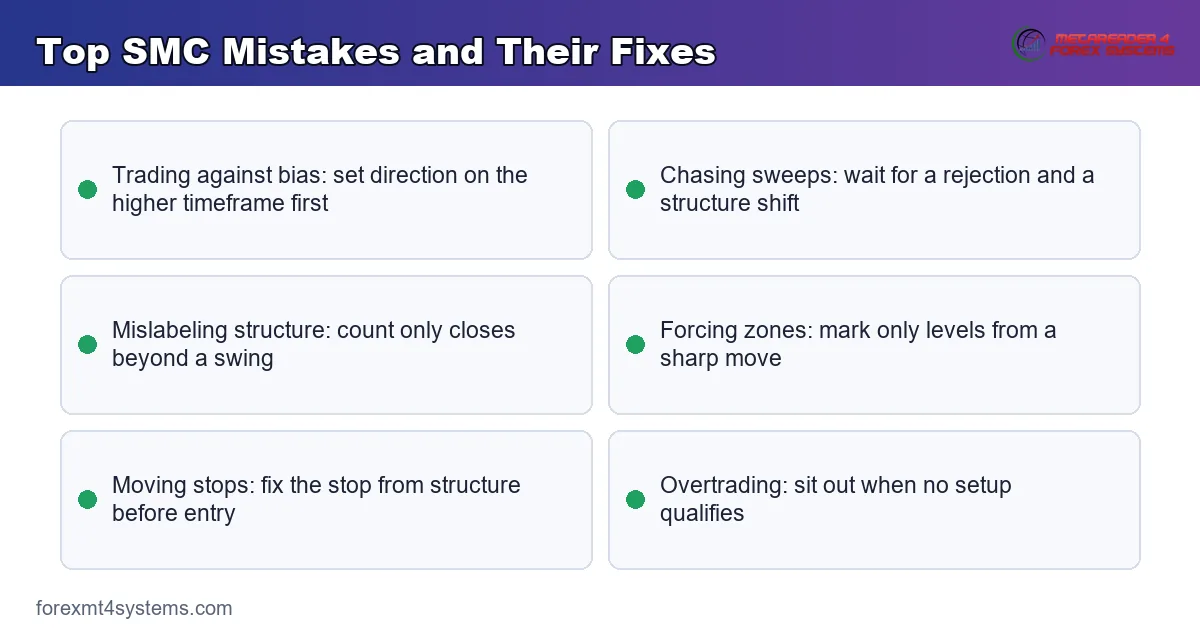
Beyond the big four, a cluster of smaller errors drains accounts steadily. The graphic below collects the most frequent ones, and the fixes follow beneath it. Each fix costs nothing but discipline.
Overloading the Chart
Some traders mark every order block, gap, and liquidity level at once. The chart turns into noise, and clarity vanishes. So keep only the levels that matter for the current bias, and clear the rest. A clean chart makes a clean decision.
Moving the Stop to Avoid a Loss
Widening a stop to dodge a loss is among the costliest habits in trading. It turns a planned small loss into an unplanned large one. So set the stop from structure before entry, and never move it against the trade. Accept the loss and hunt the next setup.
Overtrading Out of Boredom
A quiet session tempts traders into marginal setups just to feel active. Those forced trades rarely pay. So define your setups in advance, and sit on your hands when nothing qualifies. Patience is a position, and often the best one.
Risking Too Much Per Trade
Even a good method fails with reckless size. A trader risking a huge slice of the account on one idea cannot survive a normal losing run. So fix your risk per trade at a small, constant percent, and size every position from the stop distance. Survival comes first.
Revenge Trading After a Loss
A loss stings, and the urge to win it back instantly is strong. So a trader jumps into a fresh position with no setup, purely to recover. That revenge trade usually deepens the hole. Step away from the screen after a loss, reset, and return only when a real setup appears.
Abandoning the Plan After a Loss
One loss tempts a trader to switch methods entirely. That jump throws away the edge before it can play out. So judge a method over a sample of trades, not a single result. Consistency, not reinvention, builds a track record. So give a plan a fair sample of at least twenty or thirty trades before you judge whether it truly works for you.
Skipping the Trading Session Clock
Smart money setups lean on session timing, yet many traders ignore it. A shift during the dead Asian afternoon rarely carries the force of one at the London open. So check the clock before you trust a signal. Aligning your best setups with active sessions removes a whole tier of weak trades.
Pre-Trade Discipline Checklist
Run this list before every trade. A few seconds here filters most of the mistakes above. Treat any unchecked box as a reason to pass on the setup entirely.
- Higher-timeframe bias marked on the daily and four-hour charts.
- Entry sitting at a fresh, high-quality point of interest.
- Confirmation present, such as a structure shift or a delivery flip.
- Stop set from structure before entry, with no plan to widen it.
- Risk fixed at a small, constant percent of the account.
- Position size calculated from the stop distance.
- Session and news checked so the trade runs in clean conditions.
Honest Limitations: Mistakes Never Fully Disappear
Study the hardest truth head on. Even disciplined traders keep making mistakes; they simply make them smaller and less often. Here is a common late-stage error. A skilled trader nails the read, sizes correctly, and then exits far too early near 1.1387 out of fear, leaving the rest of the move toward 1.13996 on the table. The chart below shows that premature exit.

What went wrong? Usually emotion, not analysis. The plan was sound, but fear overrode it at the worst moment. Hence the value of rules that remove in-trade decisions. Set the target and the stop in advance, then let the trade run to one or the other. So management becomes mechanical, and fear loses its grip.
Partial exits offer a middle path here. Bank some profit at the first target, then trail the rest and let it breathe. So you lock in a win while still giving the move room to extend. This structure eases the fear that triggers premature full exits, because the money already banked calms the mind.
Screen Time Cannot Be Skipped
No article replaces repetition. You reduce mistakes by watching thousands of setups unfold, not by reading a list once. So treat replay practice as core work, not a chore. The traders who improve fastest are the ones who log the most honest reps on their charts.
Comparing SMC With Other Frameworks
Some errors come from misunderstanding what smart money trading even is. Traders blend it poorly with unrelated methods and confuse themselves. Our note on ICT versus SMC clears up the labels, while the supply-and-demand lens of RTM trading shows a sibling approach. So clarity on the framework itself prevents a whole class of mistakes.
No Fixed Success Rate Exists
Be blunt here. No reliable success percentage exists for smart money trading, and anyone quoting one is guessing. Outcomes hinge on your discipline far more than on any single tool. Qualitatively, traders who fix the errors above and manage risk tightly last far longer than those who chase perfect entries. That direction of effect is the only honest claim worth making.
Related SMC Concepts to Study Next
A sensible study order helps here. First, fix the bias and confirmation errors, since they cause the most damage. Then tighten your risk habits, and only then chase finer entry skills. So repair the foundation before you polish the details, one habit at a time.
Reducing SMC trading mistakes ties back to the whole toolkit. A firm grasp of structure stops most mislabeling errors, while a clear read of liquidity stops most chasing errors. The wider library of smart money indicators for MT4 and MT5 can mark structure and zones while you train your eye. Master bias, patience, and risk together, and most of the errors on this page fade from your trading for good.
FAQ
What is the most common SMC trading mistake?
Trading against the higher timeframe is the most common and costly error. A clean lower-timeframe setup fails often when the daily points the other way. So set your bias first and take only setups that agree with it.
Why do I keep chasing liquidity sweeps?
Sweeps look like instant reversals, so they tempt an early entry. Yet a sweep only proves stops were taken, not that price will turn. So wait for a rejection and a structure shift before you act on any sweep.
How do I stop moving my stop loss?
Set the stop from structure before you enter, then treat it as fixed. Widening it turns a small planned loss into a large one. So accept the loss when the level breaks, and move on to the next setup.
How many SMC tools should I use at once?
Fewer than you think. Overloading the chart with every zone and level creates noise, not clarity. So keep only the levels that matter for your current bias and clear the rest before deciding.
How long does it take to fix these mistakes?
It varies, and it depends on honest review rather than time alone. Traders who journal every trade and study replays improve far faster. So measure progress in logged reps, not in weeks.
Can I eliminate mistakes completely?
No, mistakes never fully disappear, even for skilled traders. The goal is smaller, rarer errors and tight risk control. Always manage risk on every trade. Results are not guaranteed; past performance is not indicative of future results.
External references
- For background on this concept, see Trading Psychology at Investopedia.
- For broader market context, see Risk Management at BabyPips Forexpedia.

About the author
Written by Dominic Walsh, a Forex trader and MT4/MT5 indicator, Expert Advisor and script developer. Every tool on forexmt4systems.com is tested on live charts before release and ships with ready-to-use compiled MT4 (.ex4) and MT5 (.ex5) files. Learn more about the trader and developer behind this site.
How we build, test and correct every tool: Editorial & Testing Policy. Trading carries risk; see the disclaimer.