
The ICT vs SMC question sparks endless online arguments, yet the answer is calmer than the debate suggests. ICT is one trader’s specific curriculum. Meanwhile, SMC is the broader community framework that grew out of it. So the two are not really rivals; one is the parent, and the other is the sprawling family.
This guide separates the two fairly, without tribal loyalty to either camp. So by the end, you will know exactly what belongs to ICT, what SMC added, where the vocabularies map onto each other, and which label to reach for when you plan a trade.
ICT vs SMC at a Glance
ICT stands for the Inner Circle Trader, the teaching brand of Michael Huddleston, the Inner Circle Trader. He built a large, structured curriculum around how he believes institutional algorithms deliver price. SMC, or smart money concepts, is the wider community that took his ideas, simplified them, renamed some, and spread them across social media.
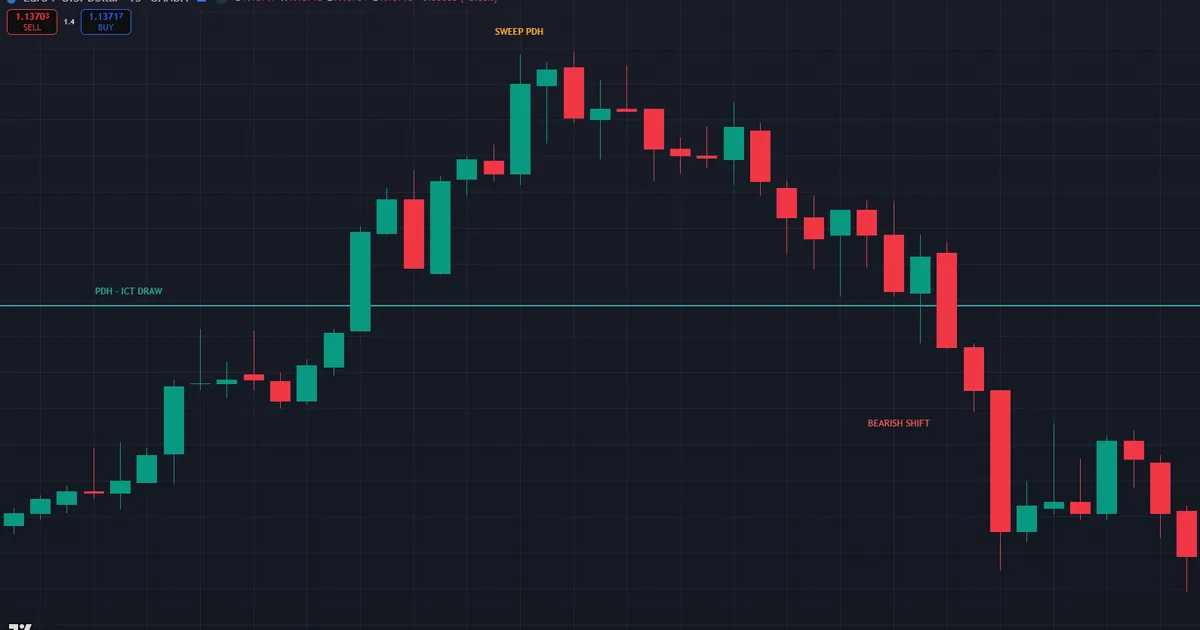
The chart below shows a pure ICT read. EURUSD sweeps the previous day high at 1.14217 up to 1.14356 during the London kill zone on a Wednesday. Then price shifts structure down, leaves a fair value gap on the drop, and offers a short on the retrace toward 1.1368. That sequence uses ICT’s own vocabulary end to end.
| Aspect | ICT | SMC |
|---|---|---|
| Origin | One author’s curriculum | Community framework derived from it |
| Scope | Deep, structured, time-based | Broad, simplified, widely shared |
| Core vocabulary | PD arrays, kill zones, models | BOS, CHoCH, order blocks, liquidity |
| Time focus | Heavy session and macro timing | Often lighter on timing |
| Consistency | Defined by the source | Varies by teacher |
Read the table as a family tree, not a scoreboard. ICT supplies the deep source material. SMC repackages a slice of it for a mass audience. Neither owns the market; both describe the same order flow with different levels of nuance.
Keep that framing as you read on. So whenever a video insists that ICT and SMC are opposites, remember the lineage. The disagreement is usually about vocabulary, teaching style, or how much timing to include. Underneath, both camps are pointing at the same candles and the same pools of resting orders.
What ICT Actually Is
ICT is a full curriculum, not a single setup. Huddleston released years of free content covering how he reads liquidity, imbalance, and time. So the body of work is large, and no single indicator captures it. Our what is ICT trading primer walks through the foundations in plain language.
Three pillars hold the method together. First come the premium and discount arrays, a family of levels that includes order blocks, fair value gaps, and breakers. The ICT PD arrays guide catalogs each one. Second comes liquidity: pools of stops above highs and below lows that the algorithm targets. Third comes time.
Time is where ICT stands apart. He teaches kill zones, macros, the midnight open, and quarterly cycles, all framed in New York time. So an ICT trader does not just ask where price is; they ask when it is likely to move. That temporal layer is often the piece SMC content leaves out.
Liquidity ties the three pillars together. ICT frames every move as a journey between pools of resting orders. Price reaches up for buy stops above old highs, then down for sell stops below old lows. So the arrays tell you where price may react, and liquidity tells you where it is heading. Time then tells you when the delivery is most likely. Read together, those three ideas form the backbone that every ICT model rests on.
The Role of Models
ICT also packages his ideas into named models. The 2022 model, the Silver Bullet, and the power of three each define a full sequence from setup to target. So a student can follow a repeatable recipe rather than improvise. These models are precise, rule-based, and tied to specific times of day.
Each model layers the same ingredients in a fixed order. First a liquidity raid, then displacement, then an imbalance, then an entry on the retrace. So the models are less about new ideas and more about disciplined sequencing. That structure is why ICT students can review a chart and agree on the read far more often than a loose SMC crowd.
Why the Curriculum Is So Large
The sheer volume of ICT material intimidates newcomers. Years of recorded lessons cover psychology, risk, algorithmic delivery, and dozens of setups. So no one absorbs it in a weekend. That depth is exactly what SMC set out to trim, which brings us to the second half of the story.
How SMC Emerged From ICT
SMC did not appear from nowhere. As ICT content spread, educators on social media distilled the most visual, teachable pieces into short lessons. So a movement formed around a compact set of labels that a beginner could apply the same afternoon.
That distillation served a real need. ICT’s depth is a barrier, and SMC lowered it. New traders could suddenly mark an order block, spot a liquidity grab, and read a change of character without watching hundreds of hours of source lectures. Hence the framework spread quickly across charts and feeds worldwide.
Something was lost in the compression, though. The timing layer, the macro windows, and the deeper narrative often fell away. So SMC became easier to learn but easier to misapply, because the context that made the labels reliable was frequently left on the cutting-room floor.
Attribution blurred along the way as well. As the labels spread, many learners met order blocks and liquidity grabs without ever hearing Huddleston’s name. So a fair account credits the source: SMC is the popular front end, and ICT is the engine behind it. Knowing that lineage helps you trace any label back to its original, fuller definition whenever a setup confuses you.
What SMC Grew Into
SMC took the useful core and made it teachable in an afternoon. Rather than years of lectures, SMC compresses the ideas into a handful of labels: break of structure, change of character, order block, and liquidity grab. So a newcomer can start reading charts quickly, which explains the framework’s explosive popularity.
That simplification is both a strength and a risk. On the plus side, SMC is accessible and visual. On the minus side, it sometimes drops the timing and narrative context that made the original ideas work. So two traders using the same SMC labels can reach opposite conclusions on the same chart.
Variation across teachers is the other wrinkle. Because SMC spread through many independent voices, definitions drifted. One educator calls a minor break a change of character; another reserves the term for external structure only. So the label you learn depends on whose videos you watched. ICT, by contrast, has a single source of truth, which keeps its definitions steadier.
The vocabulary maps cleanly, though. Use this quick translation when you move between the two dialects.
- An ICT market structure shift is what most SMC traders call a change of character.
- An ICT bullish or bearish order block matches the SMC order block almost exactly.
- ICT liquidity pools become the SMC liquidity grab or sweep.
- The ICT optimal trade entry overlaps the SMC discounted order block retest.
- ICT kill zones survive in SMC only when a teacher chooses to keep them.
The concept graphic below lines up the ICT terms against their SMC equivalents so the overlap is obvious at a glance.

Where the Two Fit in a Trading Workflow
Both frameworks share the same top-down skeleton, whatever the labels. Start on the higher timeframe, define bias and a draw on liquidity, then descend to execute. The words differ; the routine does not.
Begin with context on the four-hour or one-hour chart. Mark the range, decide the likely target, and note the point of interest price must reach to get there. An ICT trader frames this as a PD array plus a draw on liquidity. Meanwhile, an SMC trader frames it as an order block plus a liquidity pool. Same map, two legends.
Drop to the five-minute or fifteen-minute chart for the trigger. Wait for the sweep, then the structure shift, then the imbalance to retrace into. Enter on the retest with your stop beyond the raid extreme. The market structure guide shows how to label these swings consistently in either dialect.
Timing is where an ICT workflow adds an extra filter. Indeed, ICT traders weight the London kill zone, roughly 2:00 to 5:00 a.m. New York time, and the New York morning, 8:30 to 11:00 a.m., far more heavily. You can check those windows on the live forex market hours tool. So an SMC setup that ignores the clock becomes stronger the moment you add ICT’s session lens.
Choosing Which Label to Use
In practice, most traders end up bilingual. So use whichever term communicates the read most clearly to you. When you plan bias and targets, ICT’s draw-on-liquidity language keeps you honest about direction. When you mark entries on a small chart, SMC’s order-block and change-of-character labels are quick and visual.
Do not agonize over the wording. A change of character and a market structure shift point to the same candle, so pick one and stay consistent. Then your journal reads cleanly, your reviews compare like with like, and you avoid the trap of mistaking a vocabulary preference for an edge.
Worked Example: The Same Trade in Both Dialects
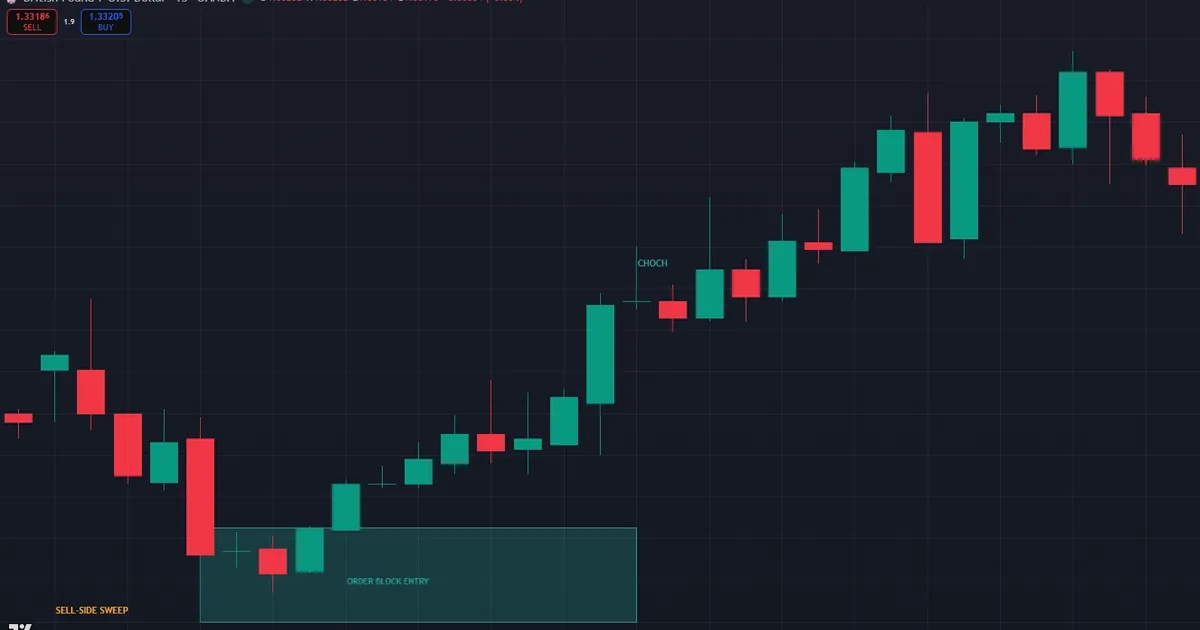
Now flip the direction and read one trade twice. GBPUSD sells off through the Asian session on the fifteen-minute chart and rests equal lows at 1.33705, a clear pool of sell stops. At 8:40 a.m. New York time, price sweeps to 1.33674, clearing the lows, then rejects hard.
An SMC trader labels what follows as a change of character. A strong bullish candle closes above the 1.33815 lower high, and a bullish order block forms at the origin of the move. So the plan is simple: buy the retrace into the order block, stop under 1.33674, target the session high. The chart below carries the full SMC labeling.
The Same Trade, the ICT Way
An ICT trader reads the identical price action with different words. That sweep of 1.33674 is a raid on sell-side liquidity. Next, the bullish close counts as a market structure shift. The order block is the last down-close candle inside a discounted PD array. Then the retrace into it becomes the optimal trade entry.
Notice the outcome. Both traders buy the same candle, at the same level, with the same stop and target. Hence the ICT vs SMC divide is mostly linguistic here. The narrative differs, the vocabulary differs, but the executed trade is one and the same.
Look closer and the ICT version adds one useful filter. The trade printed at 8:40 a.m. New York time, inside the New York morning window. So an ICT trader treats the timing as extra confirmation, not decoration. An SMC trader who ignored the clock still caught this one, yet on a quieter setup that same blind spot would have mattered.
The point is not that one framework beat the other. Rather, the ICT lens carried more information for the same effort. So the sensible path borrows SMC’s clean labels and ICT’s timing discipline, then applies both to every chart. That blend, not tribal loyalty, is what separates consistent readers from the crowd arguing online.
Download the complete indicator database
Put these concepts on your charts. One email unlocks the full library of 1,380+ indicators with compiled MT4 and MT5 files, plus my TradingView scripts. No paywall, no spam, unsubscribe any time.
Get free access to my indicator database
One email unlocks 1,380+ free MT4, MT5 and TradingView indicators — the complete library. No single-tool download; you get the whole database.
Common Misconceptions and How to Correct Them
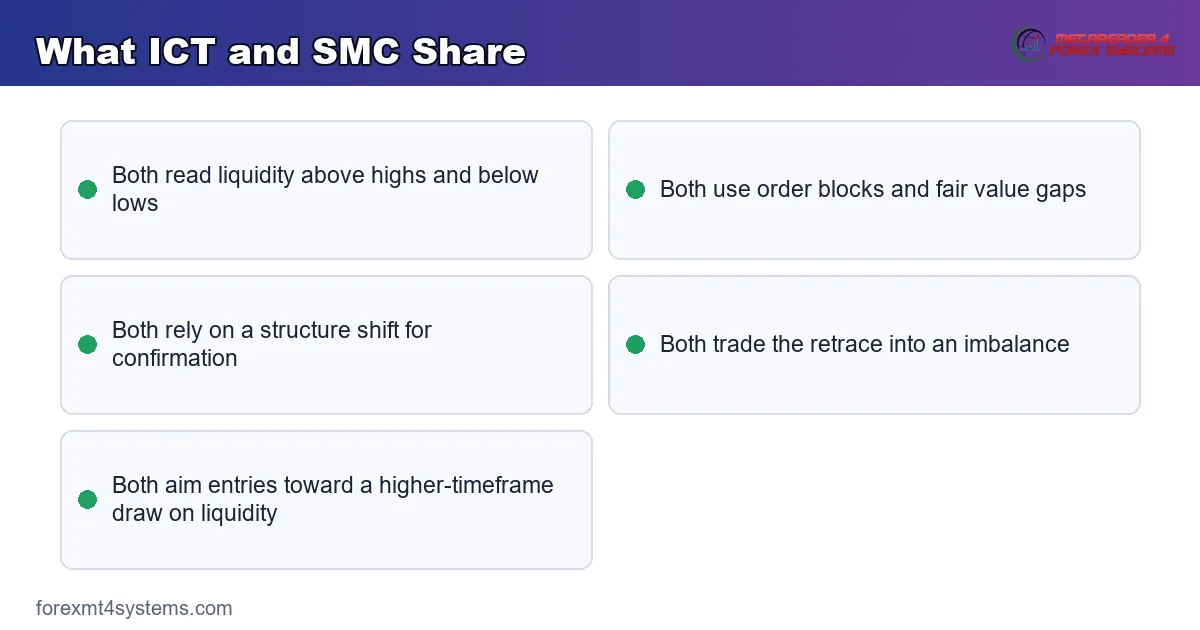
The debate breeds myths on both sides. Some come from ICT loyalists, others from SMC influencers, and a few from critics who dismiss both without study. The graphic below gathers the ones that mislead traders most, and each correction follows beneath it.
Treating them as opposing systems
ICT and SMC are not enemies. SMC is a subset and simplification of ICT, not a competitor to it. So arguing which is better misses that they describe the same order flow.
Assuming SMC keeps all the timing
Much SMC content drops kill zones, macros, and the midnight open. Instead, add the session lens back yourself, because timing often separates a clean setup from a random one.
Believing ICT is one indicator
No single tool captures the full curriculum. ICT is a way of reading liquidity, imbalance, and time together. So expect to combine several concepts rather than hunt for one magic script.
Thinking the labels change the trade
A change of character and a market structure shift are the same event. Renaming it does not alter the entry, stop, or target. So focus on the price action, not the vocabulary war.
Following signals without context
An order block alone is not a trade. Without a higher-timeframe bias and a clear draw on liquidity, the label is just a rectangle. Always anchor any signal to the larger picture first.
Quick-Reference Checklist
Run this list before you act on any ICT or SMC setup. It keeps the vocabulary from distracting you from the actual read.
- Higher-timeframe bias defined on the four-hour or one-hour chart.
- A clear draw on liquidity named as the target.
- A liquidity sweep or grab preceded the entry signal.
- A structure shift, however you label it, confirmed the turn.
- The imbalance or order block sits in a discounted or premium zone.
- An active session, London or New York, produced the setup.
- Entry, stop, and target mapped before the retest arrives.
Where the Frameworks Genuinely Diverge
Now study the case where the two really part ways, because that is where traders get hurt. A pure SMC signal often arrives stripped of timing and context. An ICT read insists on both. So the danger appears when someone borrows an SMC label and ignores the ICT narrative behind it.
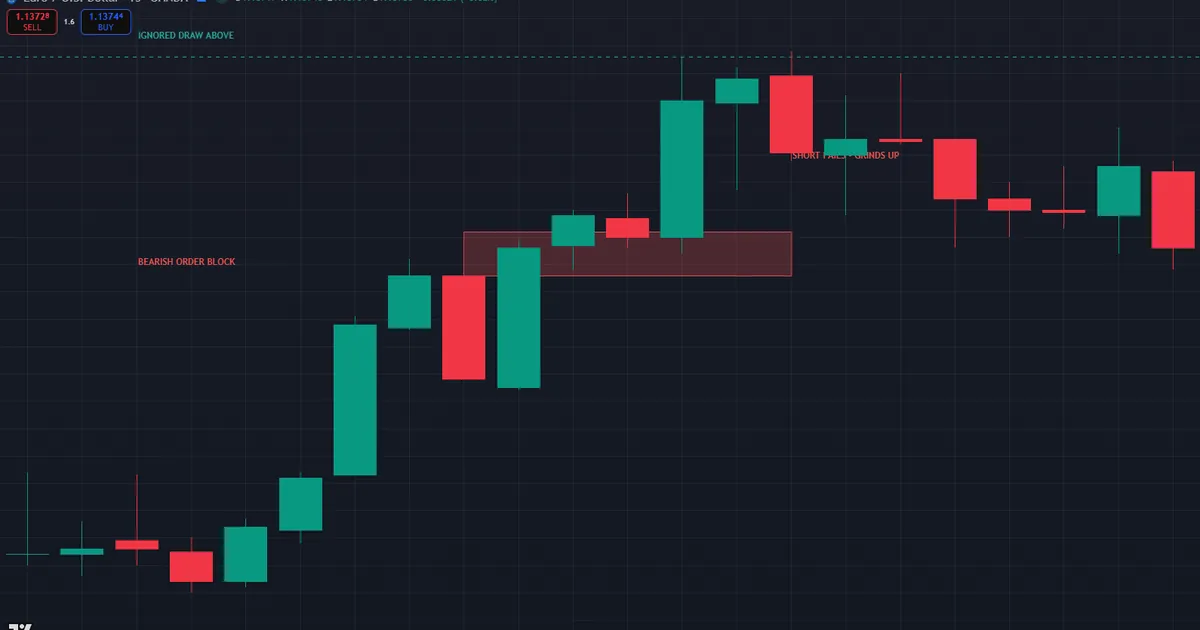
Picture a trader who spots a clean bearish order block on EURUSD and shorts it on sight. The rectangle looks textbook. Yet the four-hour draw on liquidity sits far above, at an untouched high near 1.14356, and the London session has not opened. So the higher-timeframe pull is up, and the timing is dead. Price taps the order block, pauses, then grinds straight through it toward the real target above. The chart below shows the order block, the ignored draw, and the failed short.
The Invalidation and the Lesson
The invalidation rule keeps the loss small. Once price closes a body beyond the order block against your position, the idea is void. So exit at once, without averaging. The lesson is not that SMC failed; it is that a label without context is only half a trade.
Afterwards, log three facts: the higher-timeframe draw, the session the setup printed in, and whether a sweep preceded it. Setups that skip those ingredients fail in clusters, and your own journal will prove it faster than any online argument about which framework is superior.
There is a subtler divergence worth naming too. ICT’s time-based models, such as the macros and the Silver Bullet, have no clean SMC equivalent. So a trader who only knows SMC simply cannot see those windows. Meanwhile, an ICT purist may over-filter and skip a clean SMC setup because it printed outside a favored hour. Both extremes cost trades. Hence the balanced reader keeps the timing as a weighting, not an on-off switch, and lets a strong setup earn a look even when the clock is imperfect.
Related Concepts to Study Next
Two neighboring topics complete this picture. The SMC vs price action guide zooms out further, placing SMC inside the wider history of chart reading. Meanwhile, the full guide to ICT indicators shows which tools automate the PD arrays and kill zones you just met.
Stack the three lessons and the noise fades. So instead of asking which framework wins, you will read the order flow directly and reach for whichever label communicates it most clearly. Then let the ICT indicators for MT4 and MT5 mark the arrays and sessions automatically while you focus on the decision.
A short drill locks in the bilingual habit. So take one setup and write it out twice, once in ICT terms and once in SMC terms, until the translation feels automatic. Then go the other way: read a stranger’s SMC annotation and add the ICT timing they left out. After a dozen repetitions, the two dialects merge into a single, richer read, and the online debate stops feeling relevant. What remains is the only question that pays: does this specific chart, at this specific hour, offer a setup worth risking money on.
FAQ
Is SMC just a rebrand of ICT?
Largely, yes. SMC took the core of ICT, simplified the language, and spread it widely. Some SMC teachers add their own twists, but the foundation is clearly derived from Huddleston’s curriculum.
Do I need to learn ICT to trade SMC?
Not strictly, but it helps. SMC gives you the labels quickly, while ICT explains the timing and narrative behind them. So learning both leaves you with fewer blind spots when a setup misbehaves.
Which one is better for beginners?
SMC is easier to start with because it compresses the ideas into a few visual labels. Then, as you grow, ICT fills in the session timing and deeper structure. Many traders begin with SMC and layer ICT on top.
Are order blocks an ICT or SMC term?
Both use it. The order block originates in ICT’s premium and discount arrays, and SMC adopted it almost unchanged. So the concept and the drawing are effectively identical across the two, and a chart labeled by either camp looks the same.
Why do ICT traders care so much about time?
ICT teaches that algorithms deliver price during specific windows, such as kill zones and macros. So timing filters out low-quality setups. That temporal layer is the clearest thing SMC often leaves behind.
Should I pick one framework and ignore the other?
No. They describe the same order flow, so treating them as rivals wastes energy. Use SMC labels for speed and ICT context for precision, and judge every setup by the price action itself. Results are not guaranteed; past performance is not indicative of future results.
External references
- For background on this concept, see Institutional Investor at Investopedia.
- For broader market context, see Retail investor on Wikipedia.

About the author
Written by Dominic Walsh, a Forex trader and MT4/MT5 indicator, Expert Advisor and script developer. Every tool on forexmt4systems.com is tested on live charts before release and ships with ready-to-use compiled MT4 (.ex4) and MT5 (.ex5) files. Learn more about the trader and developer behind this site.
How we build, test and correct every tool: Editorial & Testing Policy. Trading carries risk; see the disclaimer.