
Can you swing trade forex? Yes, and the currency market suits the style better than most. The honest follow-up matters more: here is what it costs you in financing, in weekend exposure and in patience.
Nothing in this guide sells the style. It sets out the bill, so you can decide whether the trade-off works for your account and your week.
Can You Swing Trade Forex? The Direct Answer
The market runs continuously from Sunday evening to Friday evening. So a position can stay open for days without any daily settlement forcing you out.
Liquidity holds up on the major pairs around the clock. Spreads on those pairs stay tight enough that a multi-day target absorbs the cost easily.
Retail platforms place no restriction on holding time either. Nothing stops a position running for a fortnight if your margin supports it.
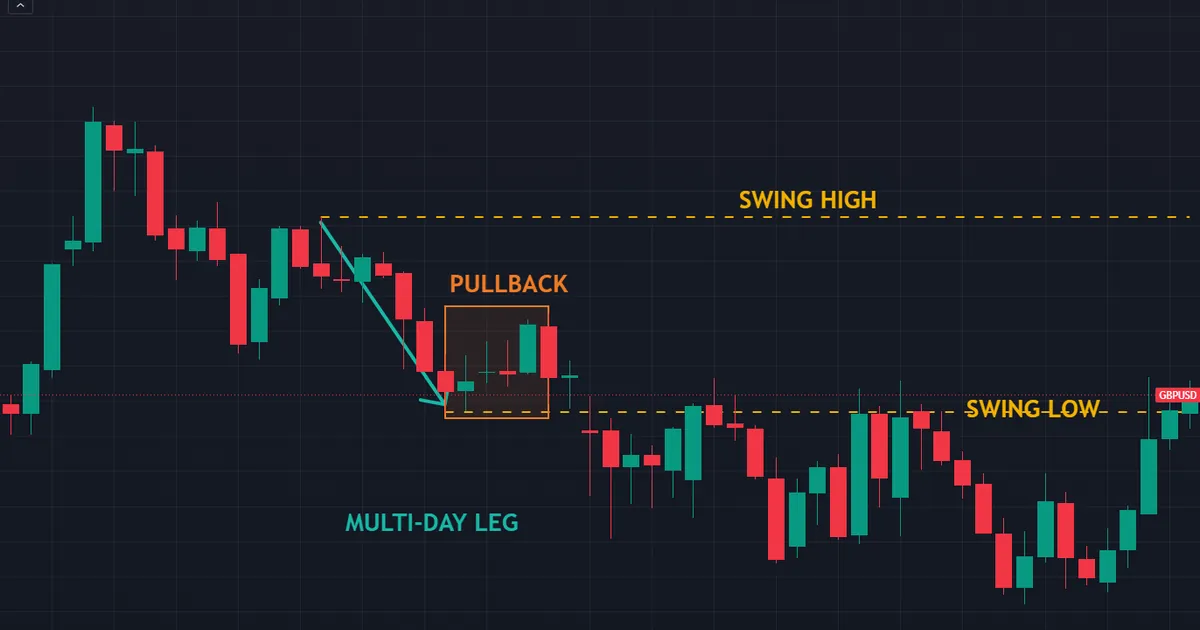
The chart above shows GBPUSD on daily bars. Legs of that size take days to develop, which is exactly the raw material this style needs.
What the Market Structure Allows
Currency legs develop smoothly because the market rarely stops. Share charts print a gap most mornings, while a currency chart usually does not.
That continuity helps a multi-day hold considerably. Your stop stays live through the Asian session, the London open and the New York afternoon.
Our guide to swing trading in forex covers how those legs get identified in the first place.
What Actually Stops People
Very few traders abandon the style because the market would not cooperate. Most leave for reasons that have nothing to do with the chart.
Financing surprises them, or a weekend gap does. Others simply cannot leave an open position alone for four days.
So the real question changes shape. Rather than asking whether the market permits it, ask whether your habits and your account can carry the cost.
A Swing Trader’s Week, Step by Step
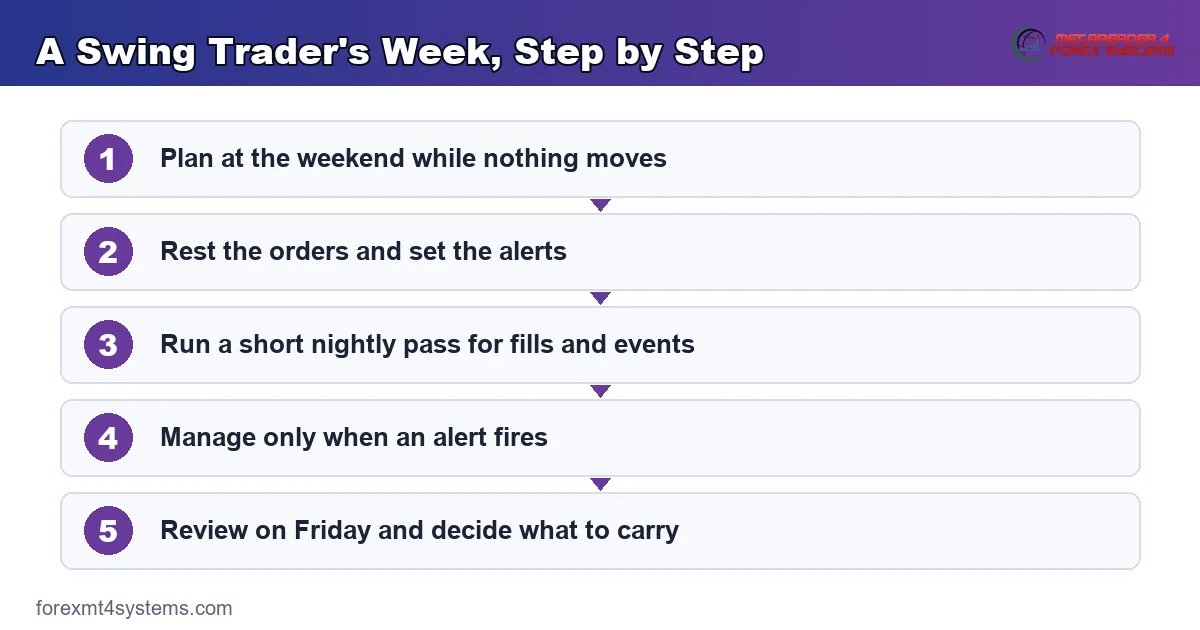
The routine stays small and repeats. Five steps describe almost every week.
- Plan at the weekend. Review the daily charts on your watchlist while nothing moves.
- Set the orders and alerts. Rest limits where you want price to come to you.
- Run a short nightly pass. Check for fills, structure breaks and scheduled releases.
- Manage only on a trigger. Act when an alert fires, never because the chart happens to be open.
- Review on Friday. Decide what to carry across the weekend and what to trim.
Step four does the heavy lifting. Because most hours require nothing, the discipline lies in leaving the position alone rather than in doing more.
Keep the same rhythm every week. A routine that changes with your mood produces a record you cannot learn anything from.
What It Costs You in Time
Time cost surprises people in both directions. The total hours stay low, though they land at awkward moments.

The Nightly Pass
Fifteen to twenty minutes covers a short watchlist. You check fills, glance at structure, then close the platform.
Doing it at the same hour helps enormously. Many traders use the daily rollover as their marker, since fresh bars print there on most platforms.
Skipping a night rarely matters much. Alerts already cover the levels that would demand a decision.
The Weekend Planning Block
Set aside an hour or two while markets sit closed. Nothing moves, so nothing pressures you.
Work through each pair in the same order. Structure first, then the pullback zone, then the invalidation level.
Finish by writing the orders down. A plan that exists only in your head evaporates the moment price does something interesting.
The Hours You Do Not Spend
Most of the week requires nothing at all. That gap is the point of the style, and it also causes the trouble.
Idle hours tempt traders into extra positions. Our guide to overtrading covers the pattern and how to interrupt it.
Fill the gap deliberately instead. Reviewing closed trades beats opening new ones on a slow Tuesday.
Swap: What Holding Overnight Costs or Pays
Every currency position carries an interest differential between the two sides. Brokers settle that difference once per day, and the amount lands in your account either way.
Where the Number Comes From
Each currency in a pair carries its own short-term interest rate. Holding one against the other creates a difference, and that difference forms the basis of the nightly adjustment.
Brokers then apply their own markup. The rate you receive rarely matches the raw differential, and the gap between them belongs to the broker.
Our guide to swap in forex works through the mechanics with worked examples.
It Can Land on Either Side of Zero
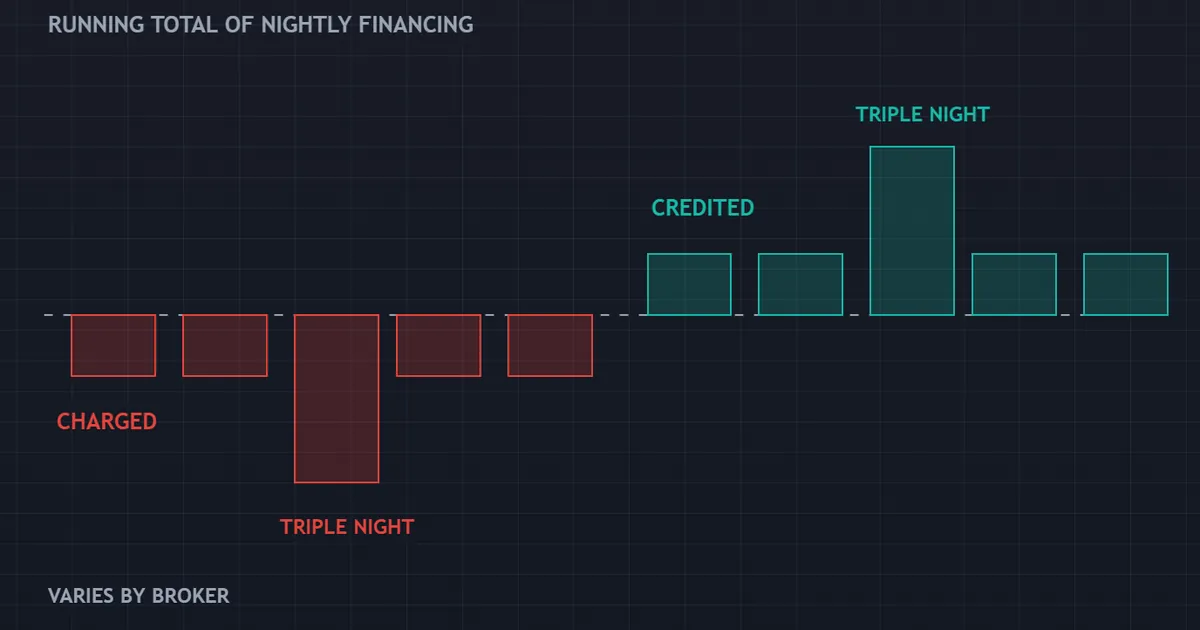
A charge is not automatic. Hold the higher-yielding currency and the adjustment can credit your account instead.
Direction decides the sign. The same pair charges one way and pays the other, so a long and a short face opposite arrangements.
Never plan a trade around the credit, though. Position risk on a multi-day hold dwarfs any nightly adjustment, and rate differentials move.
The Midweek Triple Charge
Settlement conventions push weekend financing into one midweek day. Most brokers apply roughly three times the usual amount on Wednesday for currency pairs.
Metals and some other instruments follow a different day. Check your own broker’s schedule rather than assuming the convention.
Plan around it when the target sits close. A triple charge on a small objective removes a noticeable slice of it.
It Varies by Broker and It Changes
Two brokers quote different swap rates on the same pair at the same moment. Neither figure counts as the correct one.
Rates also move when central banks move. A pair that credited you last quarter can charge you this quarter.
So check before every multi-night hold. Our swap calculator turns the quoted rate into an amount for your position size.
Carry Is Not a Strategy on Its Own
Collecting a nightly credit sounds appealing until the pair moves. A single average daily range against you wipes out weeks of accumulated interest.
Crowded positions add a second problem. When many traders hold the same high-yield side, the unwind arrives quickly and the exit gets busy.
Treat any credit as a small discount rather than a reason. The trade still has to earn its keep from the price move itself.
How Much Capital the Style Needs
Account size interacts with stop distance, and swing stops sit wide. That relationship decides whether the style works for you at all.
Why Small Accounts Struggle Here
Fixed money at stake divided by a wide stop produces a small position. Below a certain account size that position drops under the minimum lot your broker accepts.
Traders then face two bad options. They either oversize and break their own risk rule, or they skip the setup entirely.
Micro lots push that threshold much lower. Check the smallest size your account supports before assuming the style fits.
Margin Behaves Differently Over Days
An intraday position releases its margin the same afternoon. A swing position holds that margin for a week or more.
So the number of simultaneous trades shrinks. Three open swing positions can tie up more margin than a dozen intraday ones ever did.
Plan the whole book, not each trade alone. Running out of free margin midweek forces exits that your chart never asked for.
Leverage Changes Nothing About Risk
High leverage lets you open a large position on a small balance. It does not alter how much a stop costs when price reaches it.
Position size sets that figure alone. Traders who confuse the two usually discover the difference during their first wide-stop trade.
Pairs That Suit a Multi-Day Hold
Pair choice matters more here than in faster styles. Two filters remove most of the problem candidates.
Liquidity Through the Quiet Hours
Majors keep tight spreads around the clock. Exotic pairs widen sharply near the daily rollover, which is exactly when a swing trader’s stop sits unattended.
A stop parked in a widening spread can trigger on a quote nobody traded at. Liquid pairs make that far less likely.
Our volatility indicators archive collects the tools that show how much a pair actually moves before you commit to holding it.
Financing Size Across the Pair
Crosses with a wide interest differential charge or pay noticeably more per night. On a two-week hold that difference compounds into something real.
Check the figure on both directions of the pair. A pair that suits a long can punish a short badly, and the reverse happens just as often.
Stick to a short list until the routine settles. Six liquid pairs supply more setups than most traders can manage properly anyway.
Weekend Gap Risk
Markets close on Friday evening and reopen on Sunday evening. Anything that happens between those points arrives as a single jump in price.
Why a Stop Cannot Protect You Inside a Gap
A stop order becomes a market order when price touches it. If no price trades between Friday’s close and Sunday’s open, nothing touches your level in between.
Your fill then lands at the first available price. That price can sit well beyond where you placed the stop.
Our guide to the weekend gap in forex covers how large those jumps typically get.
What Traders Actually Do About It
Some cut size on Friday afternoon. Half the position across the weekend halves the exposure to the jump.
Others close everything and rebuild on Monday. That approach removes the gap entirely and pays for it in missed continuation.
A third group simply accepts it. They size every position so that a gap of a few times the usual daily range stays survivable.
Which Weekends Deserve Extra Care
Elections, referendums and central bank meetings scheduled near the weekend raise the stakes. Political surprises historically produce the largest jumps.
Thin holiday weekends behave unpredictably too. Fewer participants return on Sunday, so the reopening print can sit further from Friday’s close.
Check the calendar before Friday’s close, not after it. Deciding in advance beats deciding while a gap prints.
Download the complete indicator database
Put these concepts on your charts. One email unlocks the full library of 1,380+ indicators with compiled MT4 and MT5 files, plus my TradingView scripts. No paywall, no spam, unsubscribe any time.
Get free access to my indicator database
One email unlocks 1,380+ free MT4, MT5 and TradingView indicators — the complete library. No single-tool download; you get the whole database.
The Discipline of Not Watching
This part surprises traders arriving from faster styles. Doing nothing turns out to require more effort than doing something.
Why the Flat Middle Hurts
Swing positions spend most of their life going nowhere. Price drifts sideways for several sessions before the leg resumes or fails.
Boredom then produces interference. Traders tighten stops, take small profits early, or add a second position out of restlessness.
Each of those actions changes the plan after the fact. So the recorded result no longer tests the method you meant to test.
Practical Ways to Stay Out of the Way
Close the platform once the orders sit in place. An open chart invites decisions that the plan never asked for.
Use alerts as your only interrupt. Set them at the invalidation and the objective, then trust them to fire.
Size down until the position stops bothering you. A trade you can ignore for a week behaves far better than one you check hourly.
When a Position Sits Against You for Days
Multi-day holds spend real time underwater. A fill can run against you for two sessions and still reach its objective afterwards.
Knowing that in advance changes how it feels. Traders who expect a smooth path close early, while traders who expect turbulence hold to their level.
The stop already answered the question anyway. If price has not reached your invalidation, the reason for the trade still stands.
Record the worst point of every trade in your notes. After fifty entries that column shows whether your stops sit too tight for the style.
Mixing Swing Trading With a Faster Style
Plenty of traders want both. Combining them works, provided the two run as separate books rather than one blurred approach.
Keep the Records Apart
Log swing trades and intraday trades in different tabs. Mixed records hide which approach earns its costs and which one drags.
Separate the capital too if your platform allows it. Distinct sub-accounts stop a bad intraday week eating the margin a swing position needs.
The Real Danger Is Style Drift
Style drift begins innocently. A swing position gets closed at lunchtime because the four-hour bar looked weak, and the plan quietly disappears.
It travels the other way as well. An intraday trade held overnight because it went wrong becomes an accidental swing position with no invalidation level.
Name every trade at entry and never rename it. That single rule removes most of the damage this problem causes.
What Makes Traders Quit the Style
A handful of causes account for most departures. Each one has a fix that costs discipline rather than money.
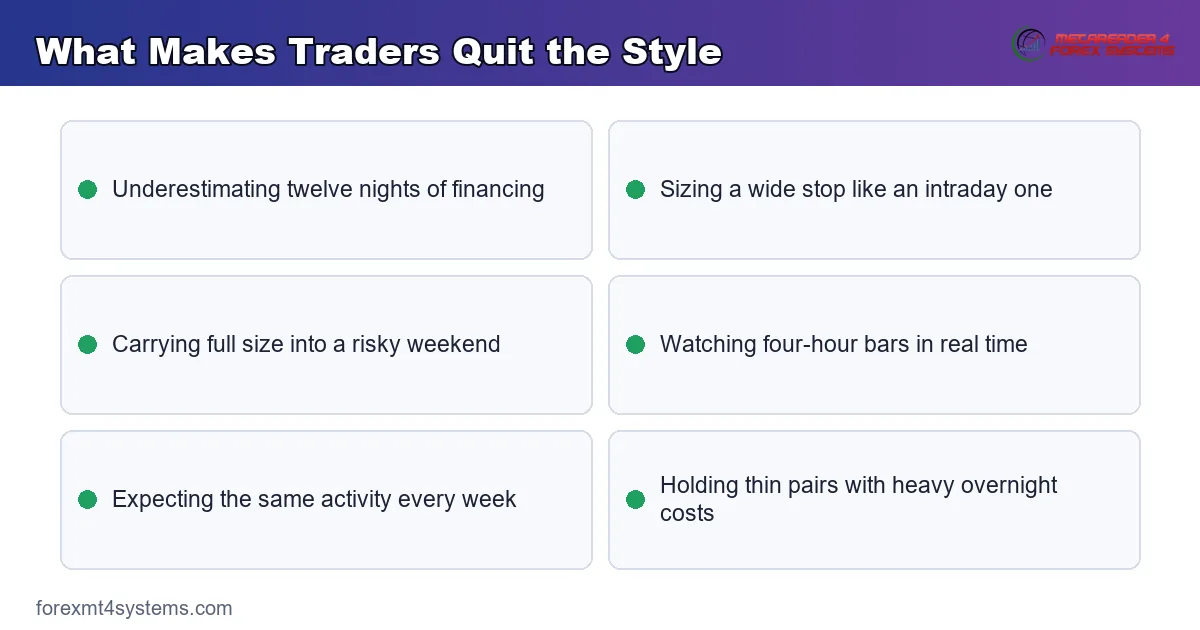
Underestimating the Financing Line
Twelve nights of charges on a small target eats a real share of it. Check the rate before entry, then size or skip accordingly.
Sizing as if the Stop Were Intraday
Swing stops sit wider, and copying an intraday lot size multiplies the money at stake. Divide fixed risk by the actual stop distance every time.
Carrying Full Size Into a Risky Weekend
A gap through your stop costs more than the stop said it would. Trim before known event weekends, or size so the jump stays survivable.
Watching Four-Hour Bars in Real Time
A trader monitoring every bar has quietly become a day trader with a swing trader’s stop. Set alerts and close the platform.
Expecting Steady Weekly Activity
Some months offer several clean legs and others offer one. Counting setups instead of forcing them keeps the style intact.
Trading Exotic Pairs for the Movement
Wide spreads and heavy financing punish long holds on thin pairs. Stick to liquid majors until the routine proves itself.
Feasibility Quick Reference
Run down this table before committing to the style. Each row states a condition rather than a promised outcome.
| Requirement | What it actually means |
|---|---|
| Screen time | Fifteen minutes nightly, plus a weekend block |
| Market access | Any retail account with no holding-time limit |
| Financing | A nightly charge or credit, tripled once midweek |
| Weekend exposure | Gap risk that a stop cannot fully control |
| Pair choice | Liquid majors, where spreads stay tight overnight |
| Position size | Set from stop distance, not from habit |
| Temperament | Comfort with days of no action |
| Account rules | Prop and funded programmes may restrict overnight holds |
Notice the last row. Funded-account programmes sometimes forbid holding over the weekend, and our summary of prop firm rules covers where those limits usually appear.
Where the Costs Actually Bite
Costs concentrate in two places, and neither one shows up on a chart. Understanding both before you start saves an expensive education later.
The Financing Line Grows Quietly
One night rarely matters. Twelve nights on a position with a modest objective can consume a visible share of what the move delivered.
Longer holds make it worse in one direction and better in the other. A credited pair rewards the same patience that a charged pair punishes.
So build the estimate into the plan. Multiply the nightly figure by your expected holding period before deciding the trade earns its place.
The Gap You Did Not Plan For
Weekend jumps arrive rarely and land hard. A single unlucky Sunday can undo several careful weeks.
Nothing removes that risk entirely except closing on Friday. Every other approach manages it rather than eliminating it.
Decide your policy once and apply it every week. Choosing weekend by weekend usually means choosing badly under pressure.
What Does Not Cost as Much as People Fear
Spreads matter far less here than in faster styles. One entry and one exit across a multi-day move spreads the cost thinly.
Commission behaves the same way. A handful of trades per month generates a fraction of the charges a high-frequency approach produces.
So the cost profile flips compared with intraday trading. Our swing versus day trading comparison sets the two bills side by side.
Related Reading
Execution comes next once the feasibility question settles. Our walkthrough on how to swing trade forex runs a real resting order from placement to management.
Slower horizons exist as well. Holding for months rather than days magnifies every cost described above, and the financing line becomes the dominant one.
Faster horizons remove the overnight problem entirely. They replace it with a spread bill that scales with trade count, which suits a different temperament.
FAQ
Can you swing trade forex with a full-time job?
Yes, and the style fits that situation better than faster alternatives. Decisions happen once or twice a day, alerts cover the hours you cannot watch, and the weekend supplies the planning window.
How much money do you need to swing trade currencies?
Enough that a sensible position size still exists after the wider stop. Because swing stops sit further away, very small accounts end up either oversized or unable to open a position at all.
Does swap always cost money?
No. Holding the higher-yielding side of a pair can credit your account instead, and the sign flips with direction. Rates vary by broker and change when central banks move, so check yours before every multi-night hold.
How risky is holding forex positions over the weekend?
The main danger comes from gaps, because a stop cannot fill inside a jump with no trading in between. Traders manage it by trimming size on Friday, closing everything, or sizing so a large jump stays survivable.
Can you swing trade with a prop firm account?
Sometimes, though many programmes restrict overnight or weekend holding. Read the rulebook before applying the style, since a breach can end the account regardless of the position’s result.
How many pairs should a swing trader follow?
Six liquid majors supply more setups than most traders can manage carefully. A longer watchlist lengthens the nightly pass without adding much, and it usually produces weaker entries rather than more of them.
Is swing trading easier than day trading?
Neither style is easier, and both demand different things. Swing trading asks for patience and tolerance of overnight exposure, while day trading asks for focus and a higher cost budget, so pick the one that matches your week. Results are not guaranteed; past performance is not indicative of future results.
External references
- For background on this concept, see Currency Swap on Wikipedia.
- For broader market context, see Swap at Investopedia.

About the author
Written by Dominic Walsh, a Forex trader and MT4/MT5 indicator, Expert Advisor and script developer. Every tool on forexmt4systems.com is tested on live charts before release and ships with ready-to-use compiled MT4 (.ex4) and MT5 (.ex5) files. Learn more about the trader and developer behind this site.
How we build, test and correct every tool: Editorial & Testing Policy. Trading carries risk; see the disclaimer.