
Ask ten traders how they work and you get ten answers. Strip out the jargon, though, and forex trading styles come down to one question: how long do you hold a position?
Everything else follows from that. Your timeframe, your trade count, your screen time and your cost burden all fall out of the holding period you choose.
What Forex Trading Styles Actually Are
A style is a time commitment. It describes how long you stay in a position and how often you open a new one.
Four names cover almost all of it. Scalping, day trading, swing trading and position trading sit on one line, ordered from seconds to months.

Above sits EURUSD on hourly bars. Plenty of movement, several turns inside each day, and a shape that looks tradable to anyone watching an intraday chart.
A Timeframe Does Not Create an Edge
Here is the honest version. No style outperforms another because of its timeframe, and nobody can hand you a figure proving otherwise.
What changes is the cost burden, the screen time and the psychological load. Those three vary enormously across the four styles, and they decide whether you can actually run the thing day after day.
So the question is not which style performs. The question is which style fits the hours, the account and the temperament you actually have.
One Market, Three Views
The hourly chart above is EURUSD. So is the daily chart later in this article, and so is the weekly chart near the end.
One market, three bar sizes, three different pictures. Slower bars need a longer span to fill a screen, so the daily and weekly captures mark the hourly stretch inside a much wider view.
Nothing about the market changed between the three captures. Only the bar size changed, and with it the number of decisions on offer.
The Four Styles at a Glance
Start with the summary, then read the detail. The table below maps each style against the four things that actually differ.
| Style | Working timeframe | Holding period | Trades per week | Screen time | Cost burden |
|---|---|---|---|---|---|
| Scalping | One to five minutes | Seconds to minutes | Dozens, sometimes hundreds | Continuous during a session | Highest, and it scales with trade count |
| Day trading | Fifteen minutes to one hour | Minutes to hours | Roughly five to twenty | Several focused hours a day | High, though well below scalping |
| Swing trading | Four hours to daily | Days to a few weeks | One to five | Under an hour a day | Moderate, plus overnight financing |
| Position trading | Daily to weekly | Weeks to months | A handful a year | A weekly review | Lowest per trade, financing dominates |
Read the last column twice. Frequency is the single biggest driver of what a style costs you, and most beginners underestimate it badly.

The panel above turns that table into a decision. Work through the five questions in order and the field usually narrows to one or two rows.
Nothing on that list mentions returns. Every question asks about your circumstances instead, because circumstances are what make a routine repeatable.
Scalping: Seconds to Minutes
Scalpers take many small positions and hold them briefly. Targets run to a handful of pips, and stops sit just as close.
What the Day Looks Like
Continuous attention during one session, usually the busiest hours. Execution speed matters, and so does a stable connection.
Decisions arrive constantly. That pace suits some people and exhausts others, which is worth testing before committing.
The Cost Problem
Costs scale directly with trade count. Fifty round trips a day pay the spread fifty times, and the target never grows to compensate.
So a scalping plan lives or dies on the cost per round trip. Compare that cost against the target before anything else, and read our breakdown of forex trading costs first.
The Permission Problem
Not every account allows it. Some brokers restrict very short holding times, and many funded programmes ban scalping outright or set a minimum duration.
Check the rules before you build the plan. Our full guide to scalping in forex covers the detail properly.
Day Trading: Minutes to Hours
Day traders open and close inside the same session. Nothing stays open overnight, which removes financing charges and weekend gap risk.
What the Day Looks Like
A few focused hours, usually built around a session open. The hourly chart at the top of this article is the natural working view.
Trade counts fall to something manageable. Five to twenty a week gives you room to think between decisions.
Where the Difficulty Sits
Intraday noise is relentless. A level that mattered at nine in the morning frequently means nothing by lunchtime.
Session timing therefore does a lot of the filtering. Our free forex market hours tool shows which sessions overlap and when a pair actually moves.
Our dedicated guide to day trading in forex goes into the session structure in full.
Swing Trading: Days to Weeks
Swing traders hold through several sessions. The working chart moves up to four-hour or daily bars, and the trade count drops sharply.
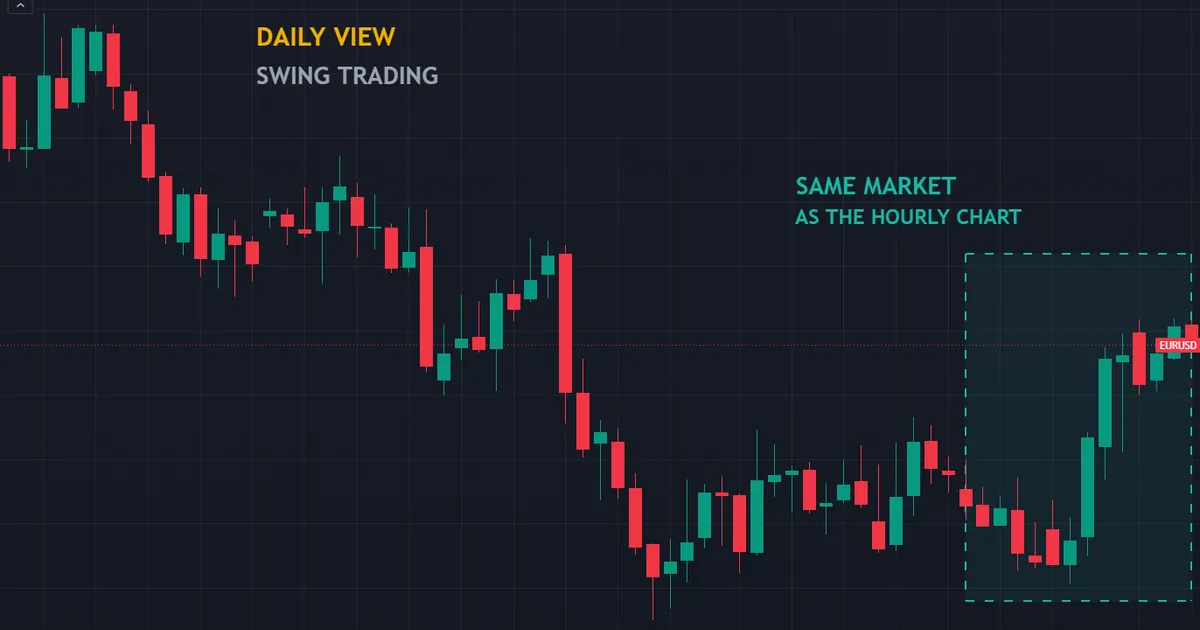
The Same Market, One Timeframe Up
Above sits EURUSD again, this time on daily bars. A shaded block on the right marks the stretch the hourly chart covered, and every hourly swing now sits inside a candle or two.
Notice what disappeared. The intraday turns that generated a dozen day-trading decisions now sit inside one bar, invisible.
Notice what appeared as well. A structure spanning several weeks becomes legible, and it was there the whole time.
What Changes in Practice
Stops widen, so position sizes shrink to keep the risk per trade constant. That trade-off catches people out repeatedly.
Overnight financing enters the picture too. Holding for a week means paying or receiving swap every night, and those rates vary by broker and change without much notice.
Screen time collapses, which is the real attraction. Our guide to swing trading in forex covers the routine that supports it.
Download the complete indicator database
Put these concepts on your charts. One email unlocks the full library of 1,380+ indicators with compiled MT4 and MT5 files, plus my TradingView scripts. No paywall, no spam, unsubscribe any time.
Get free access to my indicator database
One email unlocks 1,380+ free MT4, MT5 and TradingView indicators — the complete library. No single-tool download; you get the whole database.
Position Trading: Weeks to Months
Position traders work from daily and weekly bars. A handful of trades a year, each held through moves that would stop out every other style.
What the Week Looks Like
One review, usually at the weekend. Charts get checked, levels get updated, and nothing else demands attention.
Patience does most of the work. Months can pass between entries, and the temptation to fill the gap with unrelated trades ruins plenty of plans.
What It Demands
Capital and tolerance. Stops sit far away, so position sizes stay small, and open positions swing through large paper losses on the way to anywhere.
Financing compounds over months as well. A rate differential that looks trivial per night adds up across a long hold, in either direction.
Our guide to position trading covers the sizing arithmetic in detail.
Where Each Style Fits the Trading Day
The clock shapes a style as much as the chart does. Liquidity and range both swing hard across a twenty-four hour cycle.
The Shape of a Session Day
- Asian hours. Ranges tend to stay narrow outside the yen crosses. Scalpers who need movement often skip this stretch entirely.
- The London open. Range expansion arrives with the European desks, which is why so many day traders build their routine around it.
- The London and New York overlap. Deepest liquidity of the day, tight spreads and real movement together. Faster styles get their best conditions here.
- The New York afternoon. European desks have gone, so participation thins and moves lose follow-through.
- Daily rollover. Spreads widen briefly as the trading day rolls over, and swap gets applied to anything still open.
- The weekend break. No trading at all, and a reopen that can gap past your levels. Only swing and position traders face this risk.
Match the style to the hours you can attend. A day-trading plan built around the London open fails quietly when your work day starts at the same moment.
What Changes When You Change Style
Moving up a timeframe changes five things at once. Traders who adjust only the chart end up mismatched everywhere else.
- Stop distance grows. Wider bars need wider invalidation, or ordinary noise removes you before the idea has a chance.
- Position size shrinks. Risk per trade should stay constant, so a stop three times wider means roughly a third of the lot size.
- Decision count falls. Fewer setups arrive, which lengthens the time it takes to gather a meaningful sample of results.
- Cost per unit of target drops. The same spread takes a far smaller bite out of a hundred-pip objective than a ten-pip one.
- Overnight exposure appears. Financing, weekend gaps and scheduled releases all land on positions you keep open.
Change all five together or none of them. Half a change produces the worst of both approaches, which is where most style confusion comes from.
Methods Cut Across Styles
People confuse two different questions constantly. Style answers how long you hold; method answers how you decide.
The Same Method at Any Speed
Price action, indicator systems, fundamentals and mechanical rules all work on any timeframe. None of them belongs to one style.
A trader reading bar structure can do it on a five-minute chart or a weekly one. Our guide to price action trading treats it as a method rather than a speed.
Why the Distinction Matters
Traders abandon a perfectly sound method after switching styles badly. The method was fine; the holding period never matched it.
So separate the two when you review a losing stretch. Ask whether the decisions were wrong, or whether the timeframe simply did not suit your week.
Tools Follow the Timeframe
What changes is the settings, not the concept. A moving average tuned for hourly bars behaves very differently on the weekly chart.
Our trend indicators archive collects tools that work across timeframes once the inputs match the bars you use.
Frequency and the Psychological Load
The mental cost of a style rarely gets mentioned. It should, because that cost decides who quits.
More Trades Means More Decisions
Each decision draws on the same limited attention. Fifty a day drains it fast, and tired traders break their own rules first.
Fewer trades bring a different problem. Waiting a week for a setup tests patience, and boredom produces trades that no plan ever authorised.
Feedback Arrives at Different Speeds
A scalper learns quickly, since results pile up within hours. A position trader waits months for the same amount of information.
Quick feedback helps a beginner, and it also amplifies emotion. Slow feedback protects you from overreacting, though it hides your errors for far longer.
Common Mistakes and the Fixes
Six habits sink more style choices than any market condition. The panel below pairs each one with its correction.

Picking a Style From a Video
Somebody else’s day is not yours. Start from the hours your week genuinely offers, then choose the style that fits inside them.
Scalping on a Wide-Spread Account
The arithmetic decides this one. When the round-trip cost eats a third of the target, no amount of skill rescues the plan.
Switching After Every Losing Run
Losing runs happen inside every style. Give one approach fifty occurrences before judging it, otherwise you only ever measure noise.
Holding a Day Trade Overnight
That is a style change made under pressure, and it always arrives at the worst moment. Write the session exit rule down before the session starts.
Using the Wrong Stop for the Timeframe
A twenty-pip stop belongs to an intraday trade. Attach it to a daily-bar setup and ordinary noise removes you before the idea gets tested.
Ignoring Financing on Longer Holds
Swap charges accumulate quietly. Check the nightly figure for your pair and your broker before committing to a multi-week position.
Quick Reference: Matching a Style to Your Week
Work down the left column until a row describes your situation. The right column names the honest fit.
| Your situation | The style that usually fits |
|---|---|
| Free during one full session, fast connection, tight spreads | Scalping, if your broker and programme allow it |
| Two to four uninterrupted hours a day | Day trading around a session open |
| Under an hour a day, evenings only | Swing trading from four-hour and daily bars |
| One review a week, patient temperament | Position trading from daily and weekly bars |
| Irregular hours you cannot predict | Swing or position trading, with pending orders set in advance |
| Funded account with a minimum hold time | Day trading or slower, never scalping |
The Same Market, Three Styles’ Worth of Views
Here is the third capture of EURUSD, on weekly bars this time. Same market, a far longer span, and the hourly stretch marked once more on the right.
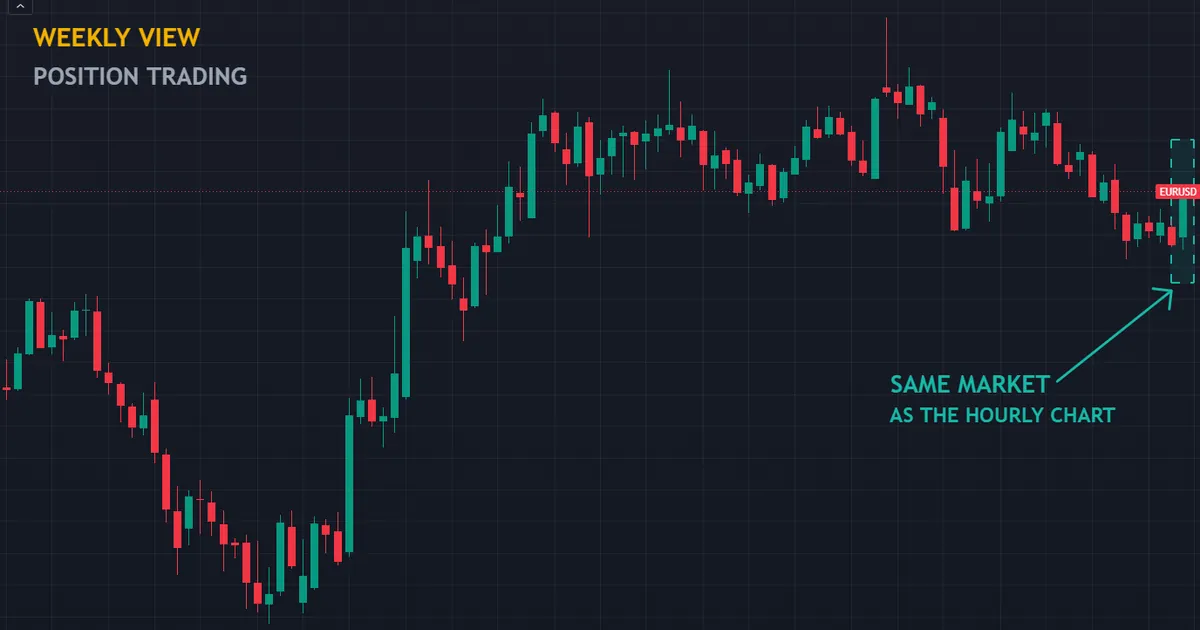
What the Weekly Chart Erases
Everything that filled the hourly chart sits inside that marked block. The turns that produced a dozen intraday decisions no longer exist as separate events.
A position trader holds through all of it without noticing. What ended a day trade on Tuesday morning is simply part of a weekly candle.
That is not an argument for higher timeframes. It is an argument for matching your stop, your size and your patience to the bars you chose.
Where Traders Go Wrong With This
Mixing timeframes without deciding which one rules. An entry taken from the five-minute chart with a target read from the weekly chart has no consistent logic behind it.
Pick a working timeframe and let a higher one supply context only. Our comparison of swing trading versus day trading shows how that separation works in practice.
The Honest Summary
One market offers as many opportunities as your schedule can process. Choosing a style is choosing how many of those you intend to see.
More decisions do not mean more return. They mean more costs, more attention and more chances to make a mistake.
Styles and the Rules You Trade Under
Your account terms can rule out a style before you ever test it. Read them first, not after a rejected trade.
Broker Terms
Some brokers set a minimum holding time, so orders closed within a minute or two get flagged. Others restrict certain order types during releases.
Execution model matters as well. Faster styles suffer more from requotes, and slower styles care more about the swap table.
Funded Programme Rules
Restrictions here are common and specific. Minimum hold times, bans on holding through the weekend and limits around scheduled releases all appear regularly.
Consistency rules catch people out too. Several programmes require your trade sizes and daily results to look similar, which quietly discourages very high frequency.
Check Before You Build
Write your intended style down, then read the terms against it line by line. Ten minutes there saves weeks of building something the account never permitted.
How to Choose Without Guessing
Three questions settle it faster than any quiz. Answer them honestly and the field narrows quickly.
How Many Hours Do You Actually Have?
Not the hours you wish you had. Count the uninterrupted blocks in a normal week, then subtract the ones that clash with your market’s active session.
Can You Leave a Position Open?
Some people sleep fine with an open trade. Others check the phone at three in the morning, which is a genuine reason to stay intraday.
What Does a Round Trip Cost You?
Divide your typical target by your typical cost. A ratio under ten to one rules out the faster styles for that account entirely.
Then commit for a stretch. Fifty trades in one style teaches more than five trades in each of four, because only the longer run separates the approach from the noise.
Write the Answer Down
Put the style, the working timeframe and the review cadence on one page. A written choice resists the pull of whatever looked exciting last week.
Revisit it once a quarter, not once a bad day. Circumstances change, and a style that fitted your old schedule may not fit the current one.
FAQ
Which of the forex trading styles suits a beginner?
Swing trading suits most newcomers, mainly for practical reasons. Slower bars leave time to think, decisions arrive a few times a week rather than a few times an hour, and costs take a smaller share of each target. That is a comment about learning conditions, not about returns. Any style can work, and none of them works without a plan.
Can I use more than one style at once?
You can, once each has its own rules, its own timeframe and its own record. Trouble starts when the two blur together, which usually happens when a day trade gets held overnight and renamed a swing. Keep separate records, and treat a style change mid-trade as a mistake rather than a decision.
Does scalping cost more than swing trading?
Per trade, no. In total, considerably more, because the cost repeats on every round trip while the target stays small. A scalper paying one pip on a five-pip target gives away a fifth of the move each time. A swing trader paying the same pip on a hundred-pip target gives away one percent of it.
Do I need a different broker for different styles?
Sometimes. Faster styles need tight spreads, quick execution and permission to hold positions briefly. Slower styles care more about swap rates and platform stability. Check the account terms for minimum holding times and any restrictions on your intended approach before funding anything.
How long before I know whether a style fits?
Give it fifty trades or three months, whichever takes longer. Shorter samples measure luck. Keep a record of the trades you took, the ones you missed because you were away from the screen, and how the routine felt, since fit is about sustainability as much as results.
Which style needs the least screen time?
Position trading, by a wide margin, followed by swing trading. A weekly review and a set of pending orders covers most of the workload. That suits anyone with a full-time job, and it comes with its own demands: wider stops, smaller positions and long stretches with nothing to do.
Does a higher timeframe make trading easier?
It makes it slower, which helps in some ways and hurts in others. Fewer decisions means fewer mistakes, and it also means each mistake carries more weight in a small sample. Wider stops force smaller positions, and longer holds bring financing costs and gap risk. Choose the timeframe that matches your week rather than the one that sounds calmer. Results are not guaranteed; past performance is not indicative of future results.
External references
- For background on this concept, see Investmentstyle at Investopedia.
- For broader market context, see Trading Securities at Corporate Finance Institute.

About the author
Written by Dominic Walsh, a Forex trader and MT4/MT5 indicator, Expert Advisor and script developer. Every tool on forexmt4systems.com is tested on live charts before release and ships with ready-to-use compiled MT4 (.ex4) and MT5 (.ex5) files. Learn more about the trader and developer behind this site.
How we build, test and correct every tool: Editorial & Testing Policy. Trading carries risk; see the disclaimer.