
Most news-trading advice skips the part that decides the outcome. Learning how to use news to trade forex starts with execution, not with prediction, because the first seconds after a release punish careless orders.
This guide sets out three honest approaches and the real cost of each. None of them rests on guessing the number, and none of them treats the release moment as a comfortable place to click.
How to Use News to Trade Forex: The Honest Framing
A scheduled release is one moment when a very large group updates its view at once. Liquidity thins, quotes jump, and the spread you pay widens for a while.
So the useful question is never which way a pair will run. The useful question is whether your order can survive the conditions that a release creates.
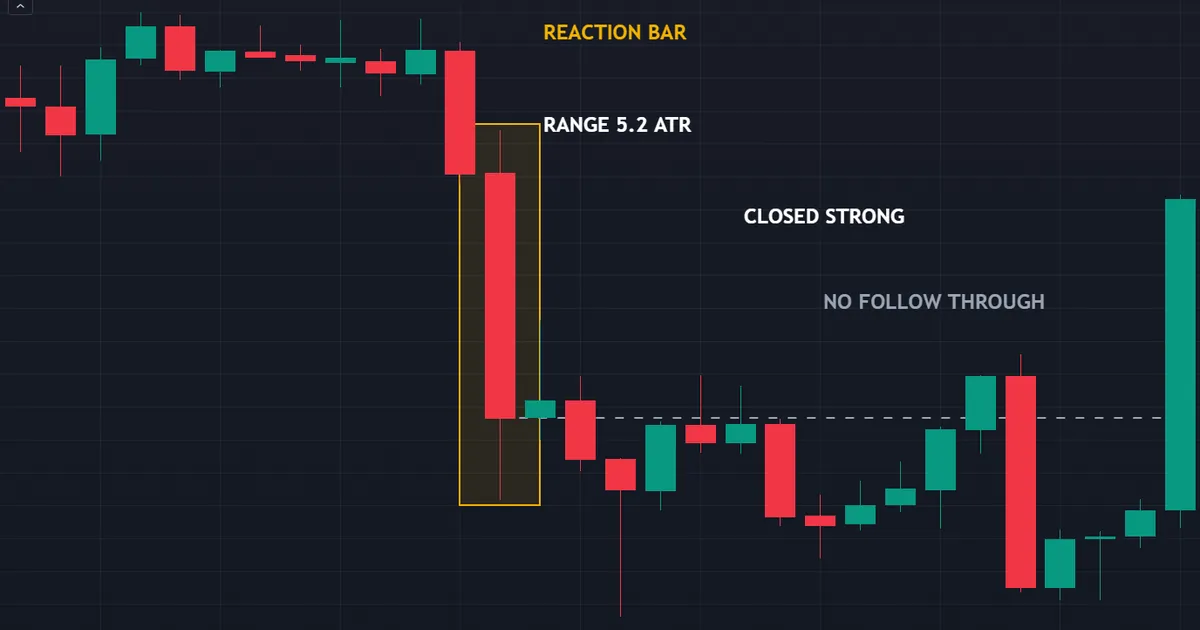
What an Outsized Bar Looks Like
Above sits an outsized hourly bar on AUDJPY, stamped 01:00 on 29 July 2026. Its range measured 5.21 times the average true range, and its body filled 66 percent of that range.
Then the following hours drifted only about 0.34 ATR further the same way. In short, the burst arrived, closed near its extreme, and then stalled.
Notice what that combination does to a plan. A trader who chased the burst got a wide spread, a fast fill and then a flat market.
Why Direction Is the Wrong First Question
Price reacts to the gap between the number and what people already expect. Traders price a view in advance, so a strong figure can send a currency lower when the market wanted stronger still.
Because of that, “good data lifts the currency” fails as a rule. The market trades surprise, and surprise only exists relative to the consensus already sitting in the price.
Our guide to reading the economic calendar covers the consensus column in detail. Read it first, since the rest of this article assumes you can find that figure.
Priced In: The Idea That Explains Most Reactions
“Priced in” means the market has already moved for an outcome people expect. If everyone anticipates a rate rise, a currency tends to drift higher before the meeting rather than after it.
Then the announcement arrives and confirms the expectation. Nothing new enters the picture, so price frequently stalls or turns on what looks like supportive news.
Surprise supplies the fuel. A release moves a market only when it forces traders to change a view they had already backed with money.
Keep that single idea in mind whenever a currency does the opposite of what a headline suggests. Most confusing reactions dissolve once you ask what the market already assumed.
The Three Honest Approaches
Three approaches survive contact with real execution. Each one costs you something, and choosing between them beats improvising at the moment of release.
- Stand aside. Flatten or avoid exposure across the release window, then return when quotes settle. You give up the move and keep your execution quality intact.
- Trade the aftermath. Let the first burst pass, wait for the spread to normalise, and work with the level the reaction left behind. You give up the fastest part of the move and gain a readable market.
- Position ahead with reduced size. Hold a pre-existing idea through the print at a fraction of normal size, with a stop placed where a spike cannot casually clip it. You accept slippage risk in exchange for staying with your original plan.
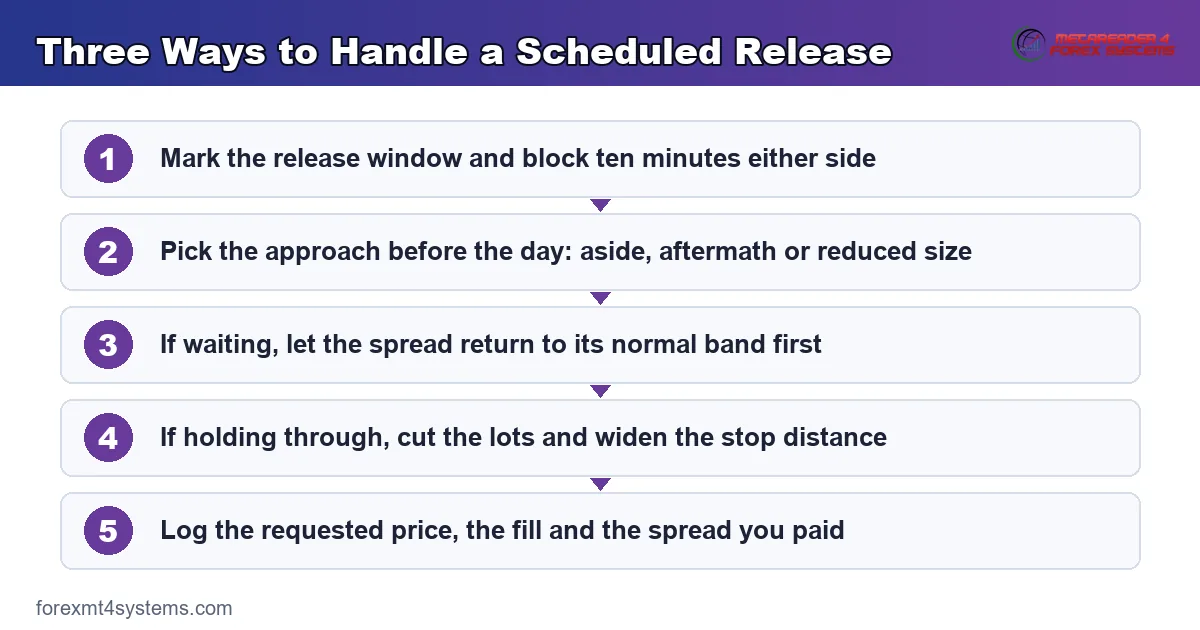
Nothing else on that list works reliably. Clicking at the instant of a release belongs to a fourth category, and the next section explains why.
Approach One: Stand Aside
Standing aside sounds passive, yet it removes the single largest source of unplanned loss. No spread widening, no slippage, no requote drama.
Set the rule mechanically. Flat by ten minutes before the release, back at the screen thirty minutes after, and no discretionary override on the day.
Traders at funded firms sometimes have no choice here. Our note on prop firm news trading rules shows how common a hard restriction has become.
Approach Two: Trade the Aftermath
The aftermath approach treats the release as a level generator rather than an entry signal. A violent bar leaves a high, a low and a settled midpoint behind it.
Wait for the spread on your platform to return to its normal band. That single condition removes most of the damage traders blame on news itself.
Then trade the structure the way you would on any other day. The reaction gave you fresh reference points, and those points do the work.
Approach Three: Size Down and Hold Through
Sometimes you already hold a position and the calendar puts a release in its path. Cutting size is the honest response.
Work the reduced size from the stop distance rather than habit. Our position size calculator handles that arithmetic quickly.
Place the stop beyond the range a spike can plausibly cover. A stop tucked five pips away simply hands the release a free exit.
Why the Instant of Release Is an Execution Problem
Trading the exact second of a print is not a strategy question. It is a plumbing question, and the plumbing works against you.
Spreads Widen, Sometimes Enormously
Market makers widen quotes when they cannot price risk confidently. Around a major release, a pair that normally shows a fraction of a pip can show many multiples of that.
That cost lands on entry and again on exit. A twenty-pip objective loses a serious slice before price moves at all.
Our explainer on why spreads widen covers the mechanics behind that behaviour.
Stops Slip, and That Is Normal
A stop order becomes a market order when price touches it. If the next available price sits far away, you fill there.
Slippage is not misconduct by default. It is what happens when price moves between your request and its execution, and releases are exactly when that gap opens widest.
Fills Are Not Certain
Limit orders solve the price problem and create a new one. A limit fills at your price or better, or it never fills at all.
Pending orders sitting just above and below a release level frequently miss the move entirely. Price gaps through the level, so the limit stays untouched while the market runs.
Add it up and the picture is plain. At the instant of a release you face a worse price, an uncertain fill and a wider spread, all at once.
Which Calendar Entries Deserve a Rule
Not every coloured dot on a calendar matters. Sorting entries into tiers keeps your rules manageable.
- Tier one: rate decisions and the statements around them. These reset expectations for every future meeting, so the reaction can run for days rather than minutes.
- Tier two: inflation and employment reports. They feed straight into rate expectations, which is exactly why the market watches them so closely.
- Tier three: growth, retail sales and trade figures. Meaningful, though usually smaller in effect unless the surprise is very large.
- Tier four: surveys and sentiment indices. Worth reading for context, rarely worth restructuring a whole day around.
- Unscheduled: speeches, minutes and off-calendar remarks. Policymakers speak frequently, and an unplanned comment sometimes moves a pair harder than a scheduled print.
Apply the strictest rule to tier one, then relax as you move down the list. Defending against every entry simply keeps you out of the market permanently.
Every Pair Has Two Calendars
A currency pair carries two national calendars, not one. A euro trader who tracks only European releases misses half the picture.
Check both legs before choosing your approach for the day. Crosses such as GBPJPY carry two full sets of event risk without a single dollar entry.
The Hour Matters as Much as the Headline
A release landing while London and New York both trade meets deep participation. The same release during a thin hour can push price much further on far less volume.
So identical headlines produce very different bars depending on timing. Note the hour alongside the event whenever you plan a week.
A Worked Example: The Payrolls Bar
US non-farm payrolls lands on the first Friday of the month at 8:30 in New York. That timing is fixed, so it makes a clean teaching case.
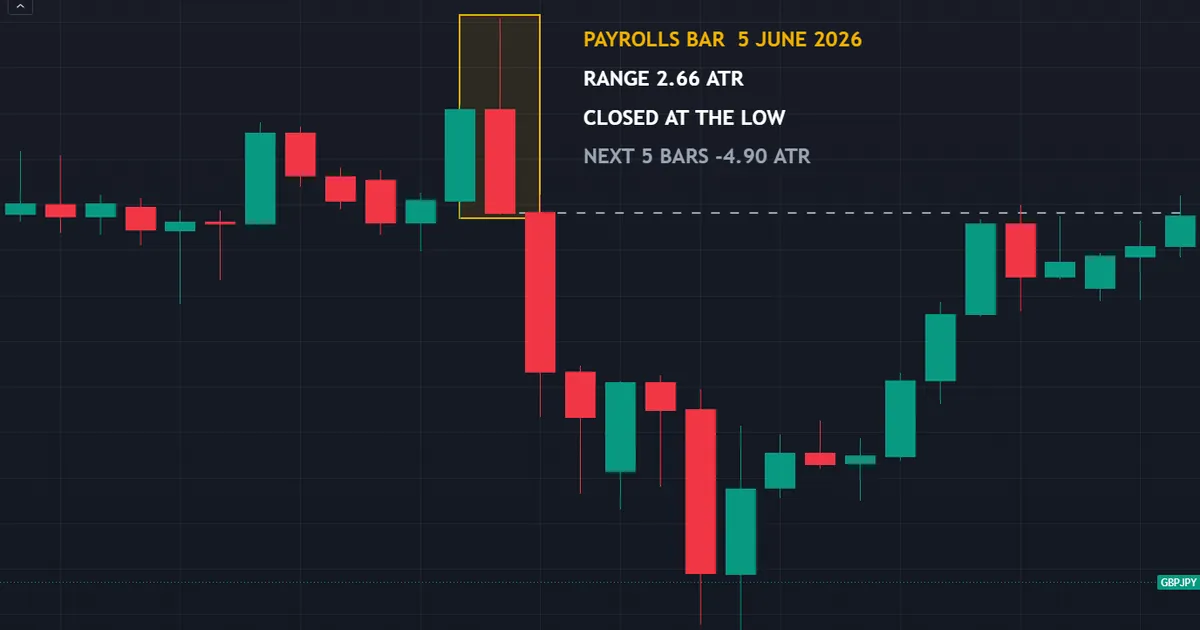
What the Bar Shows
The chart covers GBPJPY four-hour bars on Friday 5 June 2026, the first Friday of that month. The bar carrying the payrolls reaction ranged 2.66 times its average true range and closed near its low.
Afterwards the next five bars netted about 4.90 ATR further down. So the reaction extended its own direction rather than unwinding, travelling almost twice the payrolls bar’s own range as it went.
Notice which pair that is. GBPJPY carries no dollar leg at all, and a United States release still landed squarely on its chart.
How Each Approach Would Have Fared
A trader who stood aside missed the bar completely and paid nothing. That outcome deserves more respect than it usually gets.
Someone waiting for the aftermath had two fresh levels and a normal spread within the hour. That slower extension was tradable in a way the spike was not.
A trader holding through at reduced size took a jolt and survived it. The same trader at full size would have faced a decision under pressure, which is precisely the situation a plan exists to avoid.
The Part Nobody Screenshots
Reaction bars look obvious in hindsight. On the day, you see a quote flickering, a spread three times normal, and a chart that has not finished printing.
Judge any approach on how it behaves in that moment, not on how the bar reads afterwards. Hindsight makes every release look like an opportunity.
Download the complete indicator database
Put these concepts on your charts. One email unlocks the full library of 1,380+ indicators with compiled MT4 and MT5 files, plus my TradingView scripts. No paywall, no spam, unsubscribe any time.
Get free access to my indicator database
One email unlocks 1,380+ free MT4, MT5 and TradingView indicators — the complete library. No single-tool download; you get the whole database.
Common Mistakes and Their Fixes
Six habits turn ordinary release volatility into avoidable damage. The panel below collects the corrections.
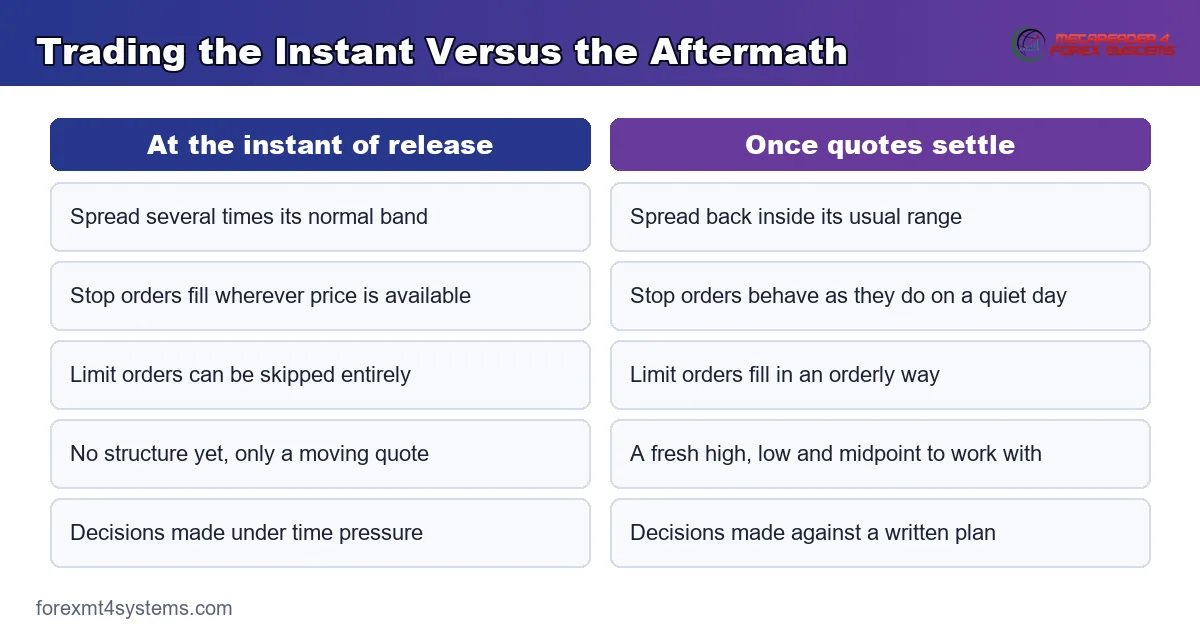
Clicking at the Instant
Entering as the number prints combines every execution problem at once. Wait for the spread to settle, then decide.
Using a Normal Stop Distance
A stop sized for quiet conditions gets clipped by noise. Widen the distance and cut the size to keep the risk identical.
Treating Consensus as a Forecast
The consensus figure describes what is already priced, not what will happen. Its value lies in measuring surprise afterwards.
Ignoring the Second Release
Many calendar entries carry revisions to prior months alongside the headline. A revision can dominate the reaction, so read the whole entry.
Doubling Down After a Bad Fill
A slipped stop feels unfair, and unfairness invites revenge. Our piece on revenge trading explains why that reflex costs so much.
Skipping the Log Entry
Record the spread you paid and the slippage you took. Without those two numbers you cannot judge whether news trading suits your broker at all.
A Quick-Reference Checklist
Keep this table beside the calendar. Each row replaces a judgement call with a rule.
| Step | What to do | Why it matters |
|---|---|---|
| Mark the window | Note the release time and block ten minutes either side | Removes surprise from your own schedule |
| Pick the approach first | Stand aside, wait, or size down, decided before the day | Stops improvisation under pressure |
| Check the spread | Watch it widen and wait for the normal band to return | Cuts the largest hidden cost of the event |
| Set the stop by structure | Beyond the plausible spike range, never at a round habit distance | Keeps noise from ending a valid idea |
| Size from the stop | Lots calculated backwards from the distance and your risk | Holds risk constant as the stop widens |
| Log fill quality | Record requested price, filled price and spread paid | Builds evidence about your own execution |
When the Reaction Does Not Stick
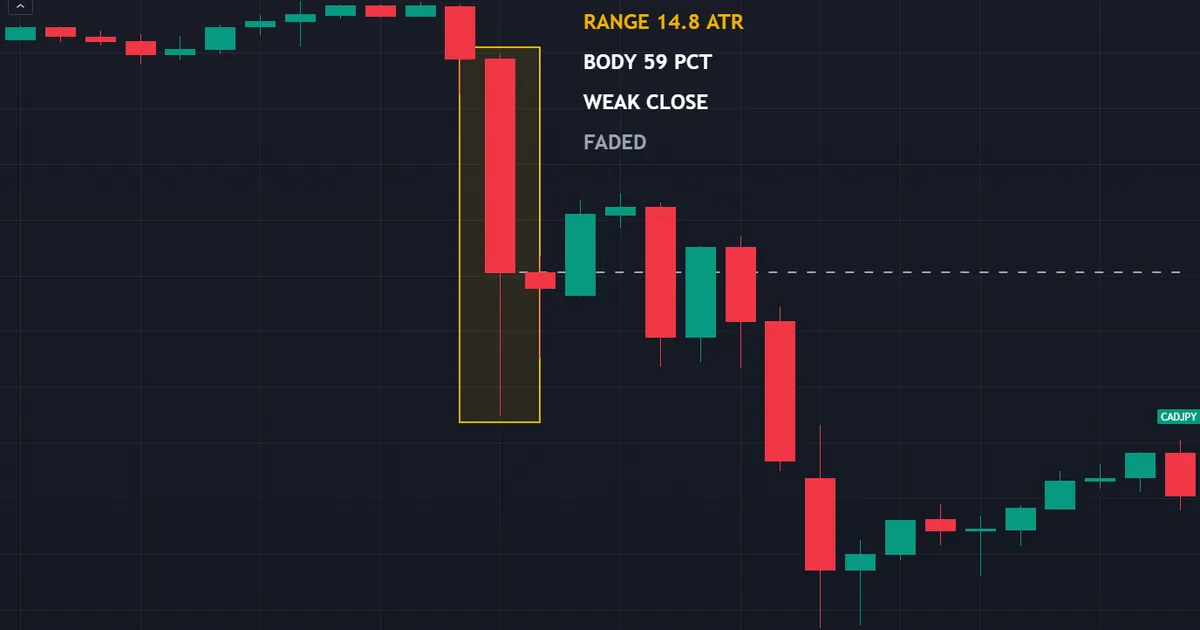
The spike did not hold: the bar closed well off its extreme, and the following bars recovered about 1.02 ATR back up, so the initial move faded. That sentence describes a CADJPY four-hour bar stamped 13:00 on 30 July 2026.
The Numbers Behind It
That bar ranged 14.78 times its average true range, which is an enormous print by any measure. Yet its body filled only 59 percent of the range.
Roughly two fifths of the move therefore round-tripped inside the bar itself. Anyone filled near the extreme watched a large slice evaporate before the bar even closed.
Afterwards the following bars recovered about 1.02 ATR back up, a small fraction of the bar’s own range. Enormous volatility produced very little durable displacement.
Why This Pattern Repeats
Initial reactions come from fast orders reacting to a headline. Slower money reads the detail, disagrees, and trades the other way within minutes.
Volume also thins in the first seconds, so a modest order pushes price further than usual. Once normal liquidity returns, much of that displacement unwinds.
None of this makes reactions untradable. It does mean the first bar is a poor guide to where the market settles.
What to Take From It
Measure a reaction bar against its own range before acting. A 14.78 ATR range with a 59 percent body is a warning, not an invitation.
Compare that with the strong-close example earlier in this article. Closing near the extreme says something; closing in the middle of a huge range says the opposite.
Two Numbers Worth Recording
Body percentage tells you how much of a bar’s range survived to the close. A high figure means the move stuck, while a low figure means it round-tripped.
Range measured in ATR tells you how unusual the bar was in the first place. Together those two numbers describe a reaction far better than any adjective.
Note both for every release you watch. After twenty entries you will spot the difference between durable displacement and a spike almost instantly.
Matching the Approach to Your Style
The right choice depends on how you trade the rest of the time. Three short profiles cover most traders.
Short-Term and Intraday
Fast traders suffer most from wide spreads, because their objectives are small. A two-pip cost against a fifteen-pip target removes a serious share of the idea.
Standing aside usually wins here. Come back once the spread settles, then treat the reaction extremes as fresh structure.
Swing and Position
Longer holds cannot dodge every release, since any given week contains several. Reducing size and widening stops becomes the practical answer.
Accept that some noise will reach the account. A swing position sized to survive a spike is doing exactly what it should.
Systematic and Rule-Based
Mechanical traders should encode the restriction rather than rely on memory. A simple time filter around listed events removes a whole class of bad fills.
Test that filter honestly against your own records. Sometimes it costs more than it saves, and only your data settles the question.
Related Guides Worth Reading Next
Two companion pieces make this material concrete. Both sit in the same fundamentals cluster.
Start with forex news release times so you know which hours actually carry risk. After that, our guide to NFP in trading covers the single most watched entry on the calendar.
Traders who want volatility flagged automatically can browse our volatility indicators archive. Any such tool measures conditions; the decision stays yours.
Building the Routine
Knowing the three approaches changes nothing without a repeatable weekly habit. The routine below takes about fifteen minutes.
Sunday: Mark the Week
Open our free economic calendar and list every high-impact entry for the pairs you trade. Write the times in your own time zone, not the site default.
Then assign one of the three approaches to each entry. Doing that in advance is most of the battle.
Each Morning: Confirm and Adjust
Check whether anything moved or was added overnight. Central banks sometimes schedule unplanned communications, and calendars update.
Adjust open positions before the window rather than during it. Ten minutes of foresight beats any amount of reaction speed.
Afterwards: Score Your Execution
Record the spread, the requested price and the fill for every order placed near a release. Numbers settle arguments that memory cannot.
Review the file monthly and look for a pattern. If your slippage clusters around one broker or one hour, that finding is worth more than any setup.
Quarterly: Ask Whether It Suits You
Every three months, total the cost of your release-window trades. Include spread paid above the normal band, slippage on stops, and any trade you closed early out of discomfort.
Compare that total against what those trades produced. Plenty of traders discover their calmest months came from doing less around the calendar.
Change one element at a time afterwards. Adjusting your waiting period, your size reduction and your stop rule together tells you nothing about which change mattered.
FAQ
Can you trade forex news profitably as a beginner?
News trading raises execution difficulty rather than lowering it, so it suits an experienced hand better than a new one. A beginner gains far more from standing aside during releases and studying the aftermath. Learn to read the calendar, watch how spreads behave, and log what your platform actually does before risking size on a print.
Which forex news releases move the market most?
Interest rate decisions and the statements around them usually rank first, because they change expectations about future rates. Employment and inflation reports come next, since they shape those expectations. Growth figures, retail sales and sentiment surveys move price less on average, though a large surprise in any of them can dominate a quiet session.
How long should I wait after a release before trading?
Use the spread rather than the clock. Watch your platform’s quote and wait until the spread returns to its normal daily band, which frequently takes several minutes on a major release and longer on a thin pair. A fixed rule of thirty minutes works well as a default while you gather your own data.
Should I use pending orders around news?
Pending orders behave badly around releases. A buy stop above the market becomes a market order when touched, so it can fill far above your level, while a limit order may sit untouched as price gaps straight past it. If you use them at all, size for a bad fill rather than the one you requested.
Why did the currency fall on strong data?
Because the market had already priced a stronger figure. Traders position ahead of releases based on the consensus, so the reaction reflects the difference between the number and that expectation. Revisions to earlier months, details inside the report and the wider risk mood all pull in their own directions too.
How much do spreads actually widen on a release?
That varies by broker, by pair and by the size of the surprise, so measure it yourself rather than trusting a published figure. Watch your platform for a minute either side of a tier-one event and note the widest quote you see. Majors typically recover within a few minutes, while crosses and exotic pairs stay wide for considerably longer.
Do prop firms allow news trading?
Many restrict it, and the rules vary widely. Some forbid opening positions within a few minutes of a listed high-impact release, others require you to hold nothing through the event, and a few permit it with reduced leverage. Read your own agreement carefully, since a breach usually voids the account rather than costing a fee.
Is trading the aftermath safer than trading the print?
Safer in execution terms, yes, because the spread has normalised and quotes update in an orderly way. It is not safer in market terms, since the level left behind can fail like any other. Treat the improvement as one of cost and certainty of fill rather than of outcome. Results are not guaranteed; past performance is not indicative of future results.
External references
- For background on this concept, see News Trader at Investopedia.
- For broader market context, see Event Study on Wikipedia.

About the author
Written by Dominic Walsh, a Forex trader and MT4/MT5 indicator, Expert Advisor and script developer. Every tool on forexmt4systems.com is tested on live charts before release and ships with ready-to-use compiled MT4 (.ex4) and MT5 (.ex5) files. Learn more about the trader and developer behind this site.
How we build, test and correct every tool: Editorial & Testing Policy. Trading carries risk; see the disclaimer.