
Change in state of delivery, or CISD, marks the exact moment order flow flips from one side to the other. Price closes back through the open of the last opposing candle, and that single close signals the algorithm has switched gears. So this guide shows you how to spot a CISD, trade the shift, and skip the traps that catch most beginners.
By the end you will read a change in state of delivery in seconds, drop it into a top-down plan, and know when to trust it over a slower market structure shift. We keep the numbers realistic and the rules strict. Then you can test the idea on your own charts before you risk a cent.
What Is Change in State of Delivery (CISD)?
A change in state of delivery is the earliest footprint of an order-flow shift. In a downtrend, sellers deliver price lower one candle at a time. Then a single candle closes above the open of the last down candle, and delivery turns bullish. That close is the CISD, and it flips the read from sell to buy in one clean event.
The idea traces to Michael Huddleston, the Inner Circle Trader (ICT), whose delivery model frames price as an engineered feed rather than random noise. In that model an unseen algorithm walks price between pools of liquidity. Community traders later shortened the delivery-flip tell to CISD. So credit for the concept belongs to that lineage.
Read the chart below to see the flip in action. Price pushes down, prints a final bearish candle, and then reverses hard. The moment a bull candle closes through that last down candle’s open, the state of delivery changes. We mark the trigger near the level where the decisive close happens, so you can see the flip at a glance.
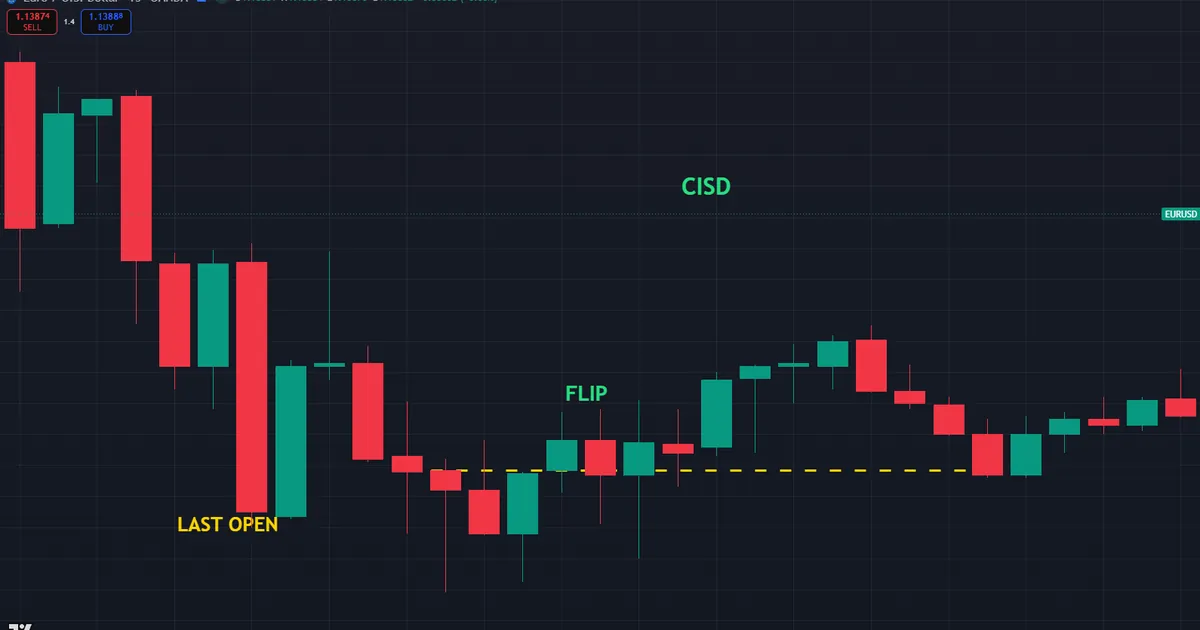
Why does one close matter so much? Because the open of the last opposing candle stores the price where the old direction handed off control. A close beyond it says the market no longer respects that handoff. So a CISD is less about the swing and more about the delivery engine changing its mind.
Delivery is the key word here. In the ICT model price does not simply move; an algorithm delivers it in a chosen direction until a job finishes. A CISD is your receipt for a change in that job. So instead of asking whether the trend has turned, you ask a sharper question: has the delivery engine started feeding price the other way?
CISD Versus a Market Structure Shift
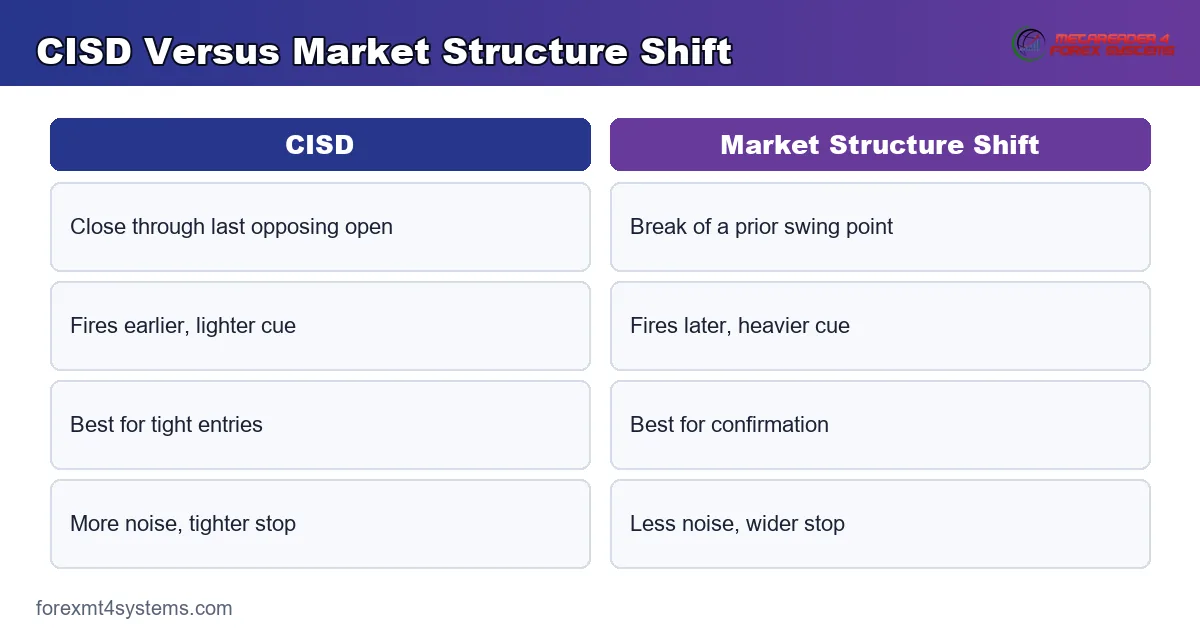
A market structure shift needs price to break a prior swing high or low. A CISD needs only a close through the last opposing candle’s open. So the CISD fires earlier and gives a lighter, faster cue than the heavier break. Our guide to the market structure shift covers that confirmation in full.
Think of the two as a matched pair. The CISD warns you first, and the structure shift confirms the reversal later. Aggressive traders act on the CISD, while patient traders wait for the swing to break. Both read the same displacement leg that powers the turn. So neither tool contradicts the other; they simply sit at different points on the same reversal.
How to Read a CISD Step by Step
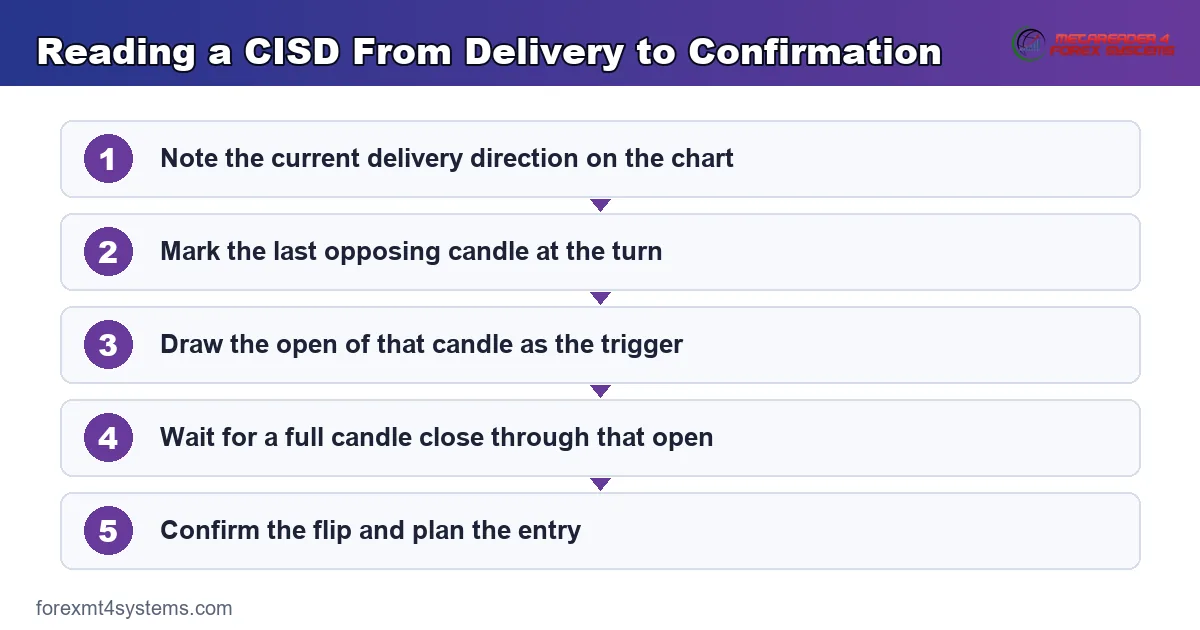
Reading a CISD follows a fixed routine. Walk the five steps below and the trigger becomes obvious. Each step narrows the read, so by the last one you either have a valid flip or you do not.
- Find the current delivery. Note whether recent candles push price up or down, and treat that as the state you expect to flip.
- Mark the last opposing candle. In a downmove, tag the final down candle before the bounce; in an upmove, tag the final up candle before the drop.
- Draw its open. The open of that reference candle becomes your trigger line for the whole setup.
- Wait for the close. Let a candle close fully through that open, not just wick past it and snap back.
- Confirm the shift. Once the close prints, delivery has flipped, and the CISD stands until price closes back the other way.
The branded graphic below stacks the sequence so you can memorize it. Notice how the close, not the wick, does the work. So a long upper wick that fails to close through the open means no CISD yet. Wait for the body.
Choosing the Right Reference Candle
The reference candle trips up most newcomers. It is the last candle that delivered the old direction, sitting right at the turn. So in a sell leg, it is the final red candle before green takes over. Grab the wrong candle and your trigger line lands in the wrong place, which turns a clean rule into guesswork.
One tip keeps you honest here. If several small candles cluster at the low, use the last one whose body pushed the extreme. That body holds the open the algorithm defended. Then a close through it carries real meaning rather than noise from a doji.
Where CISD Fits Your Top-Down Workflow
A CISD earns its keep only inside a plan. It answers when delivery flips, not whether the level deserves a trade. So pair it with higher-timeframe bias and a clean point of interest before you ever click.
First, set direction on the daily and four-hour charts. Then drop to a lower timeframe and wait for price to reach a decision zone, such as an order block or a fair value gap. The full order block trading guide shows how to frame those zones before you hunt the flip. A CISD at a fresh zone beats a CISD floating in mid-range every time.
Next, watch for the flip at that zone. A close through the last opposing candle’s open, right where your higher-timeframe bias points, stacks two edges at once. So the CISD becomes a trigger rather than a coin toss. The wider library of ICT indicators for MT4 and MT5 can mark these levels for you while the pattern still feels new.
How a CISD Relates to BOS and CHoCH
A break of structure and a change of character both need a swing to break. A CISD sits one step earlier than either. So it often prints inside the very candle that later completes a BOS or CHoCH. Read the CISD as the seed and the structure break as the flower that follows.
This ordering matters for risk. Because the CISD leads, your entry price sits tighter and your stop stays smaller. Yet the earlier signal also carries more noise. So weigh the better price against the lower certainty, and size the trade to match.
Combining CISD With a Fair Value Gap
A CISD pairs cleanly with a fair value gap. Often the flip candle itself, or the displacement leg that follows it, leaves a gap between wicks. So price frequently retraces into that gap before it runs. That retrace hands you a second, tighter entry with a smaller stop.
Here is the sequence in plain terms. The close through the opposing open confirms the flip. Then the strong leg that follows prints a fair value gap. Next, price eases back into the gap, and you enter there rather than chasing the initial close. Patience for the retrace often halves the risk.
One caution applies. Not every flip leaves a gap, and forcing a gap where none exists invites a poor entry. So when the displacement runs clean with no imbalance, take the close entry and accept the wider stop. The gap is a bonus, never a requirement.
Session Timing in New York Hours
Timing sharpens every flip. The cleanest CISDs tend to print during the London open, from 02:00 to 05:00 New York time, and the New York morning, from 08:30 to 11:00. So a close through the last opposing open inside those windows carries more weight than one during the quiet Asian afternoon. Volume drives delivery, and these windows hold the volume.
Avoid the dead zones too. The late New York afternoon and the Asian lunch lull often produce flips that fade, because thin volume cannot sustain the new delivery. So even a textbook close through the opposing open deserves less trust when the clock reads a quiet hour. Match the signal to the session and the odds improve.
Worked Example: A Bullish CISD on EURUSD
Now make the idea concrete with a long setup, step by step. EURUSD trades above a rising daily draw on liquidity, so bias points up. The plan stays simple: buy the first CISD that flips delivery bullish at a discount order block. The chart below shows the sweep, the flip candle, and the entry.
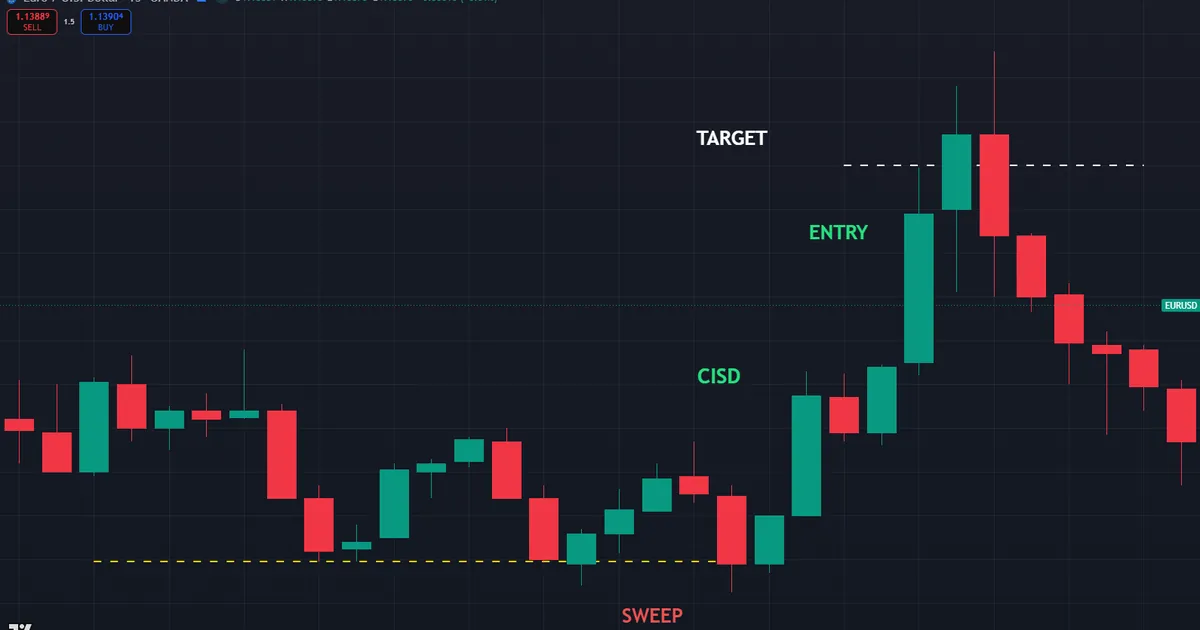
During the London open, price dips to sweep the sell stops below a prior low, near the 1.13779 area. That flush taps a discount order block sitting just under the range. So the raid gathers fuel while price sits in a fair zone rather than an expensive one.
Then a bull candle closes above the open of the last down candle, around the 1.1385 level. That close is the CISD, and delivery flips up. The entry builds from there. A long on the flip candle’s close carries a stop below the sweep low, roughly 8 pips of risk. Next, price delivers up toward the liquidity resting above the 1.1396 area. Notice the order never changes: sweep, close through the opposing open, then deliver.
Watch the confirmation, not the hope. If the flip candle had closed with a long upper wick and a weak body, the CISD would not stand, and the long would wait. So the close quality decides the trade, not the trader’s wish for a bounce.
A Bearish CISD in Brief
Flip every rule for a short and the logic still holds. GBPUSD trades below a falling daily draw, so bias points down. Price rallies into the London open and sweeps the buy stops above a prior high, near the 1.2740 area. That raid taps a premium supply zone rather than a cheap one.
Then a bear candle closes below the open of the last up candle, around the 1.2732 level. That close is the bearish CISD, and delivery flips down. A short on the close carries a stop above the sweep high, roughly 14 pips of risk. Next, price delivers lower toward the liquidity resting under the 1.2690 area. So the mirror image works exactly like the long, only upside down.
Reading a CISD Across Timeframes
A CISD scales up and down the chart, and each timeframe tells a slightly different story. On the daily, a close through the last opposing open marks a swing-level shift that can run for days. On the five-minute, the same event marks a scalp that may last minutes. So the rule stays identical while the horizon changes with the chart.
Use the layers together rather than in isolation. A daily CISD sets the bias, a one-hour CISD refines the zone, and a five-minute CISD triggers the entry. When all three point the same way, the trade carries real weight. When they disagree, trust the higher timeframe and wait. This nesting keeps you on the right side of the dominant delivery.
Download the complete indicator database
Put these concepts on your charts. One email unlocks the full library of 1,380+ indicators with compiled MT4 and MT5 files, plus my TradingView scripts. No paywall, no spam, unsubscribe any time.
Get free access to my indicator database
One email unlocks 1,380+ free MT4, MT5 and TradingView indicators — the complete library. No single-tool download; you get the whole database.
Common CISD Mistakes and How to Fix Them
The trigger reads cleanly, yet the same errors repeat. The graphic below collects four traps we see most, and the fixes follow beneath it. Each fix costs nothing but patience.
Trading the Wick Instead of the Close
A wick through the opposing open proves nothing on its own. Price must close through it with a real body. So wait for the candle to finish before you act, even when the wick looks decisive mid-bar. Many false flips collapse in the final seconds of a candle.
Ignoring Higher-Timeframe Bias
A bullish CISD against a falling daily trend usually fails. Instead, check the chart above first, and only take flips that agree with it. When the big picture disagrees, skip the setup or treat it as a quick scalp with tight risk.
Picking the Wrong Opposing Candle
The reference candle is the last one that delivered the old direction. Traders often grab a random candle nearby and misplace the trigger line. Rather than guess, mark the final push before the reversal and use its open. Precision on this single line saves the whole read.
Skipping the Liquidity Draw
A CISD with no liquidity behind it tends to drift. The strongest flips follow a sweep of stops. So look for a raid on a prior high or low right before the close through the opposing open. No sweep, no conviction.
Pre-Trade CISD Checklist
Run this list before you act on any flip. A few seconds here filters most impulsive entries. Keep a note of every trade in a trade journal so the pattern sharpens with each review.
- Higher-timeframe bias marked on the daily and four-hour charts.
- Price sitting at a real point of interest, not floating in mid-range.
- A liquidity sweep printed just before the flip candle.
- A full candle close through the last opposing candle’s open.
- Stop planned beyond the sweep extreme, target set at the next pool.
- Session window checked, ideally London or the New York morning.
Treat any unchecked box as a reason to pass. So the list is a filter, not a wish list, and every skipped box lowers the odds. Discipline on the checklist compounds faster than any single winning trade.
Honest Limitations: When CISD Fails
Study the failure case as hard as the winner. Here is a common one. Price sweeps a low, a bull candle closes through the last down candle’s open, and the CISD looks clean. Then price stalls, rolls over, and slices back below the flip candle. The chart below shows that unraveling, with the failed level marked.
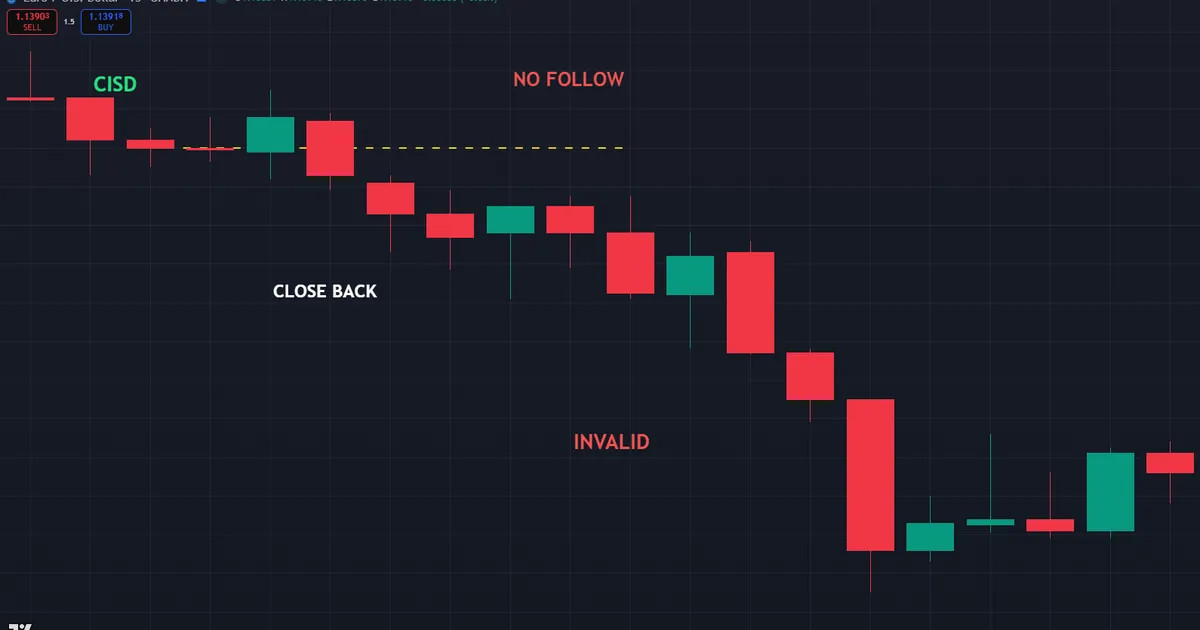
What went wrong? Usually the context. The higher timeframe still pointed down, so the flip was a minor counter-move inside a larger bearish leg. Hence the invalidation rule that limits the damage. Once price closes back below the CISD candle, the idea is dead. Exit at once, and never widen the stop to hope.
Why CISD Alone Is Not a System
A CISD is a trigger, not a strategy. On its own it fires far too often, including inside chop where every small close flips the read. So it needs the filters above: bias, a point of interest, and a liquidity draw. Traders who skip those filters collect a stream of false signals, a habit our roundup of common SMC mistakes unpacks in detail.
How News Distorts the Signal
News is a second common trap. A rate decision or an inflation print can drive price through any opposing open, and the resulting spike mimics a textbook flip. Yet scheduled releases often reverse within the hour. So a CISD born from a news candle deserves extra suspicion. Let the dust settle, then judge the flip once normal delivery resumes.
Thin holiday sessions carry the same warning. Low participation distorts the usual rhythm and produces closes through the opposing open that lead nowhere. So treat both news candles and holiday flips as lower-quality signals, and demand extra confirmation before you commit real size.
No Fixed Success Rate Exists
Be blunt here. No reliable success percentage exists for the CISD, and anyone quoting one is simply guessing. Outcomes hinge on your bias, your zone selection, and your discipline. Qualitatively, flips that align with the daily trend hold up far better than counter-trend flips. That direction of effect is the only honest claim worth making.
Related SMC Concepts to Study Next
A sensible study order helps here. First, practice marking the last opposing candle on replayed charts until the flip jumps out at you. Then layer in bias and liquidity, and only then trade the CISD live with small size. So build the habit slowly, one flip at a time, rather than forcing every close into a signal.
The CISD links tightly to a few neighbors worth your next reading hour. Displacement drives the leg that a flip confirms, so study how a violent candle range creates the shift in the first place. Market structure then locks the reversal in once a swing finally breaks. Master the trigger, the driver, and the confirmation together, and most reversals start reading like a sequence instead of a surprise.
One more habit speeds your learning. Keep a small library of screenshots, each showing a valid CISD beside a failed one from the same pair. Over a few weeks the difference between a flip with liquidity behind it and a flip without becomes second nature. So your eye, rather than a rulebook, starts filtering the weak signals for you.
FAQ
What is a change in state of delivery in simple terms?
It is the moment price closes through the open of the last opposing candle. That close signals order flow has flipped from one side to the other. So it is the earliest tell that a reversal may begin.
How is a CISD different from a market structure shift?
A market structure shift needs a prior swing high or low to break. A CISD needs only a close through the last opposing candle’s open. So the CISD fires earlier and acts as a lighter, faster confirmation.
Does the candle need to close, or is a wick enough?
The candle must close fully through the opposing open. A wick that pierces the level and pulls back does not count. So patience for the close keeps you out of many false flips.
Which timeframe works best for a CISD?
Traders read the CISD on any timeframe, though lower charts like the five-minute and fifteen-minute suit intraday entries. Anchor the flip to higher-timeframe bias first. Then the lower-timeframe trigger carries more weight.
Can I trade a CISD on its own?
No single trigger should stand alone. Pair the flip with higher-timeframe bias, a clear point of interest, and a liquidity sweep. That combination filters out most of the noise.
Is the CISD reliable enough to trade every day?
No trigger fires cleanly every session. Ranging days produce flips that lead nowhere, so selectivity matters more than activity. Always manage risk on every trade. Results are not guaranteed; past performance is not indicative of future results.
External references
- For background on this concept, see Tape Reading at Investopedia.
- For broader market context, see Price Action at BabyPips Forexpedia.

About the author
Written by Dominic Walsh, a Forex trader and MT4/MT5 indicator, Expert Advisor and script developer. Every tool on forexmt4systems.com is tested on live charts before release and ships with ready-to-use compiled MT4 (.ex4) and MT5 (.ex5) files. Learn more about the trader and developer behind this site.
How we build, test and correct every tool: Editorial & Testing Policy. Trading carries risk; see the disclaimer.