
The BGN currency is the Bulgarian lev, and since 1 January 2026 it is no longer Bulgaria’s money: the euro took over at a fixed 1.95583 leva per euro. This guide settles three things. First, why the lev never moved against the euro. Second, how the 2026 changeover worked and where old leva can still be swapped. Third, what the EUR/BGN and USD/BGN charts that data feeds still print can and cannot tell a trader.
What the BGN currency is
BGN is the ISO 4217 code for the Bulgarian lev. The code dates from 5 July 1999, when Bulgaria knocked three zeros off its money, so 1,000 old leva became 1 new lev. The old lev carried the code BGL. One lev split into 100 stotinki, and the name comes from an old Bulgarian word for “lion”, according to the Bulgarian lev entry on Wikipedia. Dropping zeros is a common fix after high inflation, as our guide to the weakest currency in the world shows.
The lev’s story also has a clear ending. Bulgaria joined the euro area on 1 January 2026, and the euro became the only legal tender on 1 February 2026. So today BGN is a legacy code. Yet TradingView’s FX_IDC feed, labelled ICE on the chart, still quotes EUR/BGN.
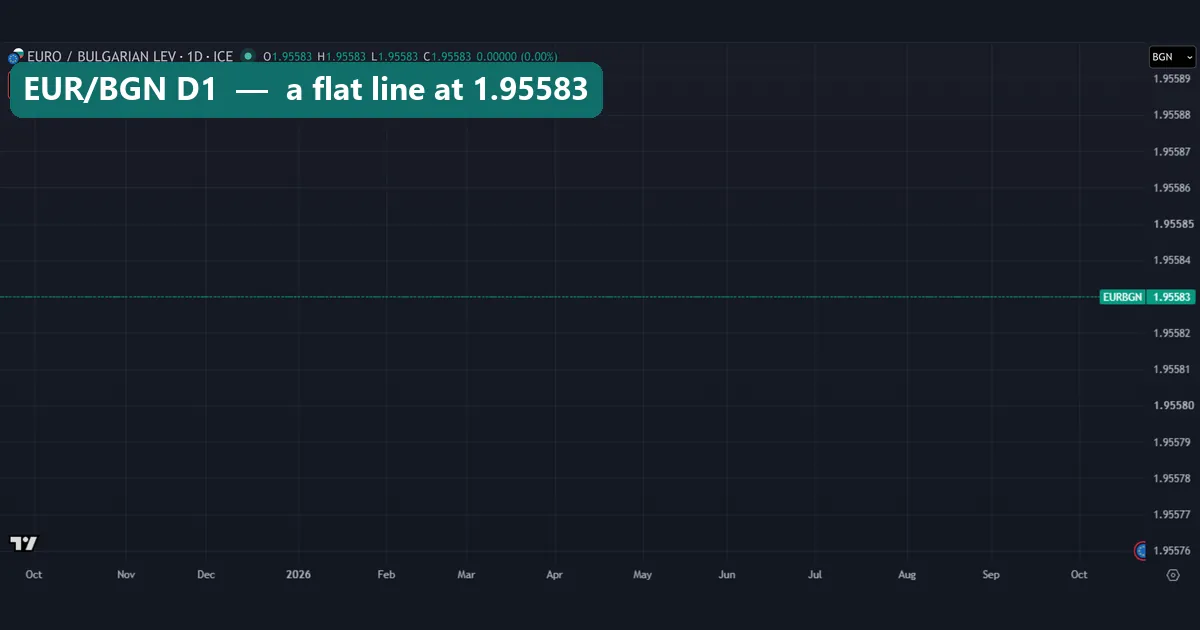
The chart above shows that feed. From autumn 2025 to 23 October 2026, the daily open, high, low and close all read 1.95583, a change of 0.00%. In short, one flat line tells the whole story of the lev.
How the lev peg began: from the mark to the euro
The peg grew out of a crisis. After the fall of communism, Bulgaria went through several bouts of fast inflation and devaluation, as the same Wikipedia entry notes. The answer was a currency board, which started on 1 July 1997.
The Bulgarian National Bank’s 2007 half-year report spells out the rule. Foreign currency reserves covered all of the bank’s monetary liabilities at a fixed rate of 1,000 leva per Deutsche Mark. From 1999, that became 1.95583 leva per euro.
The new number came from plain arithmetic. The 1999 change made one new lev equal to one Deutsche Mark, and the mark entered the euro at its own fixed rate. So the lev simply took over the mark’s euro rate. On 10 July 2020 the lev entered ERM II, the euro’s waiting room, at that same central rate. In other words, the number never changed from 1999 to the lev’s last day.
The formula behind every lev price
A currency board is stricter than an ordinary peg. Under Bulgaria’s rule, every lev the central bank issued needed foreign reserves behind it at the fixed rate. So the bank could not create leva at will or run its own rate policy. The lev just followed its anchor, while floating currencies react to central bank rate decisions at home.
For a trader, three formulas cover every lev price:
EUR/BGN = 1.95583, by ruleUSD/BGN = 1.95583 / EUR/USDeuros = leva / 1.95583
The second line matters most. USD/BGN has no life of its own. When EUR/USD rises, USD/BGN must fall by the same share, because the euro leg cannot move. Every other lev cross works the same way. For example, GBP/BGN is just 1.95583 divided by EUR/GBP.
How the lev became the euro in 2026
On 8 July 2025 the Council of the EU adopted the last three legal acts for Bulgaria’s entry. One of them set the conversion rate at 1.95583 leva per euro. The Council of the EU press release of 8 July 2025 notes that this matched the lev’s ERM II central rate and made Bulgaria the 21st euro area member.
The ECB’s page on Bulgaria’s changeover gives the timetable:
- 8 August 2025: shops start to show prices in lev and euro, for one year.
- 1 January 2026: Bulgaria joins the euro area.
- January 2026: for one month, both lev and euro cash work for payments.
- 1 February 2026: euro cash becomes the sole legal tender.
- 30 June 2026: free lev exchange at banks and post offices ends; after that they may charge a fee.
- 1 January 2027: banks and post offices no longer have to swap lev cash.
One door stays open, though. According to the same page, the Bulgarian National Bank swaps lev notes and coins indefinitely and free of charge. For live pairs such as EUR/USD, use our currency converter. For leva, the sum is fixed.
How we tested
We pulled every chart on a TradingView web chart and took the shots on 23 October 2026. We used three symbols:
- FX_IDC:EURBGN, daily from 1 September 2025 to 23 October 2026, and weekly from the week of 25 January 2021
- FX_IDC:USDBGN, daily and weekly
- OANDA:EURUSD, daily
For each day we multiplied the USD/BGN close by the EUR/USD close. If the peg holds, the result should equal 1.95583. Then we took the median and the largest gap across the window. Images 4 and 5 are our own charts, drawn from those bars.
We did not use MetaTrader 4 this time. The history we use for other guides (Capital Point Trading, MetaTrader 4 build 1471) holds 23 FX pairs and no lev pair. Also, these are price measurements, not trades, so no spread, swap or commission enters them. Our methods follow the editorial testing policy.
The BGN currency in numbers
The table pulls the key facts into one place, with the source of each.
| Item | Value | Source |
|---|---|---|
| ISO code | BGN (BGL before 5 July 1999) | Wikipedia |
| Currency board start | 1 July 1997 | BNB report |
| First anchor | 1,000 old leva per Deutsche Mark | BNB report |
| Euro anchor from 1999 | 1.95583 leva per euro | BNB report, Council |
| Euro adoption | 1 January 2026 | ECB |
| Euro sole legal tender | 1 February 2026 | ECB |
| Lev exchange at the BNB | Indefinite, free of charge | ECB |
| Daily EUR/BGN low and high, Sep 2025 to Oct 2026 | 1.95583 and 1.95583 | Our data |
| USD/BGN x EUR/USD, median | 1.95599 | Our data |
| Largest daily gap from 1.95583 | 0.622% | Our data |
| USD/BGN close, 23 October 2026 | 1.74640 | Our chart |
Two rows deserve a second look. The median of 1.95599 sits about 0.008% from the official rate. The largest gap, 0.622%, came from quotes taken at different moments, not from a crack in the peg.
Reading EUR/BGN and USD/BGN charts
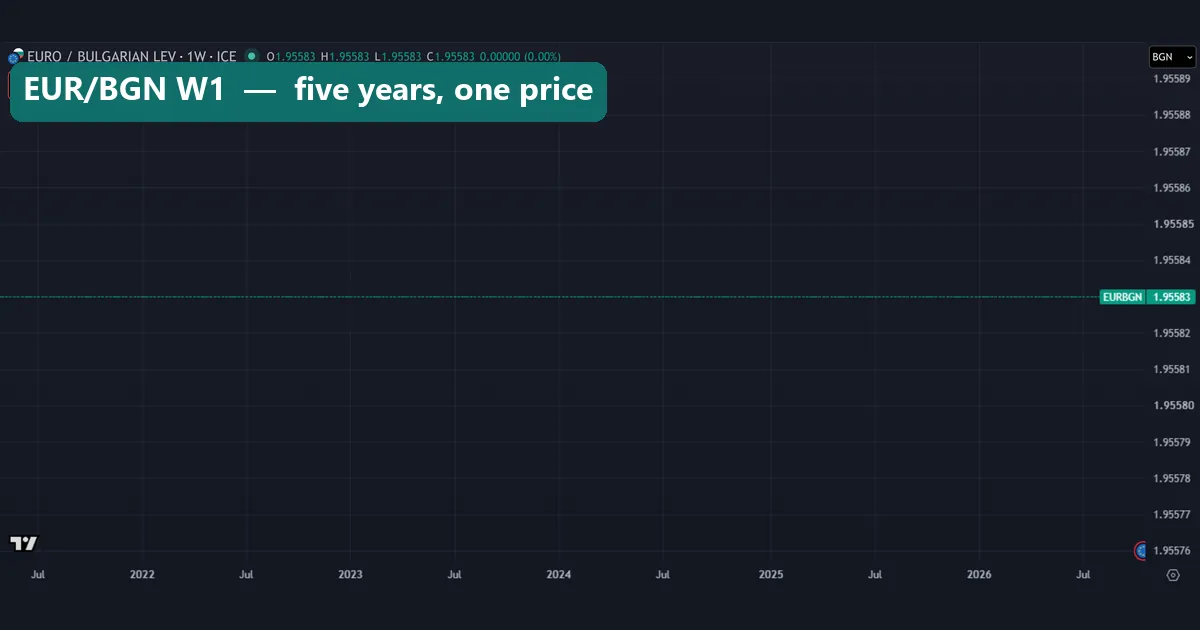
The weekly EUR/BGN chart draws a ruler-straight line from 2021 to October 2026. Its price scale runs from 1.95576 to 1.95589, so even a move in the fifth decimal would show. None does. Also note the top-left boxes: sell and buy both read 1.95583, with 0.0 between them. That points to a reference quote, not a price you could deal on.
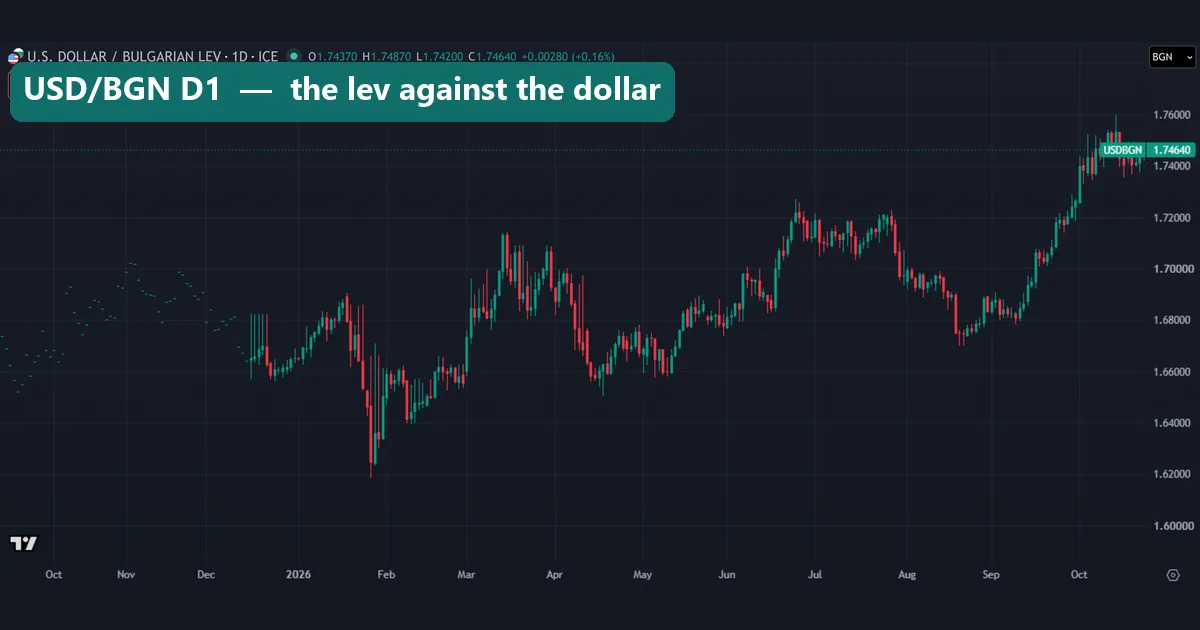
USD/BGN, by contrast, moves like any dollar pair. It dips near 1.62 in the last days of January 2026 and climbs near 1.76 in October. On 23 October it closed at 1.74640, up 0.16% on the day.
Note the left third, too. Until mid-December 2025 the bars show as flat dashes, not candles. A dash means open, high, low and close matched, so the feed carried one quote that day. That detail explains the noise in our first data chart.
Worked example: rebuilding 1.95583 from two quotes
Here is the peg check with our own closing prices from 23 October 2026. Our USD/BGN chart closed at 1.74640, and our OANDA EUR/USD chart closed at 1.11991.
- Multiply them: 1.74640 x 1.11991 = 1.95581.
- Compare that with the official rate: 1.95581 against 1.95583, a gap of about 0.001%.
- Run it the other way: 1.95583 / 1.11991 = 1.74642, just 0.00002 from the USD/BGN close.
So two charts from two different feeds agree to the fifth decimal. That is what a working peg looks like.
The same rate drives cash sums. Divide leva by 1.95583 and round only the answer:
- 100 leva / 1.95583 = 51.13 euros
- 1,000 leva / 1.95583 = 511.29 euros
- 50 euros x 1.95583 = 97.79 leva
Now see what a lazy rate does. If you round the rate to 1.96, then 1,000 leva become 510.20 euros, which leaves you 1.09 euros short. On 10,000 leva the gap grows to 10.88 euros. In short, keep all five decimals.
What our two data charts show
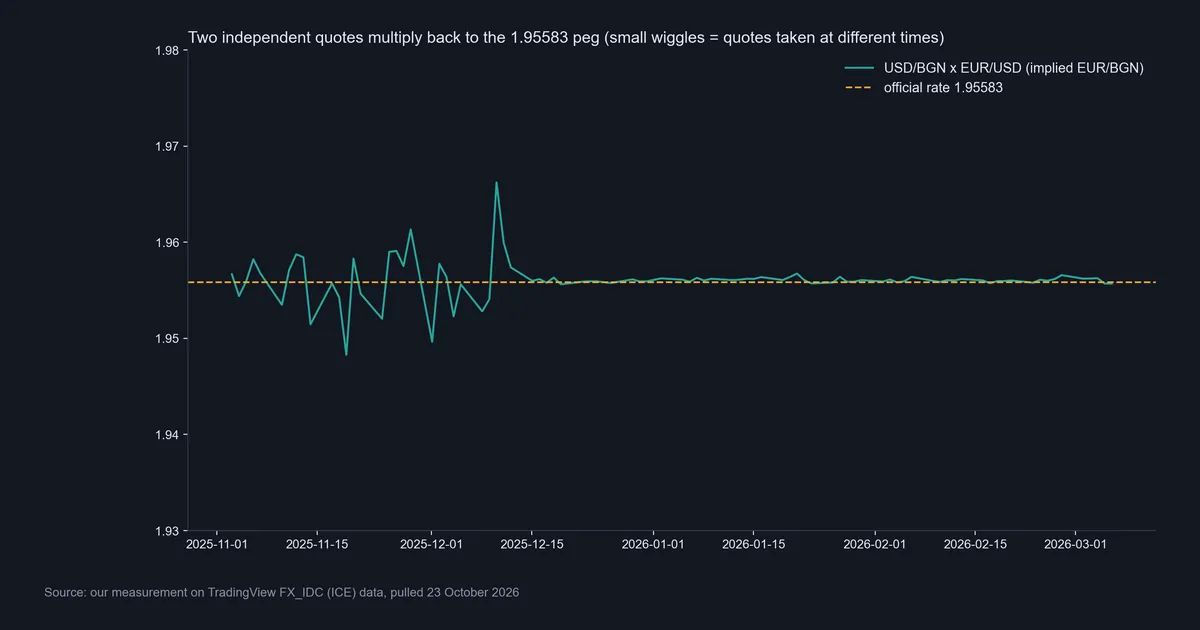
The first chart repeats the multiplication for each day from November 2025 to early March 2026. Before mid-December the line jumps around, rising above 1.96 and dipping below 1.95. After that it sits almost on the dashed official line.
That break lines up with the dashes on the USD/BGN chart. Our reading: while the feed printed one quote a day, its time stamp did not match the EUR/USD close, so the product wobbled. Once full daily bars arrived, the quotes lined up.
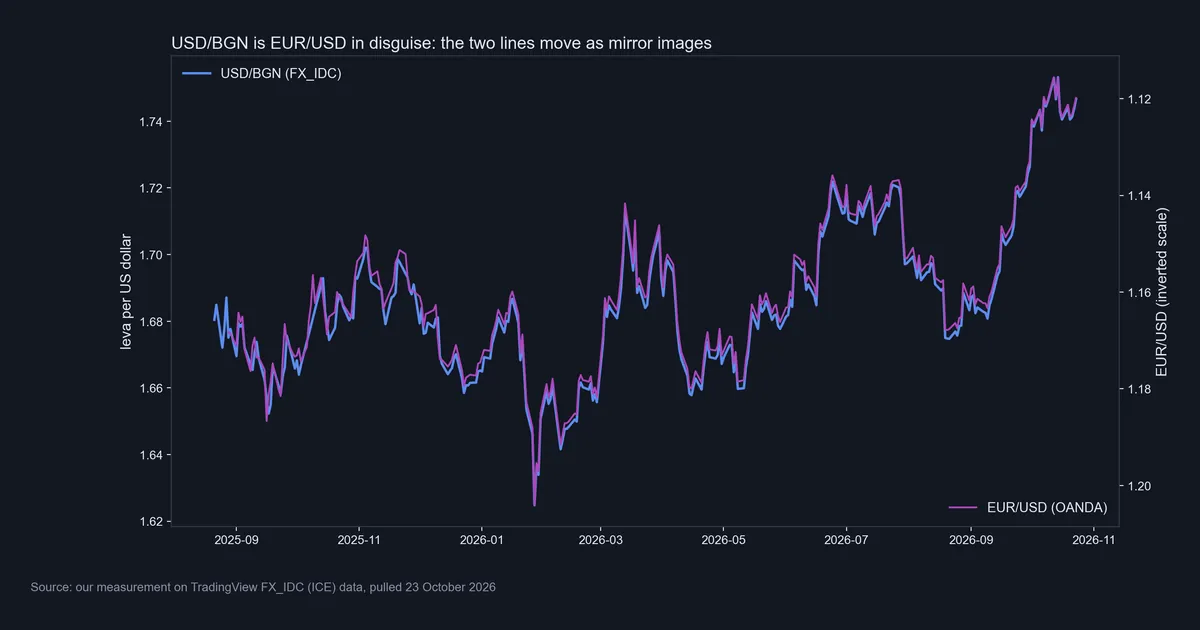
The second chart puts USD/BGN next to EUR/USD on an upside-down scale. The two lines trace the same path from August 2025 to October 2026, down to the small wiggles. That is the formula from earlier, drawn out.
So a trader gains nothing by watching both. Our guide to currency correlation in forex explains how to measure it, and the forex correlation matrix does the sums for live pairs.
Download the complete indicator database
Put these concepts on your charts. One email unlocks the full library of 1,380+ indicators with compiled MT4 and MT5 files, plus my TradingView scripts. No paywall, no spam, unsubscribe any time.
Get free access to my indicator database
One email unlocks 1,380+ free MT4, MT5 and TradingView indicators — the complete library. No single-tool download; you get the whole database.
Where it fails: what lev data cannot tell you
The quotes are not dealing prices. On every FX_IDC lev chart we captured, the sell and buy boxes show the same number with 0.0 between them. On OANDA’s EUR/USD, the same boxes showed a 1.6-pip gap. So a flat EUR/BGN line gives the reference rate, not what anyone would charge you to swap leva. Our page on the spread in forex covers that cost.
The currency is gone. Since 1 February 2026 the lev has no legal tender status. A feed that still prints EUR/BGN does not turn the lev into a live market.
Mixed time stamps create fake moves. Our 0.622% gap came from quotes taken at different times. A scanner that compares closes from different feeds can flag a “break” that never happened.
Our window is short. Our lev data starts in 2021 (weekly) and September 2025 (daily). So the 1997 crisis rests on the sources we cite, not on our charts.
A peg is a policy, not a law of nature. Bulgaria’s held until the euro took over, but a flat chart says nothing about the odds of a break elsewhere. Our page on whether central banks trade forex covers how pegs get defended.
The long view: USD/BGN since 2021 and its mirror
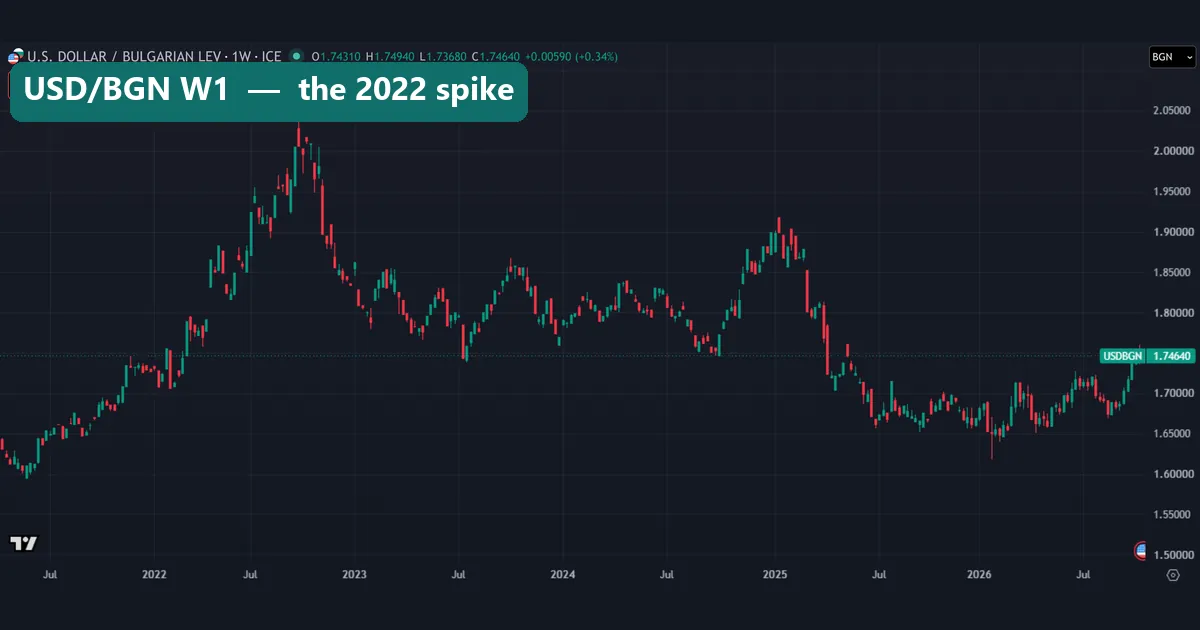
A euro peg does not stop a currency from swinging against the dollar. The weekly USD/BGN chart starts near 1.60 in mid-2021 and climbs above 2.00 in autumn 2022. It then falls back, spikes above 1.90 around the start of 2025, and ends at 1.74640.
Whenever USD/BGN sits above 1.95583, one dollar buys more leva than one euro does. In other words, EUR/USD sat below parity. Our guide on whether the euro is stronger than the dollar covers that spell from the EUR/USD side.
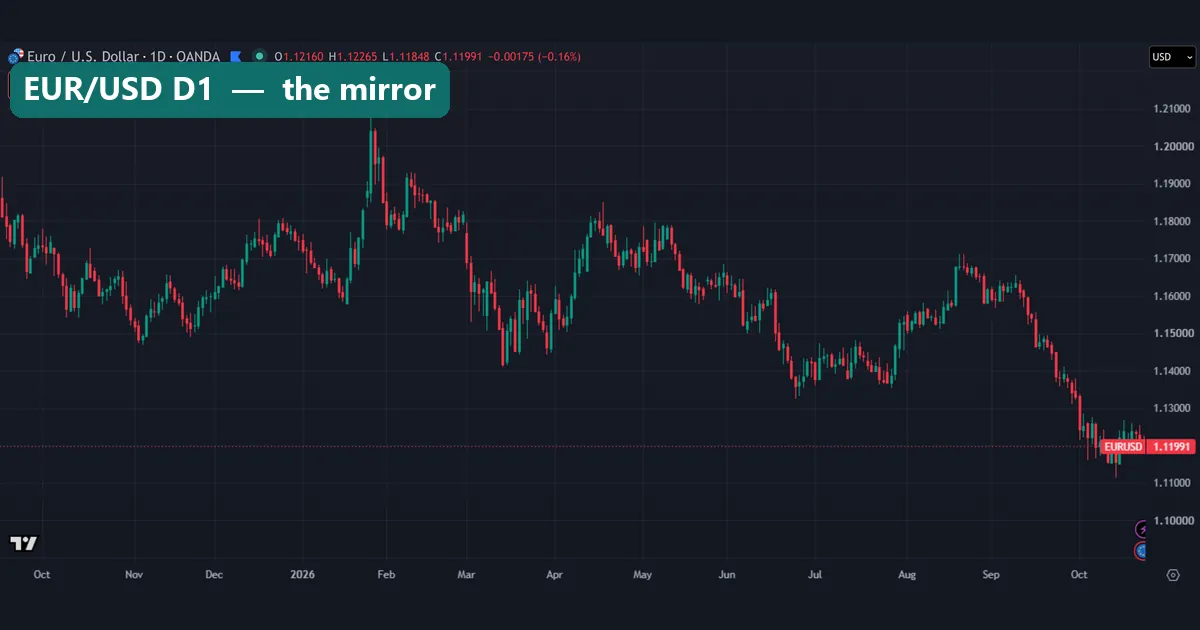
The daily OANDA EUR/USD chart is the mirror image. It peaks near 1.21 in the last days of January 2026, just as USD/BGN bottomed near 1.62. The sum checks out, because 1.95583 / 1.62 gives about 1.207. EUR/USD then slides to a close of 1.11991. So for lev history, read EUR/USD: same information, right way up.
Common mistakes with the BGN currency
1. Treating BGN as a live currency. Bulgaria has paid in euros since 2026. A quote on a screen is a reference, not a market.
2. Reading USD/BGN as news about Bulgaria. It is EUR/USD upside down. A rise means a stronger dollar against the euro, and nothing more.
3. Rounding the rate. Both 1.96 and 0.51 look close enough. Yet 1,000 leva at 1.96 come up 1.09 euros short, so use 1.95583 and divide.
4. Comparing closes from different feeds. Our own test showed gaps of up to 0.622% that came only from timing. Match the time stamps before you call a peg broken. If you want the dollar’s broad trend, the dollar index tracks it better than any lev pair.
Where to go next
Start with the most valuable currency in the world, which explains why central banks peg and what it costs them. Next, our guide to African currencies covers the CFA francs, which also follow the euro at a fixed rate.
For the euro itself, see the major currency pairs, where EUR/USD leads. Then the G10 currencies guide shows how the euro moved against the dollar since 2021.
FAQ about the BGN currency
What currency is BGN?
BGN is the code for the Bulgarian lev, the money Bulgaria used until the euro replaced it on 1 January 2026. One lev had 100 stotinki.
Is the BGN currency still in use?
No. The euro became Bulgaria’s sole legal tender on 1 February 2026, after one month in which both cash currencies worked. Data feeds such as FX_IDC still print BGN quotes.
What is the BGN to EUR rate?
The rate is 1.95583 leva per euro, set by the Council of the EU. One lev is worth about 0.51 euros, but divide by 1.95583 so the cents come out right.
Can I still exchange old leva?
Yes. The ECB says the Bulgarian National Bank swaps lev notes and coins indefinitely and free of charge. Banks and post offices keep the service until 31 December 2026, but may charge after 30 June 2026.
Why is the rate 1.95583?
In 1999 Bulgaria made one new lev equal to one Deutsche Mark. The mark entered the euro at that same rate, so the lev took it over and kept it until 2026.
Why does USD/BGN move if the lev had a peg?
Because the peg tied the lev to the euro, not the dollar. USD/BGN equals 1.95583 divided by EUR/USD, so it moves whenever EUR/USD moves.
Can you trade the BGN currency?
We found no lev pair in the MetaTrader 4 history we test with, and the FX_IDC quotes show no spread, which points to reference prices. Against any other currency, a lev position behaved like a euro position.
Does a fixed rate make a currency safe?
No. A peg holds only while the central bank can and will defend it. Bulgaria’s held from 1997 to the euro, but a flat chart says nothing about future odds; results are not guaranteed; past performance is not indicative of future results.
Last updated: 23 October 2026.

About the author
Written by Dominic Walsh, a Forex trader and MT4/MT5 indicator, Expert Advisor and script developer. Every tool on forexmt4systems.com is tested on live charts before release and ships with ready-to-use compiled MT4 (.ex4) and MT5 (.ex5) files. Learn more about the trader and developer behind this site.
How we build, test and correct every tool: Editorial & Testing Policy. Trading carries risk; see the disclaimer.