
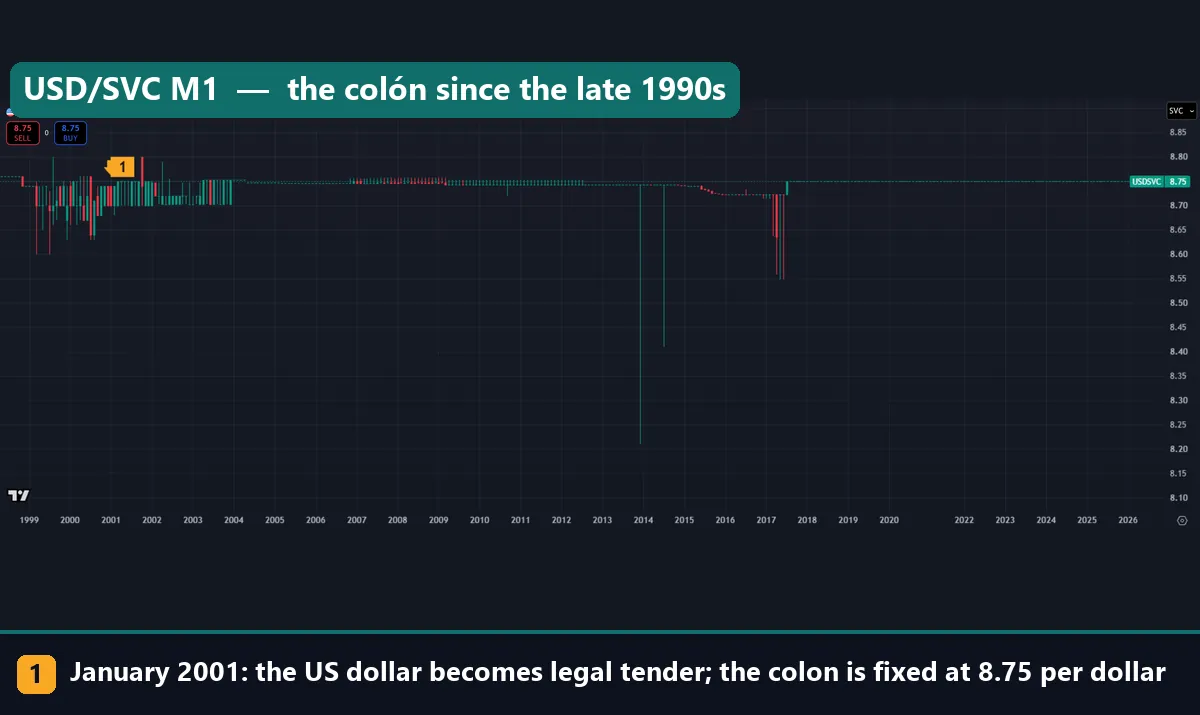
San Salvador money is the US dollar, the legal currency of El Salvador since 1 January 2001. This guide settles three questions. First, what happened to the colón, which the law fixed at 8.75 per dollar. Second, what the 2021 Bitcoin Law added and what the 2025 reform took back. Third, how the three compare on our own bars: since September 2021, the median daily move is 0.00% for the colón quote and 1.26% for Bitcoin.
What San Salvador money actually is
San Salvador is El Salvador’s capital, so its money is the US dollar. The US State Department’s 2024 investment climate statement says the Monetary Integration Law dollarized the country in 2001. It adds that the dollar makes up nearly all cash in circulation.
The old currency was the colón, code SVC. Our sources do not say the law abolished it. Instead, the law fixed its value. El Salvador’s financial regulator, the SSF, wrote the SSF rules for applying the Monetary Integration Law. They state that, under that law, the rate is 8.75 colones per dollar from 1 January 2001. They also treat the colón and the dollar as home currencies, and every other currency as foreign.
The chart above shows how that looks on a data feed. FX_IDC still prints a USD/SVC quote, and it hugs 8.75 from 2001 onward. Two thin wicks, in late 2013 and in 2014, reach about 8.21 and 8.41. Those are single bad prints, not devaluations, because the law calls the rate fixed and unalterable.
How the dollar and the colón fit together
The mechanism is plain arithmetic. El Salvador does not defend a peg, because it uses the dollar itself. The Legislative Assembly’s decree database lists the Monetary Integration Law as Decree 201, issued on 30 November 2000. Its summary sets the colón’s rate at 8.75 per dollar, fixed and unalterable. So any conversion takes one step:
US dollars = colones / 8.75, and colones = US dollars x 8.75.
One colón is therefore worth about 11.43 US cents (1 / 8.75 = 0.114286). The SSF rules also ask firms to use at least six decimal places when they convert. For a trader, a fixed number offers nothing: it does not trend, revert or break out. The cash in a San Salvador wallet is simply the dollar from every USD pair.
How Bitcoin came in, and then stepped back
In 2021 El Salvador added a second legal tender: Bitcoin. The Assembly’s database lists the Bitcoin Law as Decree 57, issued on 8 June 2021. It reached the official gazette on 9 June. According to the State Department, Bitcoin became legal tender alongside the dollar on 7 September 2021. It also notes that the law told all businesses to accept Bitcoin, with limited exceptions.
The reversal came with an IMF loan. The IMF’s 2025 staff report on El Salvador’s Extended Fund Facility describes a 40-month loan of about US$1.4 billion. It lists an amendment to the Bitcoin Law as a prior action, a step due before approval. Next, the Assembly’s record of Decree 199 dates the reform to 29 January 2025. Publication followed on 30 January, and the reform took effect on 30 April 2025. It amends articles 1, 3 and 5 and repeals articles 4, 8 and 9.
So what changed? The IMF says the reform removed the idea of currency from the law. It also removed the core features of legal tender. Private firms may now accept Bitcoin or not, and people pay taxes only in US dollars. However, the Assembly’s own summary still speaks of Bitcoin’s permanence as legal tender. We do not settle that label here. On the practical point, the IMF is clear: no firm has to take Bitcoin any more.
How we tested
We pulled FX_IDC:USDSVC and BITSTAMP:BTCUSD on the TradingView web chart on 6 November 2026. The colón file runs from 20 August 1997, and its chart header names ICE as the source. Our numbers come from daily bars, Bitcoin’s in UTC, while the long charts use weekly and monthly bars. We dropped the bars dated 6 November because they were still forming, so every window ends on 5 November 2026. We also measured EUR/USD daily bars over the Bitcoin window, for contrast.
For the colón, we checked how far each of the 6,404 daily closes since 2001 sat from 8.75. For Bitcoin, we measured the moves around the two law dates and every daily change since 7 September 2021. We ran no trade test, so nothing here includes spread, swap, financing or commission. Data charts four and five are our own measurement. Our editorial testing policy explains how we handle data like this. Note that the header prices and the SELL and BUY boxes on our captures show the live quote from capture day.
The numbers that define San Salvador money
| Parameter | Value | Where it comes from |
|---|---|---|
| Legal currency | US dollar, since 1 January 2001 | SSF rules, IMF report |
| Fixed colón rate | 8.75 colones per dollar | Decree 201, SSF rules |
| Conversion rule | At least six decimal places | SSF rules |
| Bitcoin Law | Decree 57, issued 8 June 2021 | Assembly records |
| Bitcoin as legal tender | From 7 September 2021 | State Department |
| Reform | Decree 199, issued 29 January 2025, in force 30 April 2025 | Assembly records |
| Colón closes within 0.5% of 8.75 | 97.4% of 6,404 days since 2001 | Our bars |
| Colón closes exactly at 8.75 | 39.4% of those days | Our bars |
| Colón quote, 1997 to 2000 | 8.60 to 8.77 | Our bars |
| Median daily move since 7 September 2021 | Colón 0.00%, EUR/USD 0.26%, Bitcoin 1.26% | Our bars |
The 39.4% looks low for a fixed rate, but the gap comes from the feed, not the law. Most other days print quote variants such as 8.7425 and 8.745.
Reading Bitcoin’s legal-tender years on a chart
Start with the first legal-tender day. Bitcoin closed at 52,708.2 on 6 September 2021. On 7 September it closed at 46,866.82, down 11.1% on the day. Its low, 42,900.01, sat 18.6% under the prior close. Marker 1 points at that long lower wick.
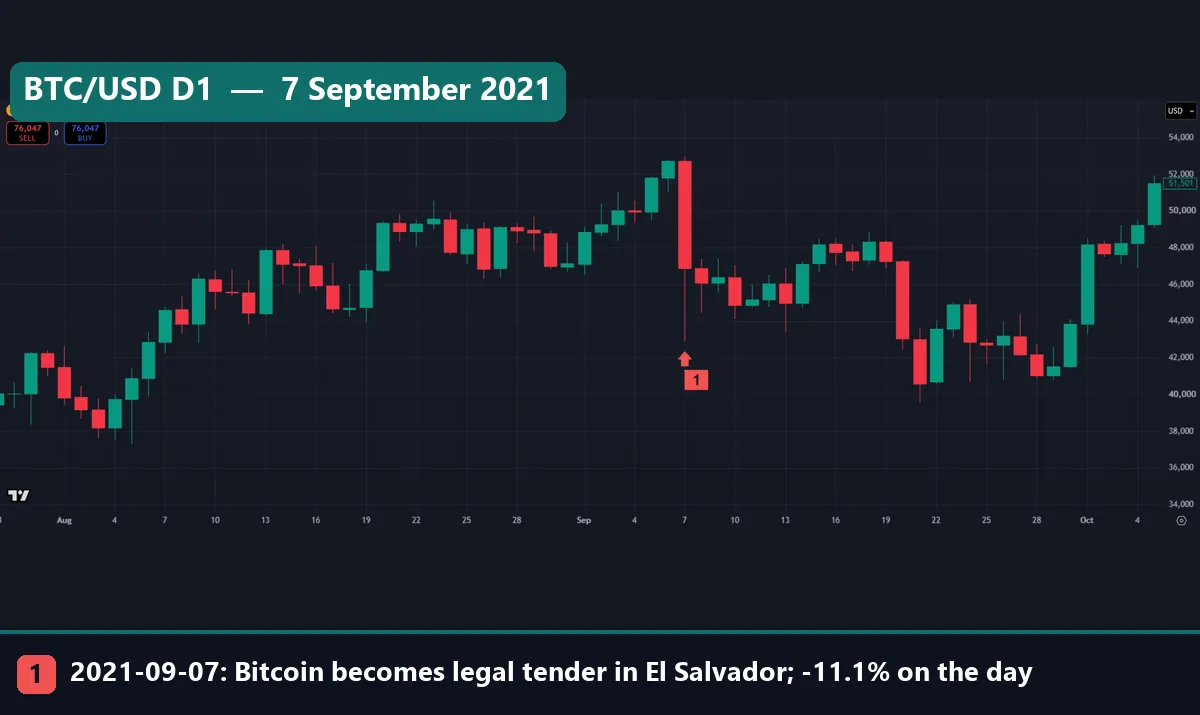
The weeks before gave no hint of it. On 9 June, the day the law reached the gazette, Bitcoin closed at 37,400. By 6 September it had risen 40.9%. After the drop, it closed between about 40,600 and 48,300 for the rest of September. On 5 October it closed at 51,501, the figure on the right edge. So the day was sharp, but the chart shows no lasting break.
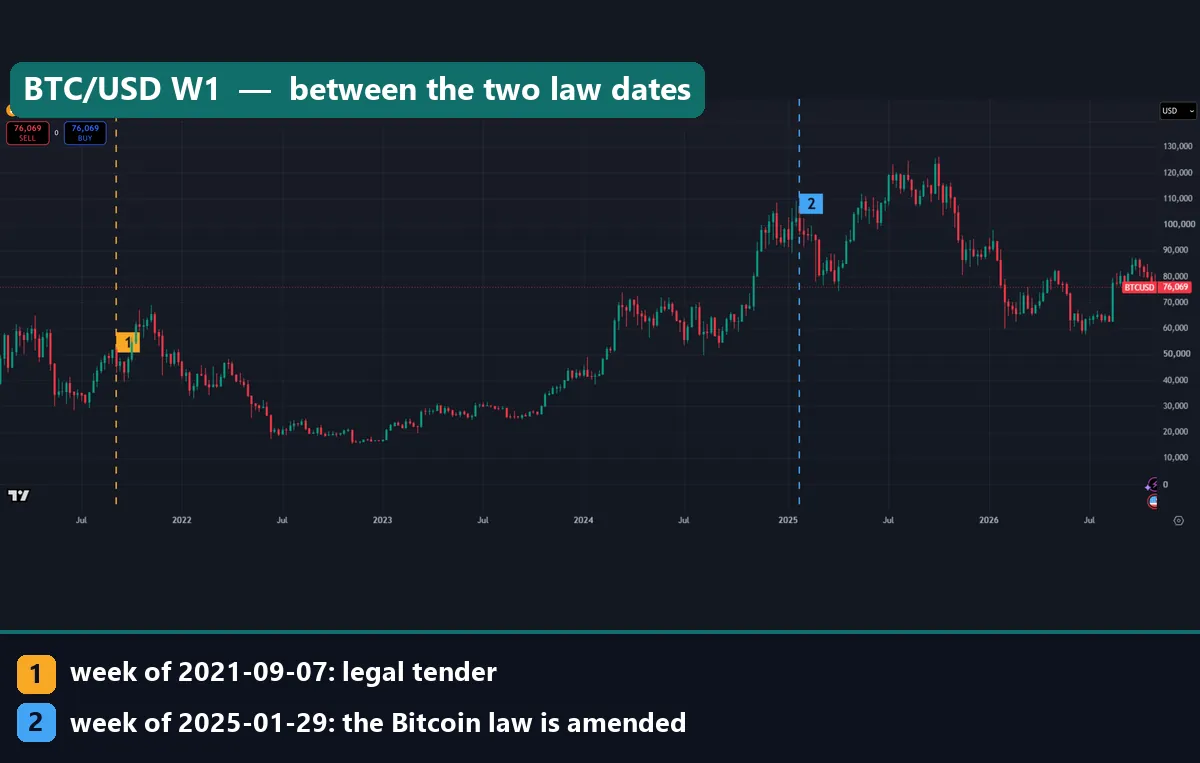
The weekly chart shows the whole era. Line 1 is the week of 7 September 2021, and line 2 the week of the reform. In between, Bitcoin fell to 15,766 on 21 November 2022. That was 76.7% under its close of 67,559 on 8 November 2021. It climbed back past its 2021 highs in early 2024, well before the reform. After line 2, it set a record close of 124,728 on 6 October 2025. The last close, 75,971.22, sits 62.1% above the 7 September 2021 close. In short, this is Bitcoin’s own cycle, and neither law date marks a turn.
Worked example: one price in three kinds of money
Follow one shop price through the three monies. These are sums on closing prices, not trades we made, and they leave out every fee.
- An old receipt for 1,000 colones converts at the legal rate: 1,000 / 8.75 = $114.285714, or $114.29 rounded.
- A $50 note equals 437.50 colones (50 x 8.75). With a median daily move of 0.00% on the quote, that figure does not change on a typical day.
- Put the same $50 into Bitcoin at the 6 September 2021 close of 52,708.2. That buys 0.000949 BTC, worth $44.46 at the next close and $40.70 at that day’s low.
- Start at the 7 September close instead, and $50 buys 0.001067 BTC. That is worth $16.82 at the November 2022 low, $133.07 at the record close and $81.05 at the last close.
The point is the path, not the end figure. Suppose a shop took Bitcoin for a $50 sale on 6 September 2021 and kept the coin. By the next close it had lost $5.54. A shop paid in dollars, or in colones at 8.75, lost nothing to the exchange rate. Fixed rates make prices dull, and that is their job. For a fall like the one in step 4, see our guide to drawdown in trading.
What our two data charts show
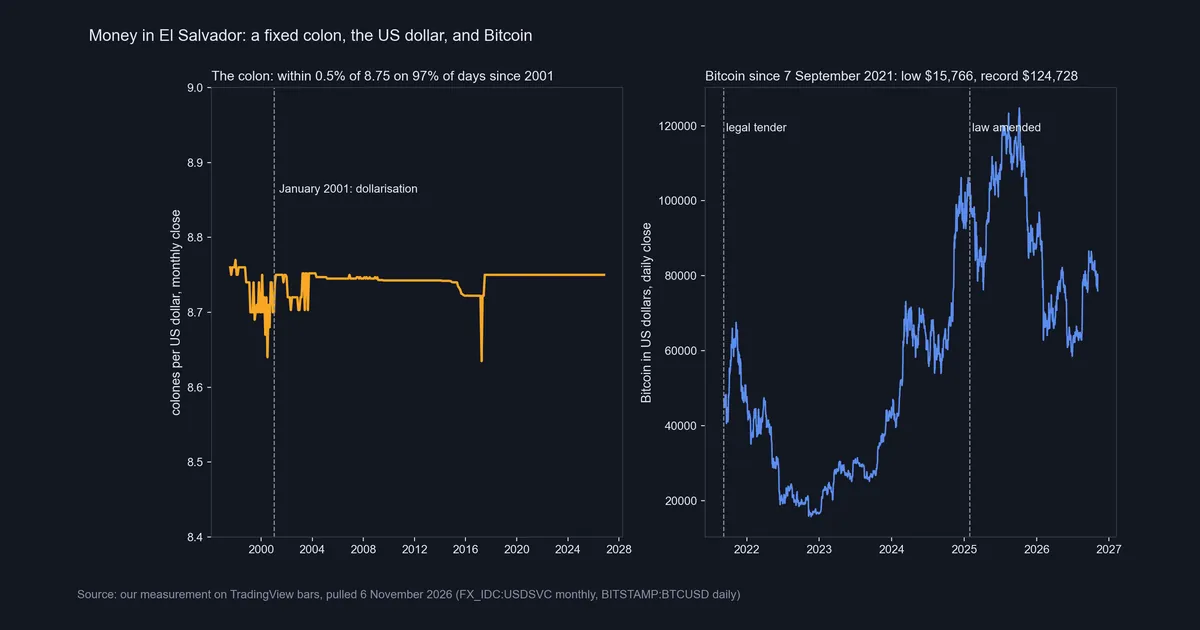
The left panel is the colón on monthly closes since 1997. Before the law, the quote drifted between 8.60 and 8.77 on daily bars. After it, the line stays within 0.5% of 8.75 on 97.4% of days, as the panel title says. The small steps are quote variants. It also slid to about 8.72 in 2015 and 2016. In 2017 the daily file shows two odd closes at 8.5487. Since July 2017, every daily close has been 8.75. The right panel is Bitcoin’s daily close since 7 September 2021, with both law dates marked.
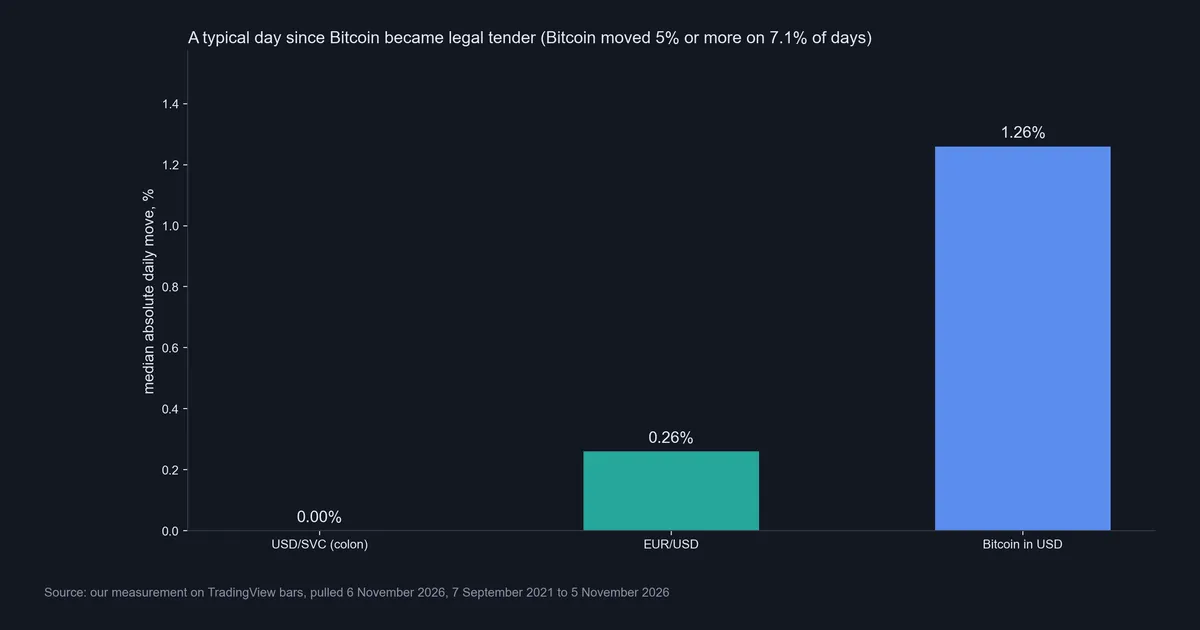
This bar chart compares a typical day since 7 September 2021. The median absolute daily move is 0.00% for the colón quote and 0.26% for EUR/USD. For Bitcoin it is 1.26%, close to five times the euro’s. Bitcoin also moved 5% or more on 7.1% of days. Over the same window, the colón quote never moved at all.
Download the complete indicator database
Put these concepts on your charts. One email unlocks the full library of 1,380+ indicators with compiled MT4 and MT5 files, plus my TradingView scripts. No paywall, no spam, unsubscribe any time.
Get free access to my indicator database
One email unlocks 1,380+ free MT4, MT5 and TradingView indicators — the complete library. No single-tool download; you get the whole database.
Where it fails
Our numbers describe quotes and prices, not money in daily life.
- A reference quote is not a price. Nobody had to deal at 8.7425 or 8.21, since the law says 8.75. A real exchange runs over the counter at a dealer’s price, with a spread on top. Tests on USD/SVC measure the feed, not the money.
- A fixed rate does not fix the cost of living. Dollar prices in San Salvador can still rise, and nothing here tracks them.
- One exchange, one clock. Our Bitcoin bars are Bitstamp closes in UTC. Other venues print other highs and lows, and a San Salvador calendar day does not match a UTC day.
- Daily bars hide the path. The 7 September low shows how deep the fall went, not how fast.
- Use is not in the chart. Price says nothing about how many people paid with Bitcoin.
- We read records, not the gazette. We used the Assembly’s decree records, the SSF rules and IMF reports, not the full gazette text. The IMF and the Assembly also describe the 2025 reform in different words.
- Five years is one cycle. One big fall and one big rise are too few to call a pattern.
The colón today and the January 2025 reform
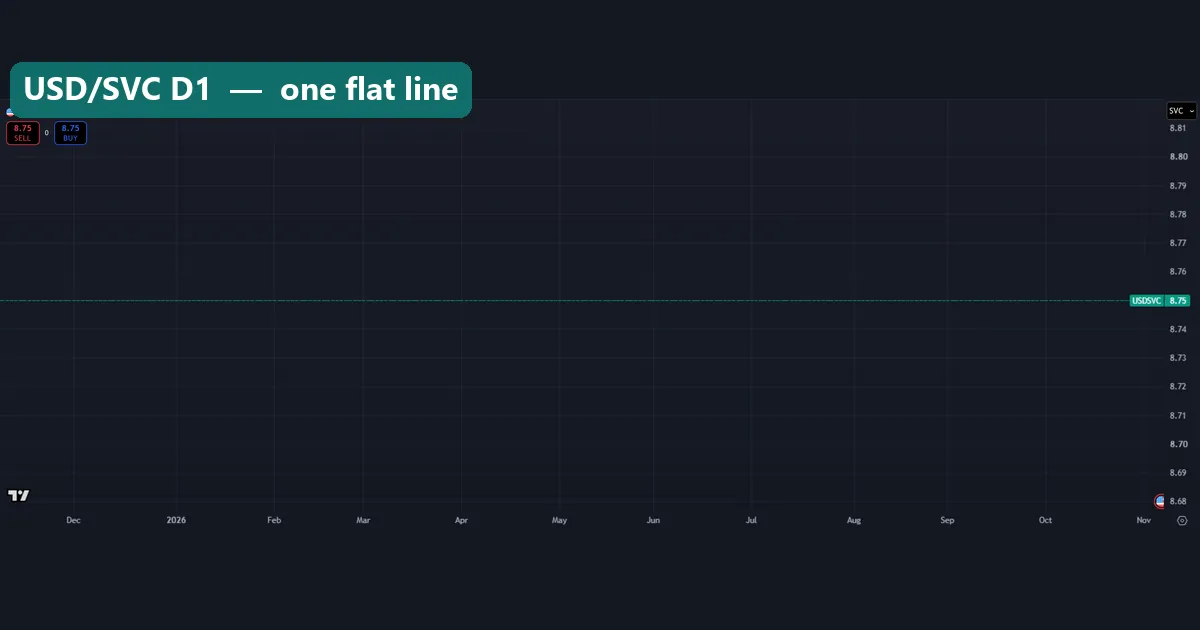
This is a year of USD/SVC daily bars to 5 November 2026. It is one flat line at 8.75, with no wicks at all. Anyone looking for a signal here will find none. A trader who wants the dollar’s moves should watch its real pairs, or the dollar index.
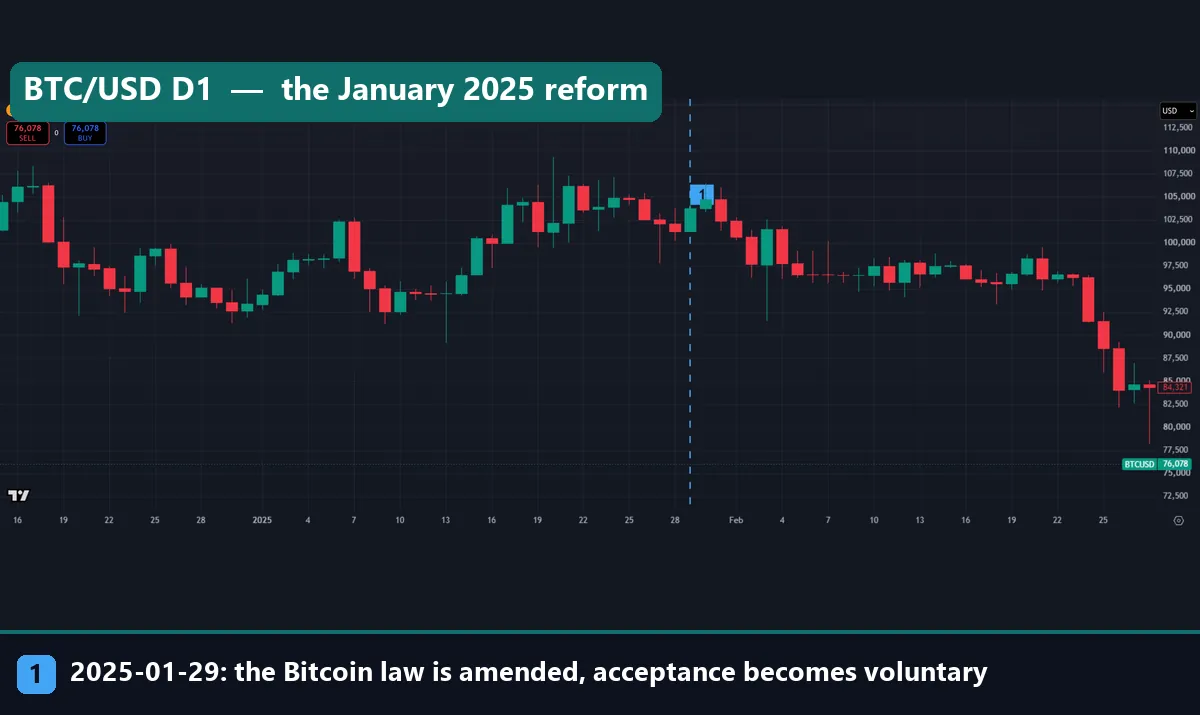
The last chart shows Bitcoin around the reform. Line 1 is 29 January 2025, the day the Assembly issued Decree 199. Bitcoin closed at 103,747 that day, 121.37% above the 7 September 2021 close. On 28 February it closed at 84,321, 18.7% under the reform-day close. Most of that fall came in the last week of February, nearly four weeks after the vote. As in 2021, the law date marks a news story, not a turn in the price.
Common mistakes with San Salvador money
Four errors come up again and again.
- Looking for a local currency to trade. The money is the dollar, and the colón is a fixed conversion. USD/SVC offers nothing to trade.
- Reading the wicks as devaluations. The 2013 and 2014 wicks and the 2017 closes at 8.5487 each reversed within a day. The legal rate stayed at 8.75 throughout.
- Tying Bitcoin’s price to the law dates. The first legal-tender day fell 11.1%, but the reform day closed higher. Bitcoin’s own cycle explains far more of the weekly chart.
- Quoting chart boxes as history. The header row and the SELL and BUY boxes show the live quote on capture day. Use the closes from the bars in view instead.
Where to go next
Begin with our guide to fiat currency. Then compare other fixed links: our Macau patacas guide measures one, and our BGN currency guide covers another. For extremes, see the most valuable currency in the world and the weakest currency in the world.
If Bitcoin interests you, start with forex vs crypto trading. Then compare its swings with our list of volatile forex pairs. To check a conversion yourself, use our currency converter. Finally, before you trust any feed, read our guide to real-time data on TradingView.
FAQ about San Salvador money
What money do people use in San Salvador?
The US dollar. It has been El Salvador’s legal currency since 1 January 2001. The State Department says people can use it in all transactions.
Does El Salvador still have the colón?
Our sources do not say the 2001 law abolished it. The law fixed it at 8.75 per dollar, and the IMF’s 2025 report still mentions it. In practice, the dollar makes up nearly all cash in circulation.
How many colones are in one US dollar?
It takes 8.75 colones to make one dollar, the rate the Monetary Integration Law set. So one colón is about 11.43 US cents.
Is Bitcoin still legal tender in El Salvador?
It depends on whose wording you read. The IMF says the 2025 reform removed the core features of legal tender. The Assembly’s summary still uses the term. Either way, firms no longer have to accept it, and taxes are due in dollars.
Do I need to change money to visit San Salvador?
Not if you carry US dollars, because the dollar is the local currency.
Why does the USD/SVC chart move if the law fixes the rate?
The feed prints quote variants such as 8.7425 and 8.745, plus a few bad prints. Since July 2017, though, every daily close has been exactly 8.75.
How much did Bitcoin fall on its first legal-tender day?
On 7 September 2021 it closed 11.1% down on Bitstamp, at 46,866.82. Its low, 42,900.01, sat 18.6% under the prior close.
Will El Salvador keep the US dollar?
We cannot say, and we make no forecast. The dollar has been legal tender since 2001, but laws can change. Our numbers are a record of the past: results are not guaranteed; past performance is not indicative of future results.
Last updated: 6 November 2026.

About the author
Written by Dominic Walsh, a Forex trader and MT4/MT5 indicator, Expert Advisor and script developer. Every tool on forexmt4systems.com is tested on live charts before release and ships with ready-to-use compiled MT4 (.ex4) and MT5 (.ex5) files. Learn more about the trader and developer behind this site.
How we build, test and correct every tool: Editorial & Testing Policy. Trading carries risk; see the disclaimer.