
Trading slang is the shorthand traders use for currency pairs, prices and positions. Cable means GBPUSD, fiber means EURUSD, and “the figure” is the big part of a price that rarely changes during a day. This guide settles what the common terms mean and backs each pair nickname with a number from our own data. For example, cable moved a median 82.4 pips a day over its last 500 daily bars, while fiber moved 67.
What trading slang actually is
Trading slang is the informal vocabulary of the currency market. Most of it grew up on bank dealing desks, where dealers shouted prices down phone lines and every word cost time. So the pound against the dollar became cable, and a billion became a yard.
Slang is not the same as formal terms. A pip, a lot and a spread have exact meanings in your platform, and our list of forex trading terms covers that side. This page covers three families of words that sit on top: pair nicknames, price and size talk, and position talk.
How trading slang works
Each nickname points at a currency or a pair. When a dealer names one currency, the US dollar is the unspoken other side. So “the aussie” means AUDUSD, and “the swissy” means USDCHF. Cross pairs that skip the dollar, unlike the major currency pairs, get their own names, such as guppy for GBPJPY.
Cable dates from the telegraph line under the Atlantic. Builders finished the first lasting line in July 1866, and it carried pound and dollar prices between London and New York, as the entry on cable (foreign exchange) on Wikipedia explains. Fiber’s origin is less clear; one story links it to the fibre-optic lines that replaced copper.
Price talk rests on how a quote splits into a big figure and the pips after it. Two formulas cover most desk talk:
price = big figure + (pips x pip size)
spread in pips = (offer - bid) / pip size
A pip is 0.0001 on most pairs and 0.01 on yen pairs. Our page on pips vs points walks through the decimals.
How we tested the nicknames
We wanted one hard number per nickname, so we measured how far each pair moves in a normal day.
- Platform: MetaTrader 4, build 1471, daily history from the Capital Point Trading server.
- Pairs: GBPUSD, EURUSD, USDCAD, AUDUSD, USDCHF, USDJPY, GBPJPY and EURGBP.
- Window: the last 500 daily bars of each pair, mostly 10 September 2024 to 14 August 2026. GBPJPY and EURGBP end on 28 May 2026.
- Measure: the median daily range, high minus low, in pips.
- Percent check: the last 250 daily bars on TradingView (OANDA), pulled 19 October 2026, range divided by the close.
- Kiwi: our MT4 history has no NZDUSD, so we used OANDA weekly closes, January 2021 to October 2026.
- Charts: TradingView web chart, OANDA data, daily, captured 19 October 2026.
Ranges are raw moves, before spread, swap and commission. A few numbers come from earlier MT4 tests, and we give their windows where they appear. Our editorial testing policy explains how we run every test.
Trading slang for currency pairs: the nickname table
Each nickname, its ticker, the story behind it and the median daily range we measured:
| Nickname | Pair | Where the name comes from | Median daily range |
|---|---|---|---|
| Cable | GBPUSD | The 1866 Atlantic telegraph line | 82.4 pips |
| Fiber | EURUSD | Unclear; often linked to fibre optics | 67.0 pips |
| Loonie | USDCAD | The loon on Canada’s 1-dollar coin | 61.6 pips |
| Swissy | USDCHF | Short for Swiss franc | 57.5 pips |
| Aussie | AUDUSD | Short for Australian dollar | 53.2 pips |
| Kiwi | NZDUSD | New Zealand’s best-known bird | Not in our MT4 data |
| Gopher or ninja | USDJPY | Unclear; ninja points to Japan | 114.2 pips |
| Guppy or geppy | GBPJPY | A play on GBP and JPY | 150.6 pips |
| Chunnel | EURGBP | The Channel Tunnel | 34.9 pips |
Read the last column as a typical day, not a fixed one. Half the days moved more and half moved less. The kiwi has no MT4 range, but the weekly data still helps. From January 2021 to October 2026 it lost 21.1% against the US dollar, and its weekly moves tracked the aussie with a correlation of 0.87.
The loonie takes its name from the loon on the 1-dollar coin that Canada introduced in 1987, according to the Royal Canadian Mint’s page on the 1-dollar coin. Loonie, aussie and kiwi are all commodity currencies.
Reading trading slang on a live chart
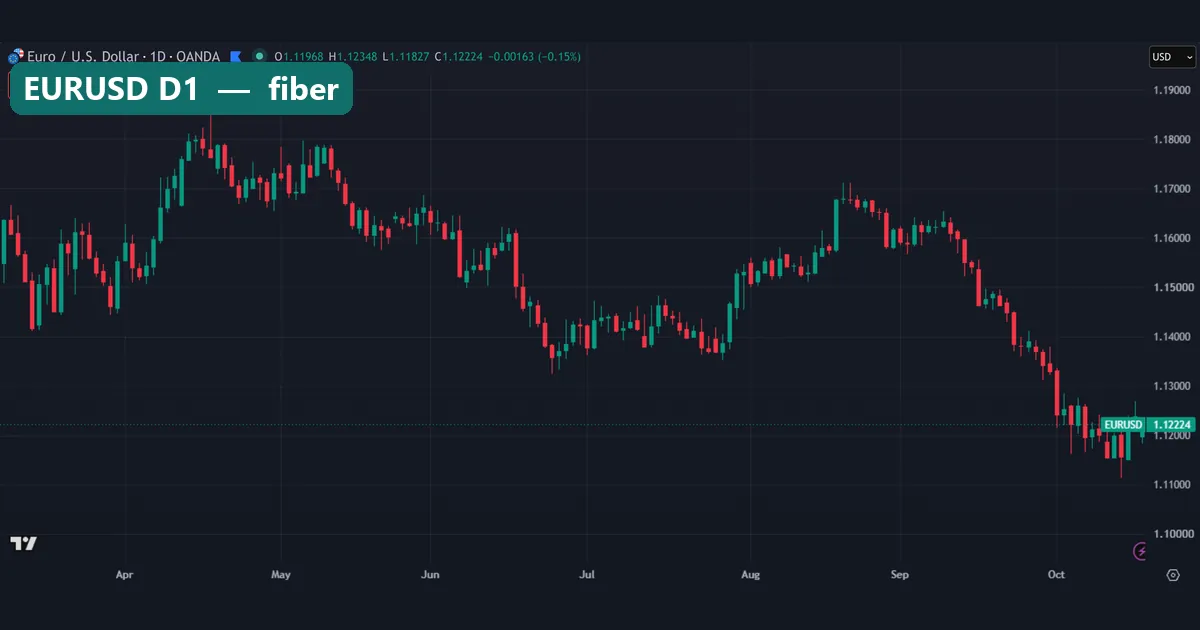
On TradingView, the red SELL box is the bid, where you can sell. Beside it, the blue BUY box is the offer, or ask, where you can buy. The small number between them is the spread in pips. Our page on the bid and ask price goes deeper.
On fiber, the boxes showed 1.12217 and 1.12233, with 1.6 between them. The big figure is 1.12, so a dealer would call the bid 21.7 and the offer 23.3. The chart shows fiber sliding from near 1.17 at the end of August to the 1.12 area by mid-October.
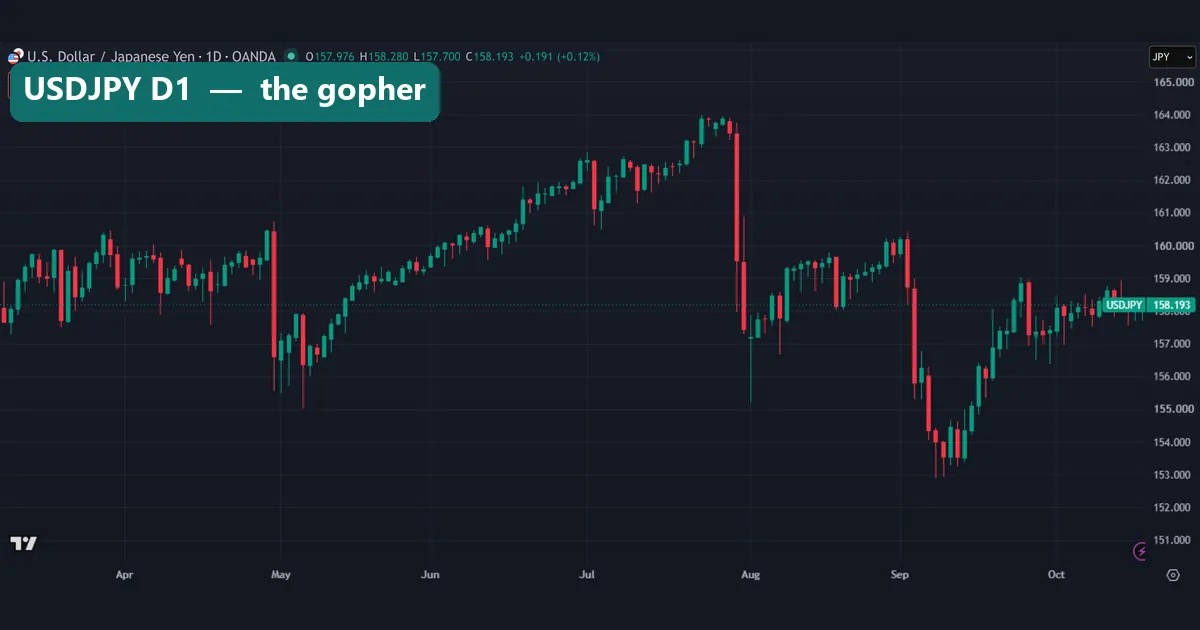
Yen pairs work the same way, but the pip is 0.01, so the big figure is a whole yen. On the gopher, USDJPY, the boxes read 158.186 and 158.201, a spread of 1.5 pips. The chart also shows the late-July peak near 164 and the drop toward 153 in early September.
Worked example: one day on cable
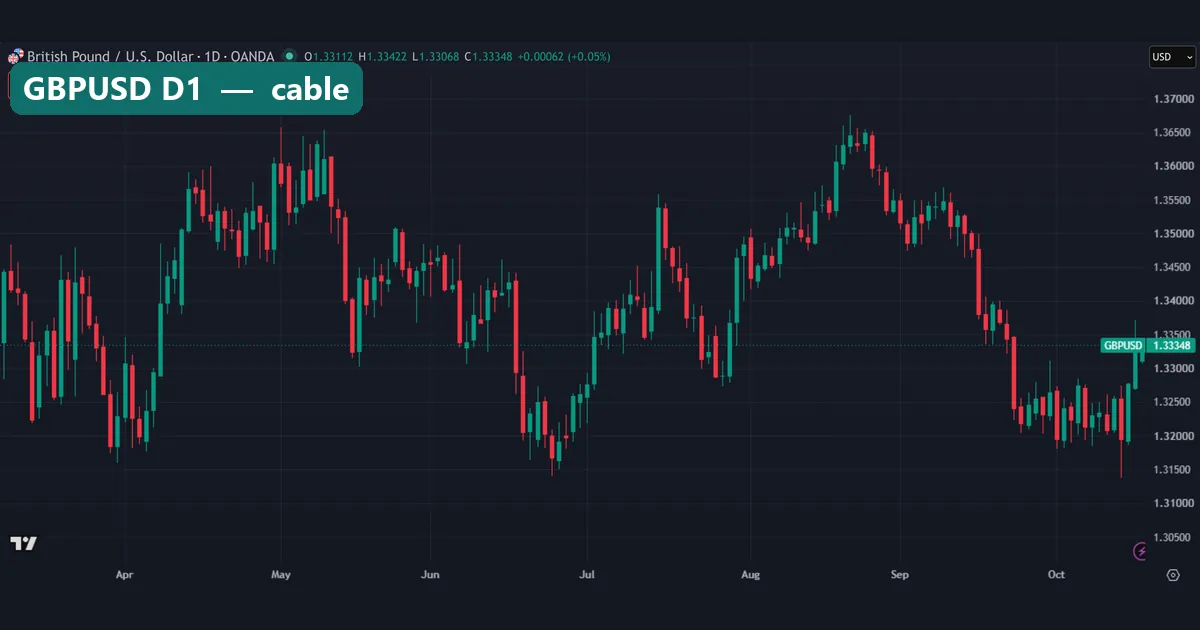
Here is how the slang turns into numbers, using the cable quote from our first chart.
- The figure. The SELL box read 1.33337 and the BUY box 1.33356. The big figure is 1.33, so the bid is 33.7 pips into it and the offer 35.6.
- The spread. (1.33356 – 1.33337) / 0.0001 = 1.9 pips, the number TradingView printed between the boxes.
- Pip value. One standard lot is 100,000 pounds, so each cable pip is worth 100,000 x 0.0001 = $10 per lot.
- Cost to get in. 1.9 pips x $10 = $19 per standard lot, paid through the spread.
- A typical day. 82.4 pips x $10 = $824 of high-to-low movement per standard lot.
- This day so far. High 1.33422 minus low 1.33068 is 35.4 pips. The bar was still forming, so it had covered about 43% of a median day.
None of this says which way cable will go next. A range is a size, not a direction. Still, it helps you size a stop or a position for an average day. Our page on lot size in forex covers mini and micro lots.
Which nickname moves the most
Our first bar chart ranks the eight measured nicknames by median daily range in pips. Guppy leads at 150.6 and gopher follows at 114.2. Chunnel sits last at 34.9, so guppy’s median day was 4.3 times chunnel’s.
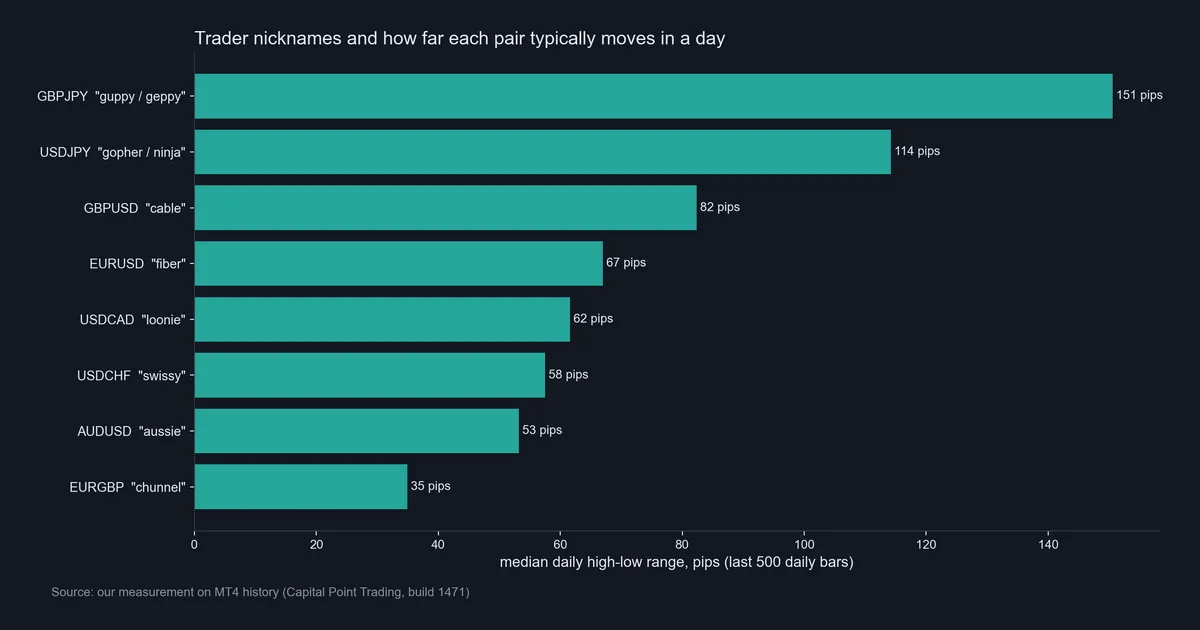
Price level explains much of the yen lead. A 1% move on USDJPY near 158 is about 158 pips. The same 1% on USDCHF near 0.82 is only about 82 pips. So pip counts flatter pairs with big prices.
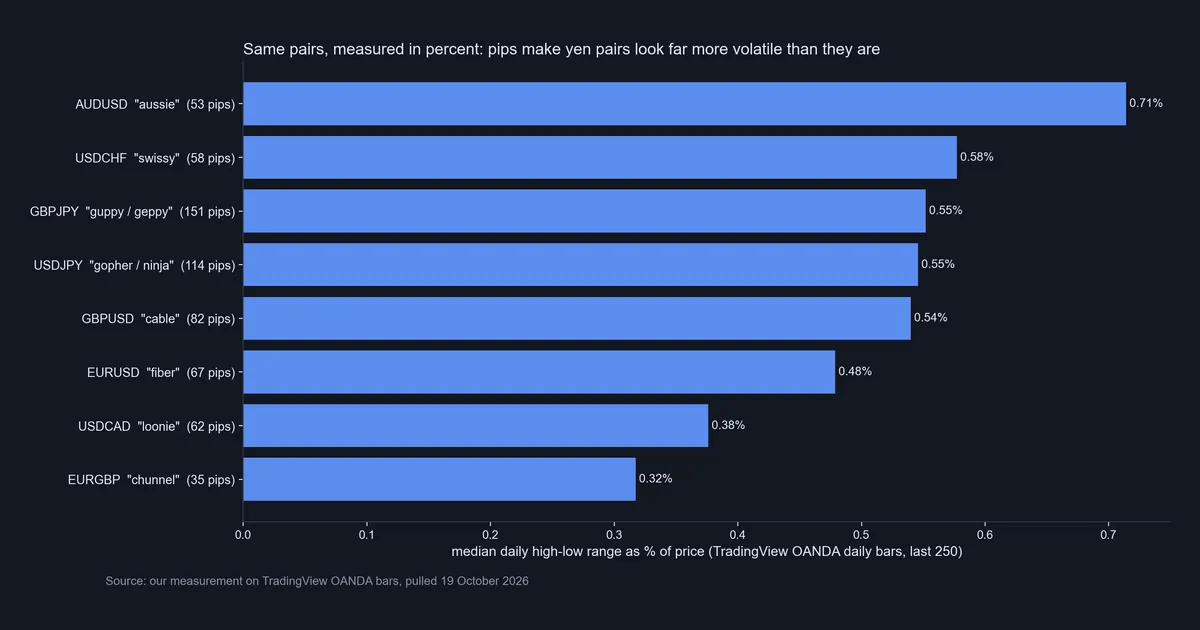
That is why we also measured the range as a percent of price. The order changes. Guppy and gopher both drop to 0.55%, level with cable at 0.54%. The aussie, near the bottom in pips, leads at 0.71%, ahead of swissy at 0.58%. The loonie at 0.38% and chunnel at 0.32% stay at the bottom either way.
Download the complete indicator database
Put these concepts on your charts. One email unlocks the full library of 1,380+ indicators with compiled MT4 and MT5 files, plus my TradingView scripts. No paywall, no spam, unsubscribe any time.
Get free access to my indicator database
One email unlocks 1,380+ free MT4, MT5 and TradingView indicators — the complete library. No single-tool download; you get the whole database.
Desk slang for prices and size
Size slang sounds casual but carries exact amounts. The market behind it is huge: the BIS Triennial Survey 2025 put global FX trading at $9.6 trillion a day in April 2025.
- Bid: the price a dealer will pay. You sell there.
- Offer or ask: the price a dealer will sell at. You buy there.
- Paid and given: “paid” means someone bought at the offer; “given” means someone sold at the bid.
- Mine and yours: “mine” means I buy at your price; “yours” means I sell at it.
- The figure or handle: the big figure, such as 1.33 on cable. “At the figure” also means a price ending in 00.
- Pip and pipette: the standard price step and its tenth. See our guide to the pip in forex.
- Lot: 100,000 units for a standard lot, 10,000 for a mini and 1,000 for a micro.
- Buck: one million units in dealer talk. Outside the desk, a buck is just a dollar.
- Yard: one billion, from the French word milliard.
- Wide and tight: a big or small spread in forex between bid and offer.
Slang for positions and outcomes
- Long: you bought the base currency. Long cable means you bought pounds and sold dollars.
- Short: you sold the base currency.
- Flat or square: you hold no position.
- Stopped out: your stop-loss order closed the trade.
- Stop hunt: price runs through a cluster of stops, then turns. See stop hunting in forex.
- Fakeout: a break of a level that quickly reverses.
Two outcome words have numbers behind them. The first is the gap between Friday’s close and Monday’s open. In our MT4 daily data for 23 pairs, June 2018 to August 2026, 92.2% of 7,409 weekend gaps traded back to Friday’s close on the Monday. Most were tiny, though: the median EURUSD weekend gap was 6.7 pips.
The second is the fix, the London 4pm rate that many funds use to value currency holdings, set out on LSEG’s page on the WMR FX benchmarks. On GBPUSD M15 data from 30 September 2025 to 26 August 2026, the two bars around the fix on month-end days had 1.87 times the range of nearby bars. On other days the ratio was 1.15.
Where it fails: the limits of trading slang
Slang is shorthand, and shorthand drops detail. Four gaps matter.
A pip is not a fixed amount of movement. In pips, guppy moved almost three times as far as the aussie in a median day. In percent of price, the aussie moved more, 0.71% against 0.55%. So a pip range tells you the pip count, not how wild the pair is.
Direction gets lost. “Buy the loonie” in plain talk means buy Canadian dollars. On a chart, that is a sell of USDCAD, because the US dollar comes first. The same trap applies to the swissy and the gopher.
The figure is not a magic level. In an earlier test on EURUSD H1 bars from our MT4 history, levels ending in 00 or 50 held on 77.1% of 642 touches. The same grid shifted 10 to 40 pips away held on 76.7% to 81.8%. So round numbers did no better than other levels. Our guide to a key level in trading has the full test.
Names vary. Gopher and ninja are rare outside some forums, and many traders never say chunnel. A median also hides the tails: a news day can run far past it.
Guppy and swissy on one scale
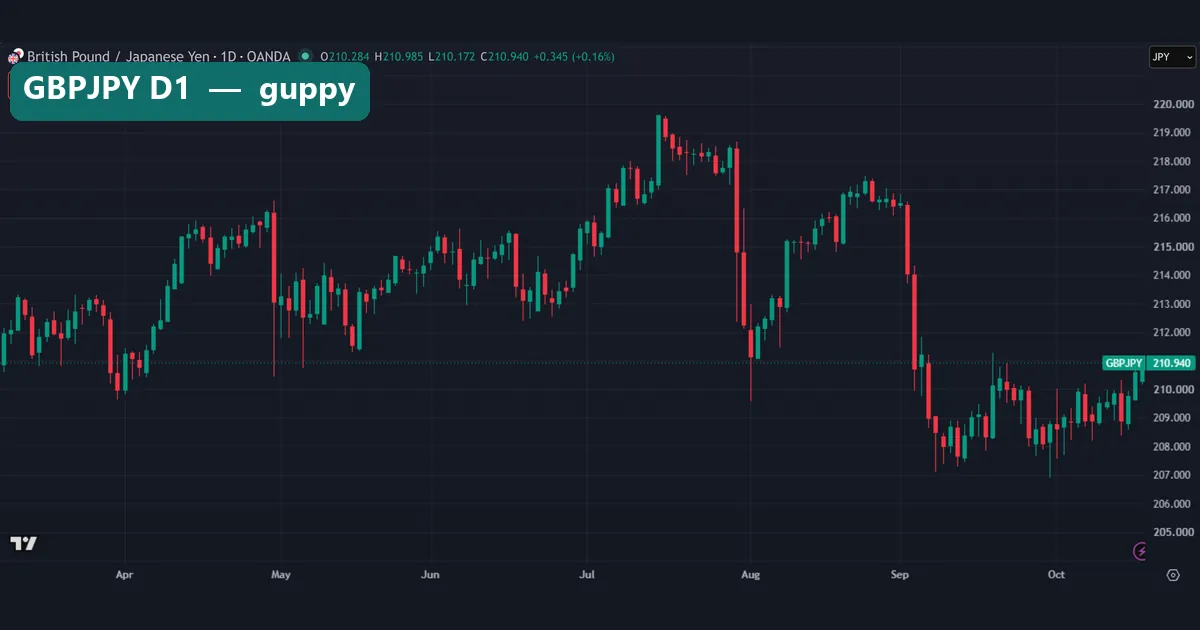
Guppy and swissy sit at opposite ends of the pip table. Guppy is GBPJPY, a cross with no dollar in it. Its boxes read 210.921 and 210.958, a spread of 3.7 pips, and the bar in the header had covered 81.3 pips. The chart shows a steep fall in early September, from about 217 to about 208, typical of the volatile forex pairs.
Swissy is USDCHF. Its boxes read 0.82499 and 0.82513, a spread of 1.4 pips, and the day’s range so far was 22.1 pips. The chart shows a steady climb from near 0.78 in May to near 0.835 in October. Over the longer weekly window, though, the franc was the only G10 currency that gained on the dollar, up 8.0% from January 2021 to October 2026. Our page on safe-haven currencies explains why.
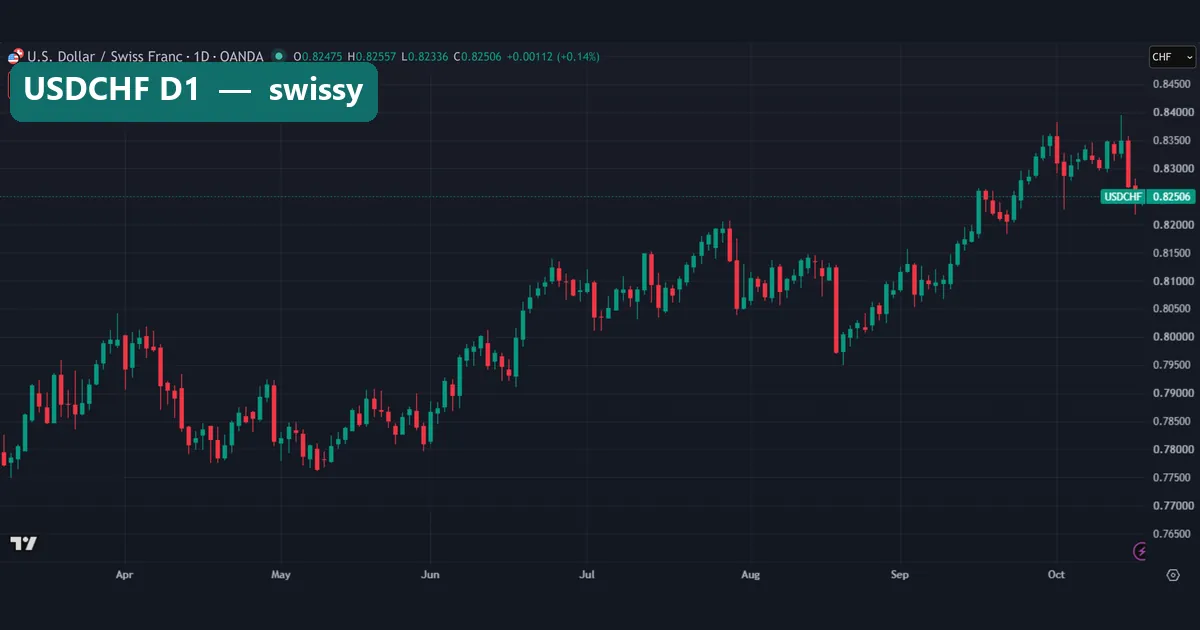
Against a typical day, the two spreads look alike: guppy’s 3.7 pips is 2.5% of its median day, and swissy’s 1.4 pips is 2.4%. Both are single readings from one feed, so treat them as examples, not typical costs.
Four common mistakes with trading slang
1. Mixing up the currency and the pair. Going long the yen means selling USDJPY. Check the ticker order before you click.
2. Treating a buck like a lot. A buck is one million units, or 10 standard lots. Mishear it and your size is off by a factor of ten.
3. Reading “the figure” as support. Round numbers are where traders talk, not proof that price will turn.
4. Using a median range as a target. Cable’s 82.4-pip median day is a size, not a goal. Half the days fell short of it, so a plan that needs the full range will often miss.
Where to go next
Start with the pip, lot and spread pages linked above. Next, our guide to daily forex pips measures every pair we hold, not just the nicknamed ones. Outside the site, the Wikipedia entry on cable, the Royal Canadian Mint’s coin page, the BIS survey and LSEG’s benchmark page each back one claim above.
FAQ about trading slang
What does cable mean in forex?
Cable is GBPUSD. The name comes from the 1866 telegraph line under the Atlantic, and its median day in our data was 82.4 pips.
Why do traders call EURUSD fiber?
Nobody knows for sure; one story links it to fibre-optic lines, the successors to cable. It moved a median 67 pips a day in our sample.
What is the loonie in trading?
The loonie is the Canadian dollar, after the loon on its 1-dollar coin. On a chart, buying the loonie means selling USDCAD.
What does “the figure” mean?
The figure, or big figure, is the leading part of a price, such as 1.33 on cable. “At the figure” means a price ending in 00.
What is a yard in forex?
A yard is one billion units of currency, from the French word milliard. A buck, by contrast, is one million.
What does stopped out mean?
Your stop-loss order closed the trade. It says nothing about the idea, only that price hit your exit.
Which nickname pair moves the most?
In pips, guppy (GBPJPY) led at 150.6 a day. In percent of price, the aussie led at 0.71% over the last 250 OANDA daily bars, while guppy fell back to 0.55%.
Does learning trading slang improve results?
Slang helps you read forums and desk commentary faster, and it cuts mistakes over size and direction. It gives no edge on price by itself; results are not guaranteed; past performance is not indicative of future results.
Last updated: 19 October 2026.

About the author
Written by Dominic Walsh, a Forex trader and MT4/MT5 indicator, Expert Advisor and script developer. Every tool on forexmt4systems.com is tested on live charts before release and ships with ready-to-use compiled MT4 (.ex4) and MT5 (.ex5) files. Learn more about the trader and developer behind this site.
How we build, test and correct every tool: Editorial & Testing Policy. Trading carries risk; see the disclaimer.