
Stock market holidays are the weekdays when US stock exchanges hold no trading session, and the NYSE calendar lists ten of them in 2026. This guide gives the 2026 and 2027 dates and the 1:00 p.m. half days from the exchange’s own page. Then it tests S&P 500 closes from July 1952 to November 2026. The sessions before a closure did slightly better than usual, the sessions after did nothing special, and EUR/USD went much quieter while Wall Street was shut.
What counts as a stock market holiday
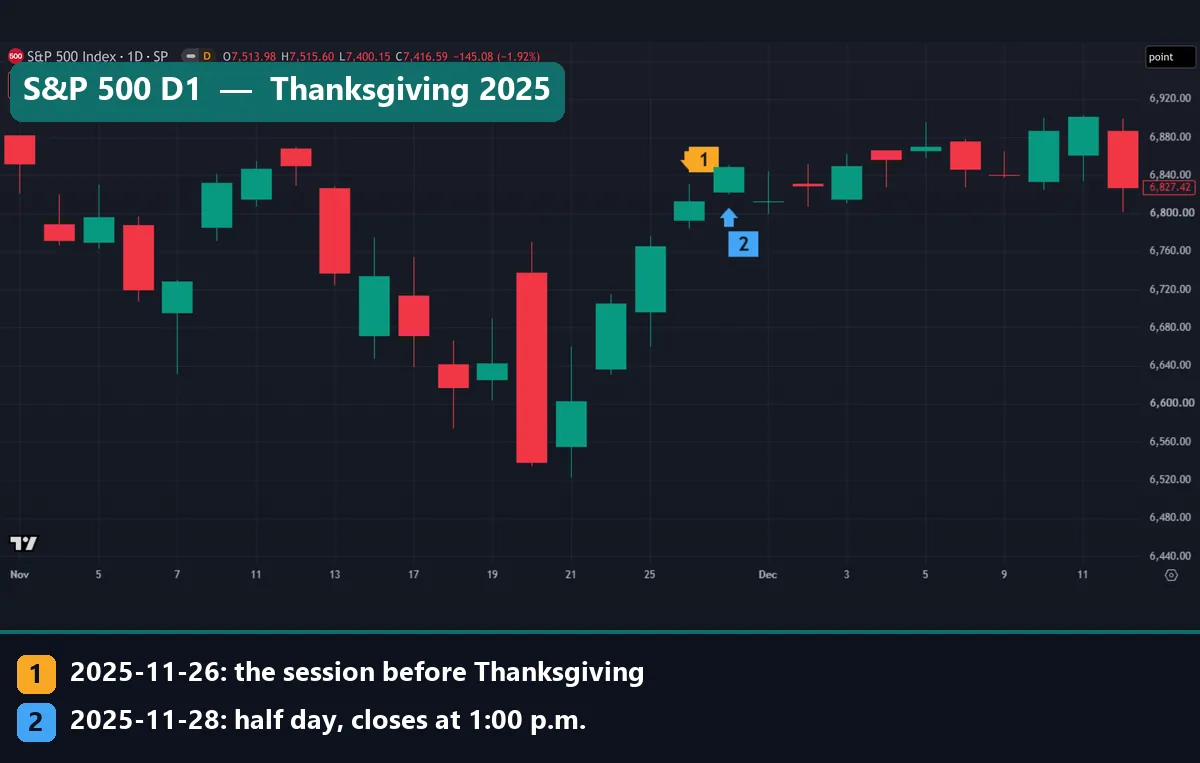
A stock market holiday is a weekday on which the exchange runs no session. No orders match, no closing auction takes place, and a daily chart skips the date. In the chart above, Thursday 27 November 2025 has no candle. The Wednesday before it (marker 1) was a full session, and the Friday after (marker 2) was a half day.
A half day differs from a holiday. The market opens as usual but stops at 1:00 p.m. Eastern Time.
Bank and bond holidays differ again. The Federal Reserve’s list of holidays observed includes Columbus Day and Veterans Day, yet the NYSE trades on both. Good Friday runs the other way: stocks shut, but the Fed’s list leaves it out. SIFMA’s holiday schedule recommendations for 2026 close the bond market on Columbus Day and Veterans Day, and suggest a 12:00 p.m. close on Good Friday. So “markets shut today” always needs a follow-up question: which market? Our forex bank holidays calendar covers the currency side.
How the NYSE holiday calendar works
Most US holidays follow a weekday rule. Martin Luther King, Jr. Day and Washington’s Birthday take the third Monday of January and February. Memorial Day takes the last Monday of May, Labor Day the first Monday of September, and Thanksgiving the fourth Thursday of November. New Year’s Day, Juneteenth (19 June), Independence Day (4 July) and Christmas (25 December) keep fixed dates.
Good Friday moves with Easter: Good Friday = Easter Sunday - 2 days. That gives 3 April 2026, 26 March 2027 and 14 April 2028.
Fixed dates that land on a weekend shift. A Saturday holiday moves to the Friday before, and a Sunday holiday to the Monday after. So Independence Day falls on Friday 3 July in 2026 and on Monday 5 July in 2027. New Year’s Day breaks the pattern, though. When 1 January lands on a Saturday, the NYSE observes no holiday at all, as its page notes for 2028.
NYSE holidays for 2026 and 2027
These are the full-day closures on the NYSE holidays and trading hours page, as we fetched it on 16 November 2026.
| Holiday | 2026 | 2027 |
|---|---|---|
| New Year’s Day | Thursday 1 January | Friday 1 January |
| Martin Luther King, Jr. Day | Monday 19 January | Monday 18 January |
| Washington’s Birthday | Monday 16 February | Monday 15 February |
| Good Friday | Friday 3 April | Friday 26 March |
| Memorial Day | Monday 25 May | Monday 31 May |
| Juneteenth | Friday 19 June | Friday 18 June (observed) |
| Independence Day | Friday 3 July (observed) | Monday 5 July (observed) |
| Labor Day | Monday 7 September | Monday 6 September |
| Thanksgiving Day | Thursday 26 November | Thursday 25 November |
| Christmas Day | Friday 25 December | Friday 24 December (observed) |
Early closes at 1:00 p.m. ET (1:15 p.m. for eligible options) fall on Friday 27 November 2026, Thursday 24 December 2026 and Friday 26 November 2027. On those days the late sessions of NYSE American, NYSE Arca, NYSE National and NYSE Texas end at 5:00 p.m. As of 17 November 2026, two closures remain this year: Thanksgiving and Christmas.
How we tested
We pulled daily and hourly bars from the TradingView web chart on 16 and 17 November 2026. Bars dated 17 November were still forming, so we dropped them. The counts come from these series and rules:
- SP:SPX daily closes, 1 July 1952 to 5 November 2026: 18,744 sessions, all from the five-day trading week.
- A closure is a weekday with no bar between two trading days. That finds 654 weekday closures, holidays and unscheduled shutdowns alike.
- We took the session before and the session after each closure: 644 of each, since some closures ran several weekdays in a row. Changes run close to close.
- The day after Thanksgiving: 74 years, 1952 to 2025.
- OANDA:EURUSD daily high-low, 6 May 2002 to 6 November 2026, on 188 weekdays with no S&P 500 session. Christmas, New Year’s Day and 26 December stay out, because forex runs thin then anyway.
- Charts: SP:SPX daily, OANDA:EURUSD 1-hour and CME_MINI:ES1! 1-hour, with the hourly axes in UTC.
Holiday dates come from the NYSE page text we saved on 16 November 2026. Our method follows the site’s editorial testing policy.
The settings behind our numbers
Every figure on this page depends on a handful of choices. Change one and the numbers move, so here they are.
| Setting | What we used | Why |
|---|---|---|
| Index | SP:SPX daily closes | A price index, so it leaves out dividends |
| Start | 1 July 1952 | Five trading days a week from here on |
| Closure | A weekday with no bar between two sessions | Catches holidays and unscheduled shutdowns |
| Before and after | The session either side of each closure | 644 of each |
| Return | Close to close, in % | Includes any overnight gap |
| Baseline | All other sessions (17,456) | What a normal day looks like |
| Forex check | OANDA:EURUSD daily high-low, in pips | Forex keeps trading on US holidays |
| Left out of the forex check | 25 December, 1 January, 26 December | Thin everywhere, not only in New York |
Reading stock market holidays on a chart
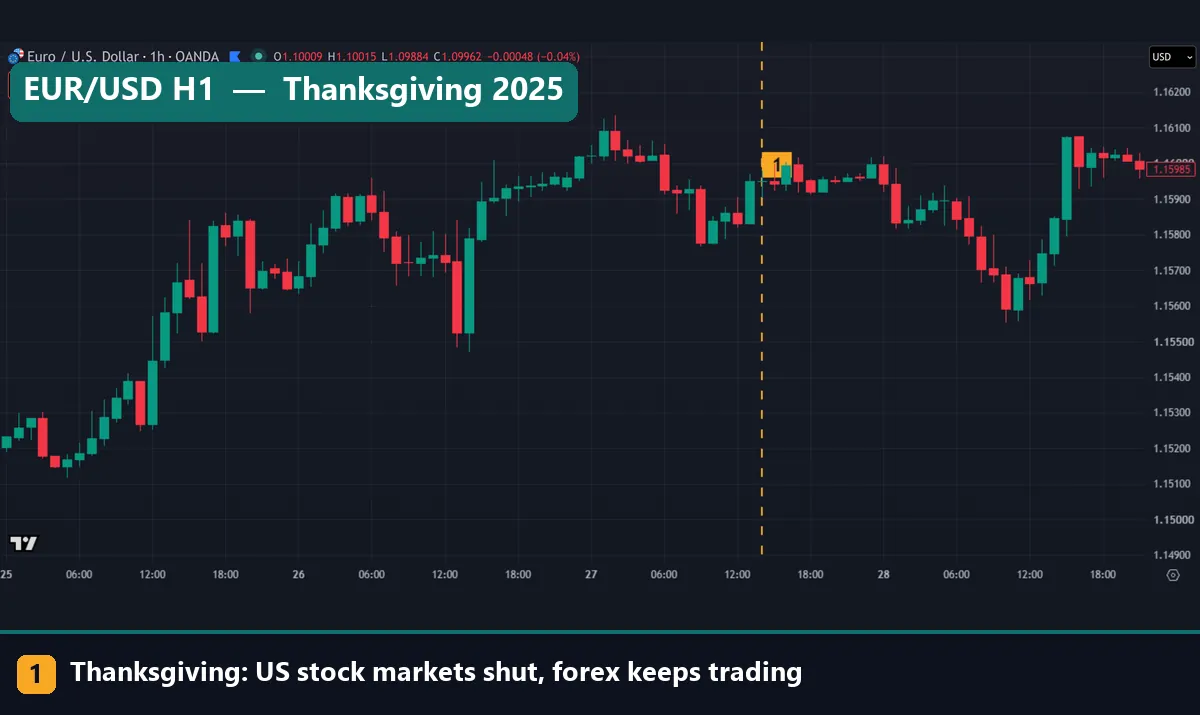
Forex does not stop for a US stock holiday, so an hourly EUR/USD chart has no gap. The dashed line marks Thanksgiving Day, 27 November 2025, near the hour New York stocks would normally open. To its right, the candles shrink, and most sit between the 1.15900 and 1.16000 grid lines until Friday. By contrast, single hours on 26 November covered more ground than all of Thanksgiving afternoon. Our forex market hours guide explains why New York hours carry so much movement.
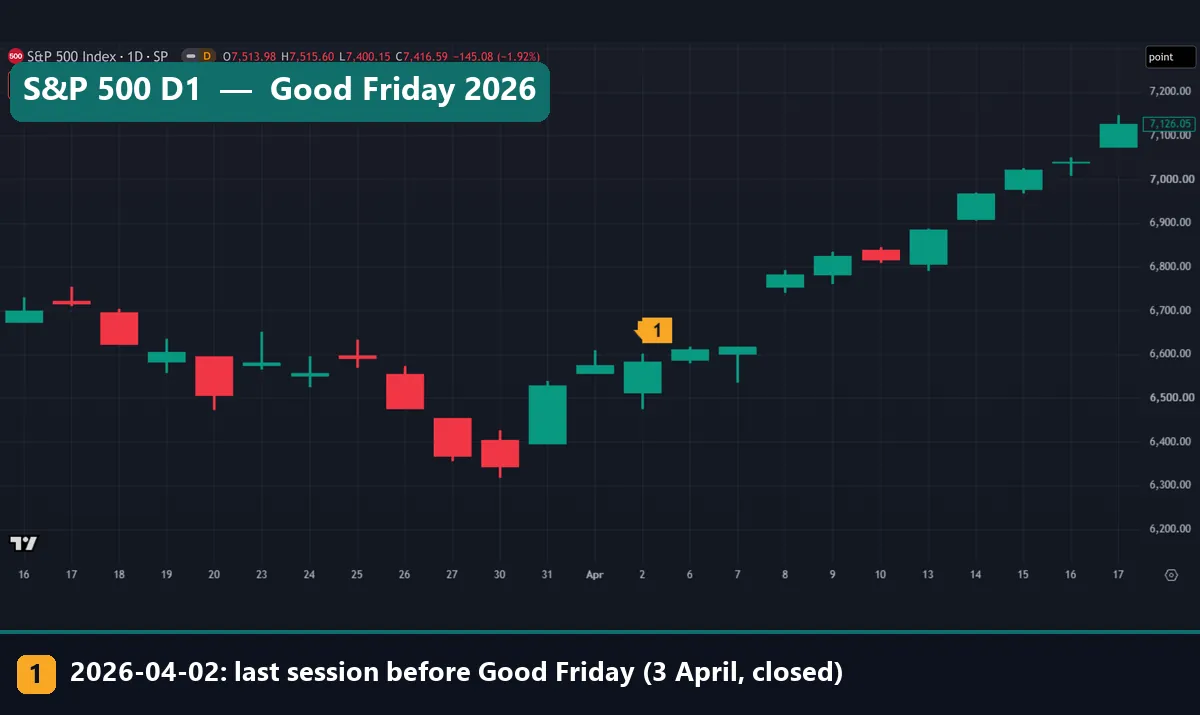
The daily S&P 500 around Good Friday 2026 shows the stock side. The date axis jumps from 2 April to 6 April, because Friday 3 April has no candle. Marker 1 is Thursday 2 April, the last session before the closure. It opened below the previous close and finished a little above it. The big gap up came on 8 April, three sessions later, so do not credit the holiday for it.
Worked example: Thanksgiving week 2026
The NYSE puts Thanksgiving on Thursday 26 November 2026, with a 1:00 p.m. early close on Friday 27 November. Here is how our numbers apply.
- Wednesday 25 November is the session before a closure. Since 1952 such sessions closed higher 63.4% of the time (median +0.19%). Since 2000 that drops to 59.1% (median +0.13%).
- The baseline: all other sessions closed higher 52.7% of the time since 1952 (median +0.04%), and 53.5% since 2000 (median +0.06%).
- Thursday 26 November has no stock session. EUR/USD trades, with a median holiday range of 47.8 pips against 83.8 on other weekdays.
- Friday 27 November is the half day. Over 74 years, that Friday closed higher 70.3% of the time, with a median of +0.27%.
Now size it. Our Thanksgiving 2025 chart has a price scale near 6,800. A +0.19% day at that level comes to about 13 index points, and +0.13% to about 9. Spreads, commissions and slippage come out of that first. In 2025, both marked sessions closed above the day before, which fits the tendency. But one year proves nothing. Keep our economic calendar open that week, because one US data release can swamp a move this small.
Before and after a closure: what 654 cases show
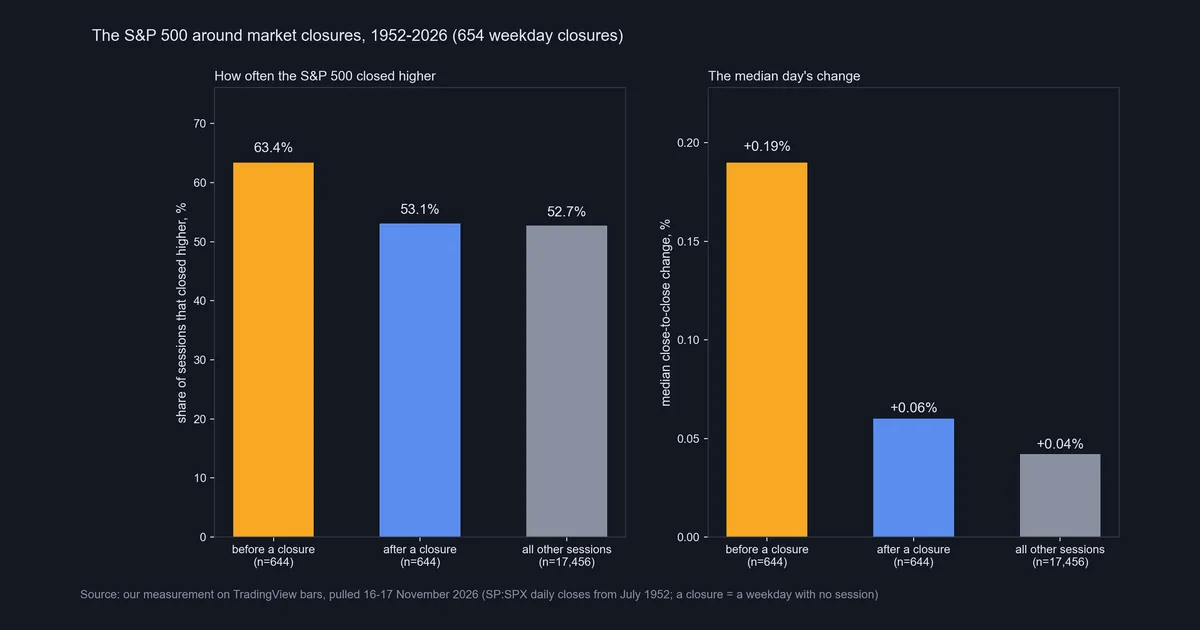
The left panel counts how often the S&P 500 closed higher. That happened on 63.4% of the 644 sessions before a closure, 53.1% of the 644 after, and 52.7% of the 17,456 others. The right panel gives the median changes: +0.19%, +0.06% and +0.04%.
So the day after a closure looks like any other day, while the day before stands out. Traders suggest reasons, such as short sellers covering ahead of a long weekend, but we did not test causes. The gap has also narrowed. Since 2000, 59.1% of the 247 pre-closure sessions closed higher, against 53.5% for other sessions. That makes 5.6 percentage points, down from 10.7 over the full history.
Wikipedia’s article on calendar effects covers this family of patterns, such as the January effect and the weekend effect. It also notes the efficient-market argument that such anomalies should not last once prices take them in. Our since-2000 numbers fit that argument. And the S&P 500 is only one of many stock indices, each with its own calendar.
Forex on US holidays, and closures per year
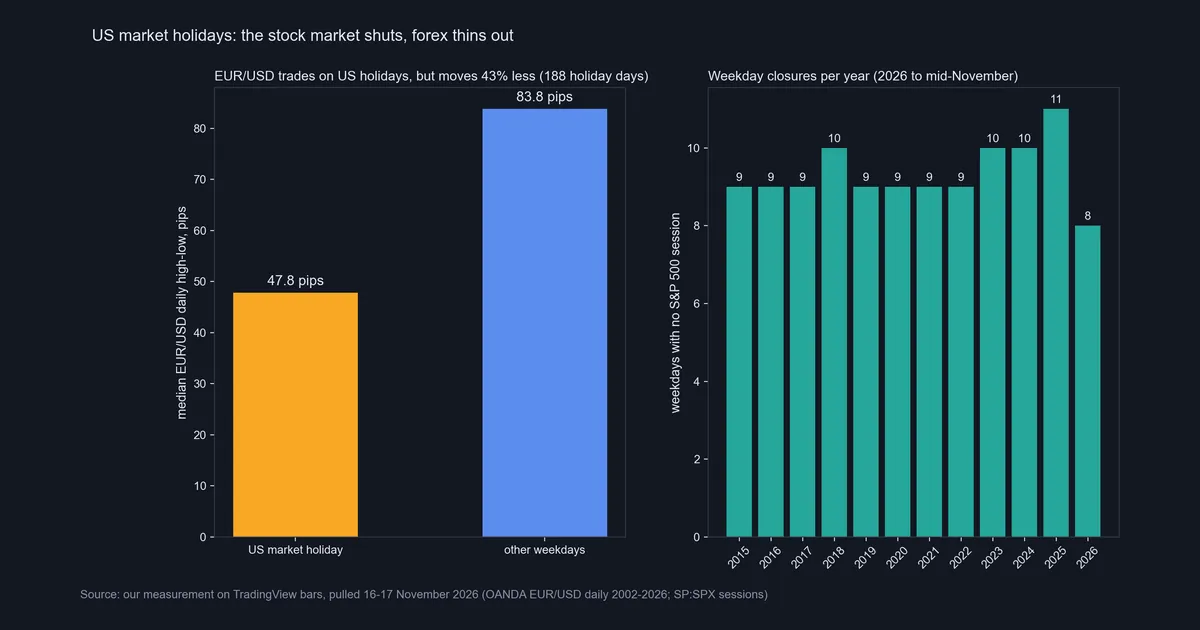
The left panel answers a common forex question. EUR/USD keeps trading when New York stocks shut, but it moves far less. On 188 US holidays from 2002 to 2026, its median daily range came to 47.8 pips, against 83.8 pips on other weekdays. That is 0.57 times as much, or 43% less. For weekly opening times, see when the forex market opens.
The right panel counts weekday closures per year since 2015, mostly 9 or 10. The NYSE first closed for Juneteenth in 2022, which explains the step up. Yet 2022 shows 9, because New Year’s Day 2022 fell on a Saturday and the exchange traded on Friday 31 December 2021. Days of mourning added 5 December 2018 and 9 January 2025, the latter for former President Jimmy Carter. That explains the 11 in 2025. The 2026 bar shows 8 so far, and Thanksgiving and Christmas will make it 10.
Download the complete indicator database
Put these concepts on your charts. One email unlocks the full library of 1,380+ indicators with compiled MT4 and MT5 files, plus my TradingView scripts. No paywall, no spam, unsubscribe any time.
Get free access to my indicator database
One email unlocks 1,380+ free MT4, MT5 and TradingView indicators — the complete library. No single-tool download; you get the whole database.
Where it fails: the limits of holiday data
The pre-holiday edge is small. A median of +0.19% before costs leaves little once you pay to trade, and since 2000 it sits at +0.13%. Over the full history, more than a third of pre-closure sessions failed to close higher. Since 2000, about four in ten did.
Some closures came without warning. Our 654 include Hurricane Sandy on 29 and 30 October 2012 and the shutdown after the September 2001 attacks. Nobody knew on the session before that a closure was coming, yet both sit in the “before” group.
Feeds have quirks too. TradingView’s SP:SPX history carries a flat bar on 11 September 2001, a day the NYSE never opened, so our rule dates that closure from 12 September. Also, SP:SPX is a price index that nobody can buy directly. Futures, ETFs and CFDs add their own costs and their own holiday hours.
Finally, 47.8 pips is a median across 188 days. A holiday can still bring a large move when news lands.
Futures and the Christmas 2025 stretch
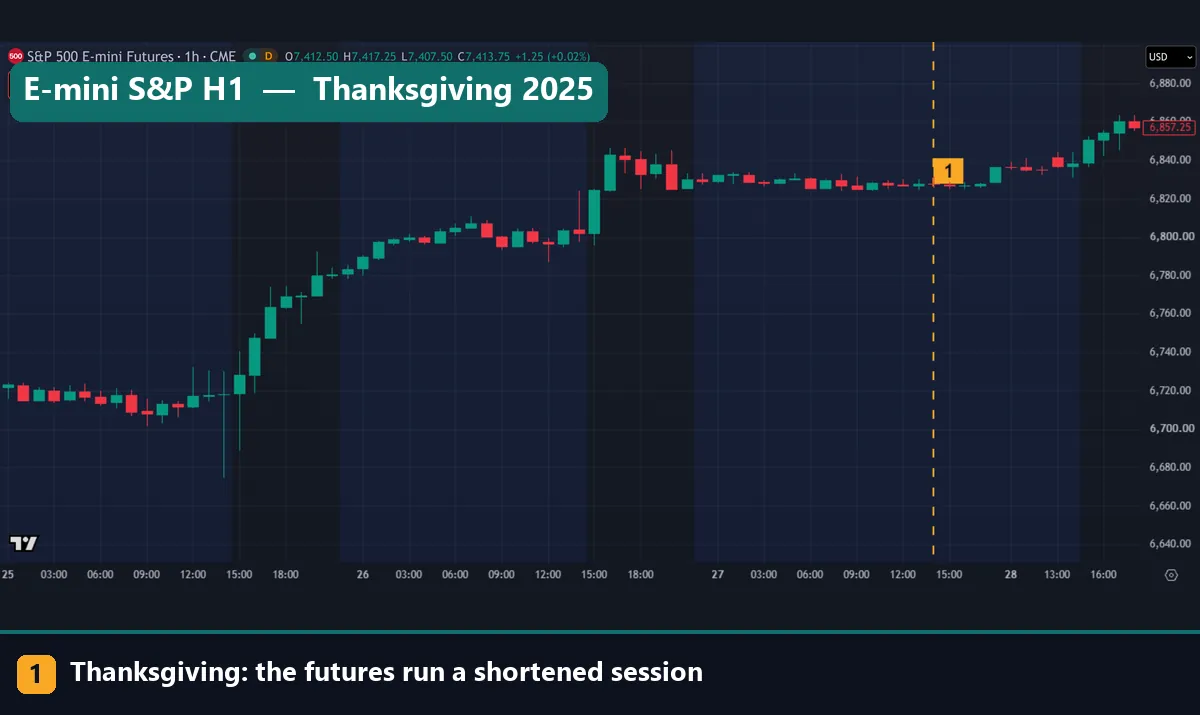
E-mini S&P 500 futures do not stop for Thanksgiving; they run a shortened session. On the hourly chart, the Thursday bars after the dashed line look tiny next to Wednesday’s. The band marking regular New York hours on 25 and 26 November never appears on Thursday. A few bars later the Thursday run stops, then resumes in the evening. Friday adds an oddity: no bars from the early hours until 13:00 UTC. The holiday schedule does not explain that hole, so check exchange notices before reading anything into a gap like it. Our guide to Dow Jones futures on TradingView covers index futures charts.
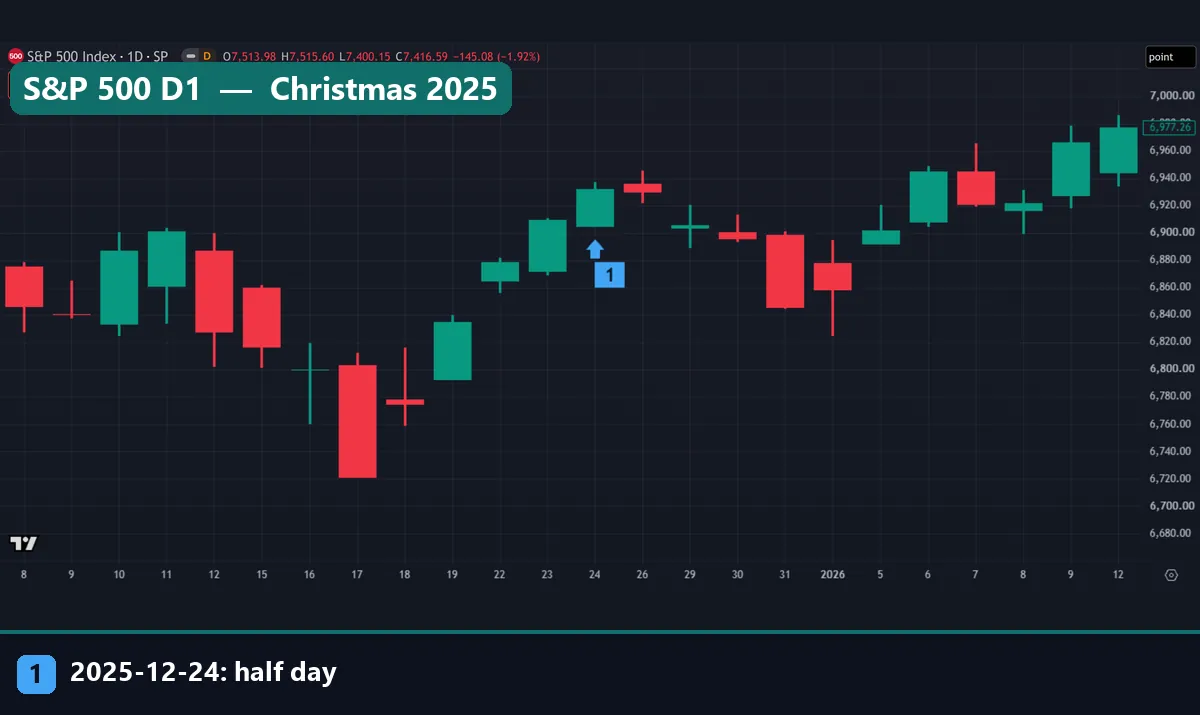
The daily S&P 500 over Christmas 2025 shows why the tendency works as no rule. Marker 1 is the 24 December half day, which closed above the day before. The axis then skips 25 December and 1 January 2026. Yet 31 December, also a session before a closure, fell: look for the tall bearish candle just before the 2026 label. One up, one down. That is what a 63.4% tendency looks like up close.
Common mistakes around market holidays
1. Assuming every market shuts. A stock holiday leaves forex trading, futures on a short session and bonds on SIFMA’s schedule. On Columbus Day, the NYSE trades while the Fed and the bond market rest.
2. Trading the pre-holiday tendency on its own. A median of +0.19% before costs, built partly on closures nobody saw coming, cannot carry a strategy. At most it adds a small tilt to a trade you already had reasons to take.
3. Forgetting the half day. On 27 November and 24 December 2026 the core session ends at 1:00 p.m. ET, not 4:00 p.m. So afternoon orders and alerts need moving. Broker CFDs on US indices also set their own holiday hours.
4. Reading thin holiday trade as a signal. EUR/USD moved 43% less on US holidays in our data. In thin hours a small order pushes price further, and spreads tend to open up, as our page on why spreads widen explains. So a holiday breakout deserves less trust, not more.
Where to go next
Holidays sit inside the wider trading clock. Our New York trading session guide covers the hours that go missing on a US holiday. Our page on pre-market trading explains what happens before 9:30 a.m. on a normal day. Weekend Wall Street looks at one broker’s weekend Dow price, quoted while the exchange stays shut.
Read how high-impact news moves forex before you trade a thin session, and see the forex weekend gap for the gap that can follow a long weekend. For primary sources, use the NYSE, Federal Reserve and SIFMA pages linked above.
FAQ about stock market holidays
Does the stock market trade on Veterans Day?
Yes. The NYSE holds normal sessions on Veterans Day and Columbus Day. Both sit on the Federal Reserve’s holiday list, though, and SIFMA’s 2026 schedule closes the bond market on 12 October and 11 November.
Do US stocks trade on Good Friday?
No. The NYSE shuts on Good Friday, 3 April in 2026 and 26 March in 2027, even though the Fed’s holiday list leaves it out. Forex keeps trading, and SIFMA suggested a 12:00 p.m. bond-market close on Good Friday 2026.
What time does the stock market close the day after Thanksgiving?
At 1:00 p.m. Eastern Time, with eligible options at 1:15 p.m. The NYSE lists Friday 27 November 2026 and Friday 26 November 2027 as early closes. In our data, that Friday closed higher in 70.3% of 74 years.
Does the NYSE open on Christmas Eve 2026?
Yes, until 1:00 p.m. ET on Thursday 24 December 2026. In 2027 Christmas falls on a Saturday, so the exchange takes Friday 24 December off instead.
Does forex trade on US stock market holidays?
Yes. Currencies trade around the clock on weekdays, holiday or not, but activity drops. Across 188 US holidays since 2002, the median EUR/USD daily range came to 47.8 pips, against 83.8 on other weekdays.
Why does the NYSE skip New Year’s Day in 2028?
Because 1 January 2028 falls on a Saturday, and the NYSE does not move that holiday to the Friday before. Its calendar page lists no New Year’s holiday that year. The same happened in 2022, when the exchange traded on Friday 31 December 2021.
How many days a year does the stock market close?
Usually ten weekdays since Juneteenth joined the list in 2022, plus any unscheduled closures. Our count since 2015 runs from 9 to 11 a year. The 11 in 2025 came from a day of mourning on 9 January.
Do stocks really rise before market holidays?
Slightly, on average. Since 1952 the S&P 500 closed higher on 63.4% of sessions before a closure, against 52.7% on other sessions, with a median of +0.19% before costs. Since 2000 the figures fall to 59.1% and 53.5%. Treat it as a mild historical tilt, not a plan; results are not guaranteed; past performance is not indicative of future results.
Last updated: 17 November 2026.

About the author
Written by Dominic Walsh, a Forex trader and MT4/MT5 indicator, Expert Advisor and script developer. Every tool on forexmt4systems.com is tested on live charts before release and ships with ready-to-use compiled MT4 (.ex4) and MT5 (.ex5) files. Learn more about the trader and developer behind this site.
How we build, test and correct every tool: Editorial & Testing Policy. Trading carries risk; see the disclaimer.