
Forex trading on the weekend is not possible in the spot market, because the interbank market shuts at the Friday close and only reopens on Sunday evening, UTC. So the short answer is no. Still, the weekend matters to anyone who holds a trade into it. This guide settles three things: when the market stops and starts, how far prices jump while it is shut, and what that means for an open position. All of it comes from our own charts and from 7,409 weekends of MT4 history.
Can you do forex trading on the weekend?
Not in the real market. Spot forex has no central exchange. Instead, banks and dealers trade with each other across a chain of financial centres, from Wellington and Sydney to Tokyo, London and New York. When New York finishes on Friday afternoon, no major centre is open. Liquidity providers stop streaming prices, so your broker has nothing to pass on.
In practice, the week ends at about 21:00 UTC on Friday in the northern summer and about 22:00 UTC in winter. It then restarts at the same clock time on Sunday, when Monday morning arrives in New Zealand and Australia. The overview of the foreign exchange market on Wikipedia describes this decentralised, round-the-clock weekday structure.
So you cannot open, close or change a spot forex trade on Saturday. However, your open positions stay open. For the full weekday clock, our forex market hours tool shows each session in your own time zone.
How the weekend close works
Nothing happens to your account at the Friday close. Positions and orders stay open, but price stops moving. Then, on Sunday, the first quote of the new week can sit some distance from the last Friday quote. That jump is the weekend gap.
We measure it with one simple formula: gap = Monday open minus Friday close, in pips. A positive number means the week opened higher. For a fair comparison between pairs, we also divide the gap by the 14-day ATR at Friday. That turns “20 pips” into a share of a normal day’s range.
Next, we ask whether the gap filled. A gap fills when Monday’s range trades back to Friday’s closing price. That said, a fill says nothing about whether a stop got hit first.
One more detail: a weekend gap is a single price jump, so a stop order inside it fills at the first available price. It does not fill at your stop level. Our guide to slippage in trading explains why that happens.
How we tested
We used two sources. First, we read the daily history in MetaTrader 4, build 1471, on a Capital Point Trading terminal. It covers 23 forex pairs from 12 June 2018 to 24 August 2026, which is 37,748 daily candles and 7,409 pair-weekends. Gold has only 34 weekends in that history, so we treat its numbers as a small sample.
Second, we pulled hourly bars on the TradingView web chart with OANDA data on 5 October 2026. We marked three recent weekends: 18 to 20 September, 25 to 27 September, and 2 to 4 October 2026. We looked at EURUSD, GBPUSD, USDJPY, GBPJPY, USDCHF and XAUUSD. For the crypto comparison we used BTCUSD from Bitstamp on the same day.
The MT4 server runs on UTC+3 in summer and UTC+2 in winter, so its daily candles start on Sunday evening UTC. Our TradingView times are all in UTC. The method follows our editorial testing policy: we report the numbers we measured, including the ones that look dull.
Weekend schedule and measurement settings
Our measurement has a few parameters. Here they are, so you can repeat the test on your own data.
| Parameter | Value we used | Why it matters |
|---|---|---|
| Last FX bar on Friday (H1, UTC) | Opens 20:00, closes 21:00 | Sets the Friday close price |
| First FX bar on Sunday (H1, UTC) | 21:00 | Sets the opening price of the week |
| First gold bar on Sunday (H1, UTC) | 22:00 | Gold reopened one hour after FX on OANDA |
| Gap formula | Monday open minus Friday close | Positive means the week opened higher |
| ATR length | 14 days, taken at Friday | Scales the gap to a normal day |
| Fill rule | Monday’s range reaches Friday’s close | Tells you if price returned the same day |
| Sample | 23 pairs, 2018-06-12 to 2026-08-24 | 7,409 pair-weekends in total |
These UTC times are for the northern summer. In winter, both the Friday close and the Sunday open move one hour later. The SymbolInfoSessionTrade function in the MQL5 documentation lets an EA read your own broker’s trading sessions per weekday, which beats guessing.
Reading the weekend on a chart
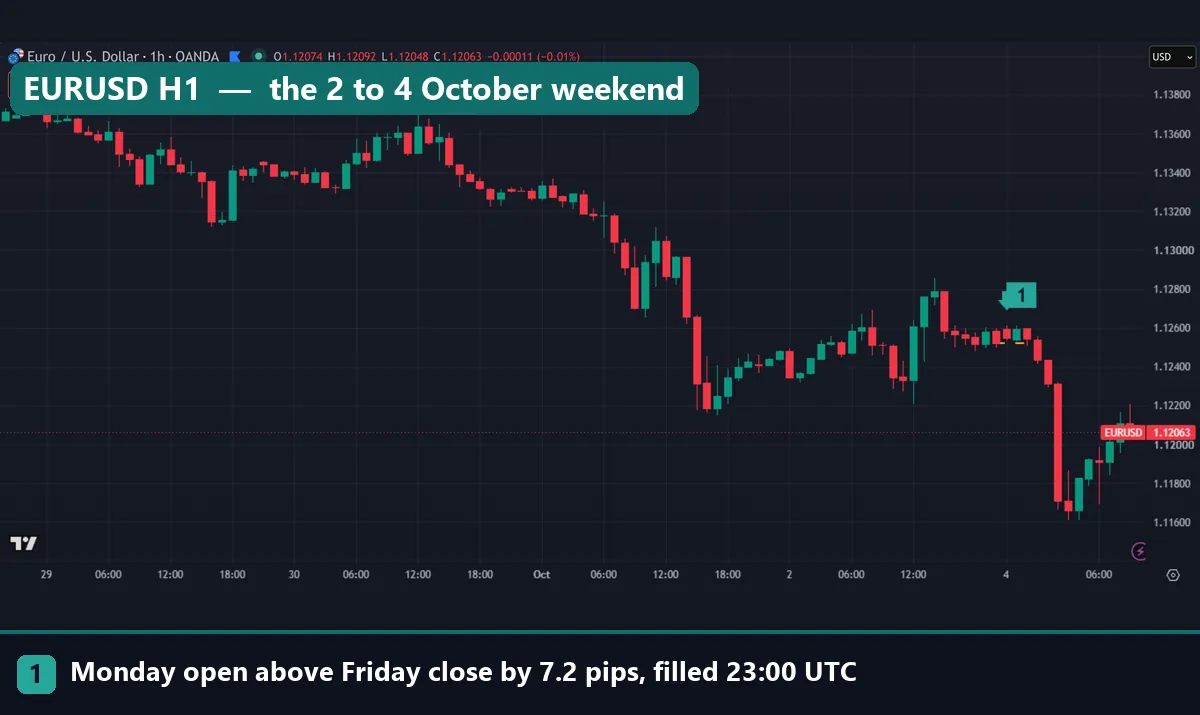
On an hourly chart, the weekend looks like nothing at all. Look at the date axis of the EURUSD chart above. It runs from “2” straight to “4” with no “3”. Saturday 3 October simply does not exist on the chart. The orange dashed line marks the Friday close at 1.12524, and marker 1 sits on the first bar of the new week.
The software joins Friday’s last bar to Sunday’s first bar, so the gap shows up as one bar opening away from the prior close.
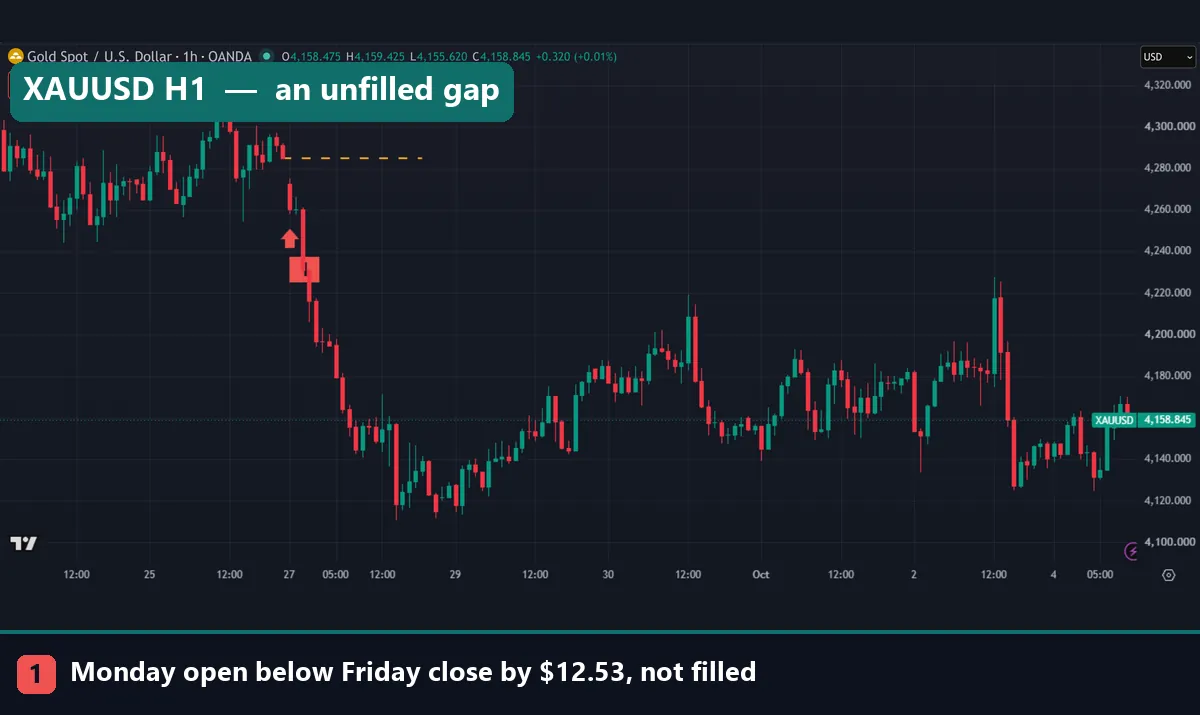
On XAUUSD the Sunday bar opened below the dashed Friday line and never came back to it in the following days. The legend under the chart gives the size: $12.53. Gold then kept falling for two days, so this gap did not fill.
The third chart shows the more common case. GBPJPY opened lower but traded back to Friday’s close within the first hour.
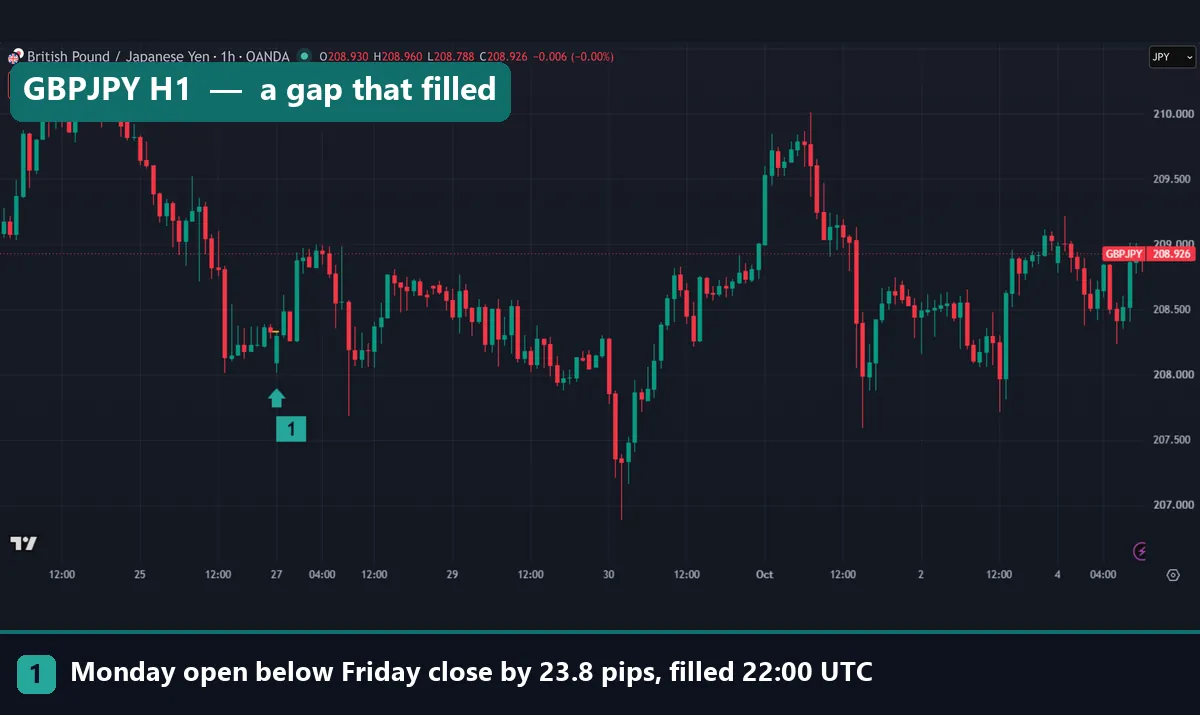
In short, look for three things: the missing weekend dates on the axis, the first bar of the week, and its distance from the dashed Friday close.
Worked example: three weekends in late 2026
First, EURUSD closed Friday 2 October at 1.12524. It reopened on Sunday 4 October at 21:00 UTC at 1.12596, a gap of 7.2 pips higher. Price traded back to 1.12524 at the 23:00 UTC bar, two hours after the open. With a long-run EURUSD median of 6.7 pips, this weekend was ordinary.
Next, GBPJPY closed Friday 25 September at 208.327. It reopened at 208.089, which is 23.8 pips lower. The gap filled at the 22:00 UTC bar. That is above the GBPJPY median of 16.1 pips but well under its 90th percentile of 58.9 pips.
Then gold. XAUUSD closed Friday 25 September at 4,284.97 and reopened at 22:00 UTC on Sunday at 4,272.435. That is $12.53 lower, and the gap did not fill in our window.
Now a hypothetical stop, using the same prices. Say a GBPJPY long had a stop 10 pips under Friday’s close, at 208.227. The market reopened at 208.089, so the stop could only fill there or lower. That is 13.8 pips worse than planned. On the gold chart, a stop $5 under Friday’s close would have filled about $7.53 beyond its level. The gap, not the stop, sets the exit price.
How big weekend gaps get across 23 pairs
Three weekends prove little, so we measured them all. The first chart ranks pairs by their median gap and adds the 90th percentile.
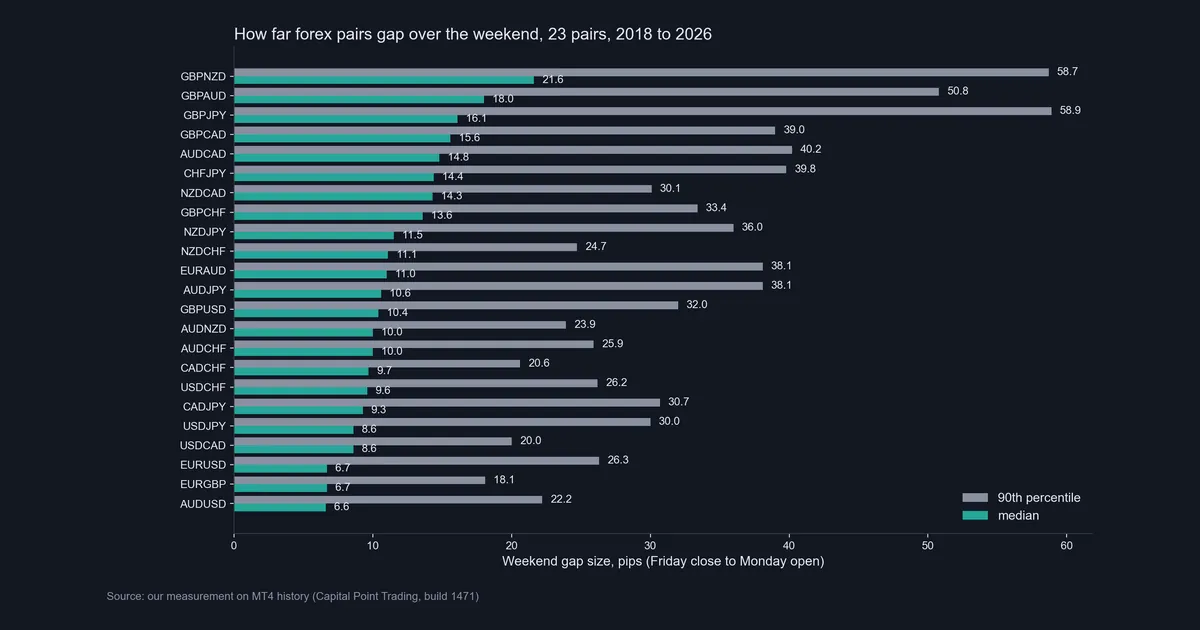
The majors gap least. AUDUSD has a median of 6.6 pips, EURUSD and EURGBP 6.7 pips. At the other end, GBPNZD has a median of 21.6 pips and GBPJPY a 90th percentile of 58.9 pips. But raw pips mislead, so the second chart scales gaps by ATR.
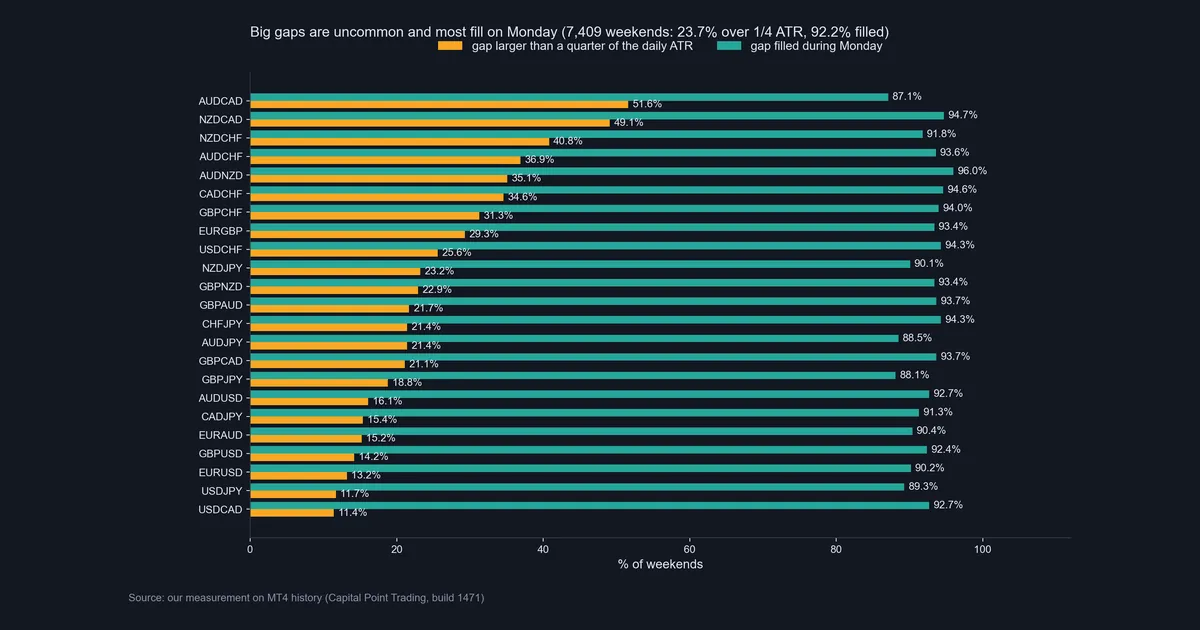
Across all 7,409 weekends, the median gap was 0.133 of a daily ATR. Only 23.7% of gaps exceeded a quarter of the ATR, and 6.5% exceeded half of it. Also, 92.2% of gaps filled during Monday. AUDCAD shows 51.6% over a quarter ATR, but on only 62 weekends, and NZDCAD has 57. Both are small samples.
The extremes matter more than the medians. EURUSD’s largest gap was 146.5 pips lower on 28 February 2022, the Monday after the weekend that followed Russia’s invasion of Ukraine. GBPJPY dropped 253.9 pips on 7 April 2025. Gold’s largest gap in its 34 weekends was $47.52, on 15 June 2026. For the gap types and their names, read our deep dive on the weekend gap in forex.
Download the complete indicator database
Put these concepts on your charts. One email unlocks the full library of 1,380+ indicators with compiled MT4 and MT5 files, plus my TradingView scripts. No paywall, no spam, unsubscribe any time.
Get free access to my indicator database
One email unlocks 1,380+ free MT4, MT5 and TradingView indicators — the complete library. No single-tool download; you get the whole database.
What some brokers offer on Saturday and Sunday
Some brokers quote a few markets over the weekend. These are usually contracts on indices or major pairs that the broker prices itself. That matters, because no interbank market sits behind those quotes. The broker sets the price, the spread and the rules, and the position often closes or converts when the real market reopens.
So check the contract details first: how the broker builds the price, what spread applies, and what happens at the Sunday open. We do not test or rank brokers, and we name none here.
Crypto is a different case. Bitcoin and other coins trade on exchanges that never close, so many brokers keep crypto contracts open all weekend. Our page on forex vs crypto trading covers the differences in hours, costs and volatility.
Also note what does not change. Swap still applies to positions held over the weekend, and most brokers charge the weekend roll on one weekday, often Wednesday. The swap in forex guide explains the triple swap day.
Where it fails: the limits of weekend trading and of our data
Holding over the weekend fails in one clear way. You cannot react to news for about 48 hours. Political events still happen on weekends, and the market prices them in one jump at the Sunday open. A stop gives no protection against that jump.
The gap fill figures also fail as a trading rule. Yes, 92.2% of gaps filled on Monday. But a fill only tells you price touched Friday’s close at some point. It does not say how far price moved against you first, and it does not include spread or costs. We did not test a gap-fade strategy, so we make no claim that fading gaps pays.
Next, spreads. The Sunday open is often the thinnest hour of the week, and spreads can stay wide for a while. Our page on why spreads widen covers the causes.
Finally, our data has gaps of its own. The gold history covers only 34 weekends. Other brokers’ feeds will also give slightly different gaps. In short, use our numbers as a size guide, not a forecast.
Crypto keeps trading, forex does not
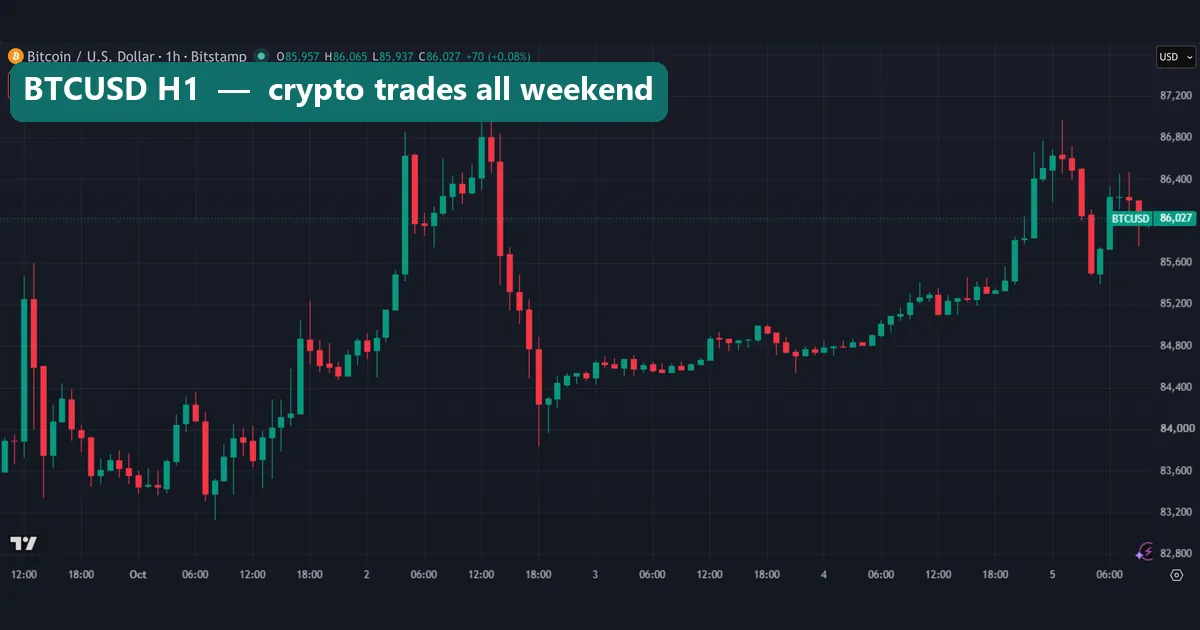
The two charts below make the difference plain. First, the Bitstamp BTCUSD hourly chart has bars on Saturday 3 October and Sunday 4 October. There is no hole in the date axis, because the exchange never closed.
Then compare the EURUSD daily chart. Each week holds five candles. The axis jumps over Saturdays and Sundays, for example from 6 August to 11 August.
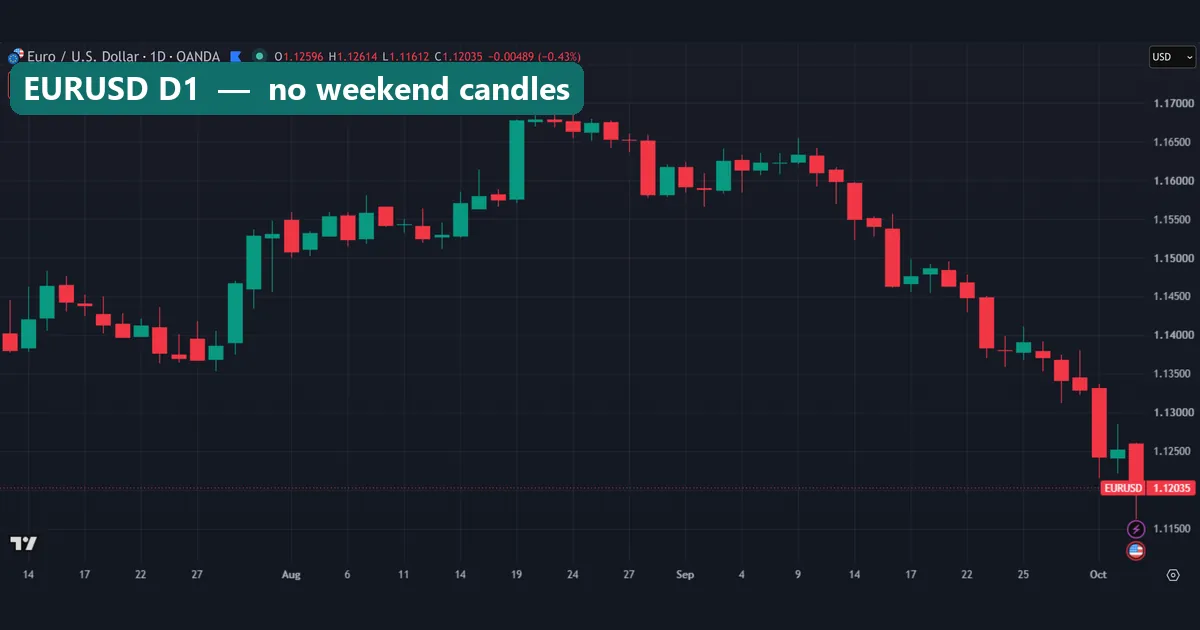
The last EURUSD candle on that chart belongs to Monday 5 October. Its open is 1.12596, which is the same price as the Sunday 21:00 UTC open in our worked example. So OANDA folds the Sunday evening hours into Monday’s daily candle. Our MT4 daily history behaves the same way: its weekday tally has zero weekend candles. Its range at capture time, 1.12614 down to 1.11612, dwarfs the 7.2 pip gap.
Common mistakes with positions over the weekend
- Trusting the stop to cap the loss. A stop inside a gap fills at the reopening price. Size the position for the gap, not only for the stop distance. Our position sizing guide shows the math.
- Holding full size on high-leverage accounts. A large gap can push margin below the stop-out level at the open. Read how a margin call and stop out work before you hold over a Friday.
- Treating the gap fill as a sure trade. Gold’s $12.53 gap on 27 September did not fill. Most gaps do fill, but a minority never does, and you cannot tell which in advance.
- Ignoring the calendar. Friday data releases and holiday-thin Mondays raise the odds of a messy open. Check the economic calendar and our forex bank holidays list before Friday.
How to use the weekend instead
The weekend is still useful. First, review the week’s trades while the charts stand still. Then mark the Friday close on each pair you follow, so the Sunday open has a reference.
Next, plan your levels for Monday. The new week’s opening price often acts as a reference for intraday traders, and our page on the new week opening gap shows how ICT traders mark it. Also check which sessions open first. The Asian trading session guide covers the hours right after the Sunday open.
Finally, decide in advance what you will hold. A simple rule: if a position cannot survive a gap the size of its pair’s 90th percentile, cut it before Friday’s close. For EURUSD that is 26.3 pips; for GBPJPY it is 58.9 pips.
Where to go next
For the gap itself, start with our types of gaps in forex page. For the weekday clock, see forex trading sessions. To size a stop from volatility rather than a fixed number, read about ATR stop loss distance. If you want gaps marked on your TradingView chart, our Gap Hunter Pro indicator draws them.
Outside our site, the Triennial FX Survey from the BIS shows where and how much currency trades each weekday. Also, gaps and gap analysis at StockCharts ChartSchool covers gap types from the stock market side.
FAQ: forex trading on the weekend
Is the forex market open on Saturday?
No. The spot market stops at the Friday close and stays shut all of Saturday.
What time does forex open on Sunday?
In our OANDA data, the first FX bar printed at 21:00 UTC on Sunday during the northern summer. Gold started one hour later, at 22:00 UTC.
Can I keep a trade open over the weekend?
Yes. Positions and orders stay open, but price can reopen past your stop.
How big is a typical weekend gap?
Small on most weekends. Across 7,409 pair-weekends, the median gap was 0.133 of a daily ATR. On EURUSD it was 6.7 pips.
Do weekend gaps always fill?
No. In our data, 92.2% filled during Monday, so about one in thirteen did not.
Why does my broker show prices on Saturday?
Some brokers quote their own weekend contracts or crypto pairs. Those prices do not come from the interbank forex market.
Which pairs gap the most over the weekend?
In pips, GBPNZD, GBPAUD and GBPJPY had the largest medians. Scaled by ATR, AUDCAD and NZDCAD led, on small samples.
Should I close all trades before the weekend?
That depends on your size and plan. Check whether each position could survive a gap near its pair’s 90th percentile, and cut size if not. Also remember that results are not guaranteed; past performance is not indicative of future results.
Last updated: 5 October 2026.

About the author
Written by Dominic Walsh, a Forex trader and MT4/MT5 indicator, Expert Advisor and script developer. Every tool on forexmt4systems.com is tested on live charts before release and ships with ready-to-use compiled MT4 (.ex4) and MT5 (.ex5) files. Learn more about the trader and developer behind this site.
How we build, test and correct every tool: Editorial & Testing Policy. Trading carries risk; see the disclaimer.